Cube averages: what Ao5 means in speedcubing
Cube averages tell you how fast you usually solve, not how fast you can solve on a lucky day. The best known one is the Ao5, short for "average of 5": you solve five times, throw out the fastest and the slowest, and average the three that are left. This post gives the rule as the World Cube Association (WCA) writes it, shows the arithmetic on real-looking times, and then uses the same sum on five 2048 games.
Cube averages: what an Ao5 is
An Ao5 is a trimmed average of five solves. The WCA's regulations say that for the "Average of 5" format, competitors get 5 attempts, the best and worst are removed, and the arithmetic mean of the remaining 3 decides the ranking. You can read the wording in the WCA regulations, Regulation 9f8.
Cubers keep two numbers side by side. The single is your fastest solve. The average is your Ao5. A big gap between them means you have the speed but not the steadiness yet.
How to work out an Ao5 step by step
- Write down five solve times.
- Cross out the fastest.
- Cross out the slowest.
- Add the three that are left.
- Divide by 3 and round to the nearest hundredth of a second.
The rounding matches the regulations: results under 10 minutes are cut off at hundredths of a second, and averages and means under 10 minutes are rounded to the nearest hundredth (Regulation 9f1). So a single is truncated, and an average is rounded.
These five times are made up for the example, not a real result:
- Solve 1: 11.42
- Solve 2: 9.87
- Solve 3: 13.05
- Solve 4: 10.64
- Solve 5: 12.30
The fastest is 9.87 and the slowest is 13.05, so both go. That leaves 11.42, 10.64 and 12.30. They add to 34.36, and 34.36 divided by 3 is 11.4533, which rounds to 11.45.
Your single was 9.87 and your Ao5 was 11.45. That gap of about a second and a half is normal. The 13.05 did not hurt you, because it was dropped, but the 9.87 was not your usual level either.
DNF means "did not finish". The regulations let one DNF count as your worst result of the round. With two or more DNFs, the average is a DNF (Regulation 9f9).
Try it: 12.10, DNF, 11.80, 12.50, 11.95. The DNF is the worst, so it goes. 11.80 is the fastest, so it goes too. The middle three are 12.10, 12.50 and 11.95. They add to 36.55, and divided by 3 that is 12.1833, so 12.18. Swap one more time for a DNF and there is no average at all.
Why the best and worst are dropped
One solve can be a gift: an easy start and a clean finish. The next can be a fumble. If every solve counted, one great or one awful attempt would drag the number around. Dropping both ends gives a score that sits closer to a normal solve, and it means a single mistake does not ruin a round.
The rule also has a quirk. Because only the middle three count, two averages can match while the singles differ. The regulations settle ties by the best single attempt (Regulation 9f14), so the faster single wins.
Ao5 and mean of 3 are not the same
A mean of 3 (Mo3) adds three solves and divides by 3. Nothing is dropped. A DNF in any of the three makes the whole mean a DNF (Regulations 9f10 and 9f11). That is a stricter rule than the Ao5, which forgives one DNF.
Which events use which? From Regulation 9b, the 3x3x3 cube, 2x2x2, 4x4x4, 5x5x5, One-Handed, Clock, Megaminx, Pyraminx, Skewb and Square-1 use Average of 5. The 6x6x6 and 7x7x7 use Mean of 3. 3x3x3 Blindfolded is Best of 5 in the round, and the WCA also keeps Average of 5 rankings and records for it outside the round, which do not change the round's ranking.
A simple way to remember it: Ao5 forgives your worst solve, Mo3 does not.
The regulations name Average of 5, Mean of 3 and Best of X as round formats. They do not define an Ao12 or an Ao100. Those come from timer programs, which show them as a rolling window over your last 12 or 100 solves. Each new solve pushes the oldest one out, which is why the number moves every time you finish a solve.
Programs can differ in how much they trim from a long set. Before you compare your Ao100 with someone else's, check how each timer works it out.
The same sum on five 2048 games
The arithmetic does not care what it measures. Evolved 2048 is the 2048 puzzle on a cube you turn like a Rubik's cube. Its top bar shows Score, Best and Moves, and it has no average, so here is one by hand.
These are five test games played signed out by a simple script, slides only, one game each, before the game gained its Edge merges setting. Their scores were 180, 160, 220, 260 and 148. For a score, higher is better, but the trimming works the same: drop the highest (260) and the lowest (148), then average 180, 160 and 220. That is 560 divided by 3, or 186.67.
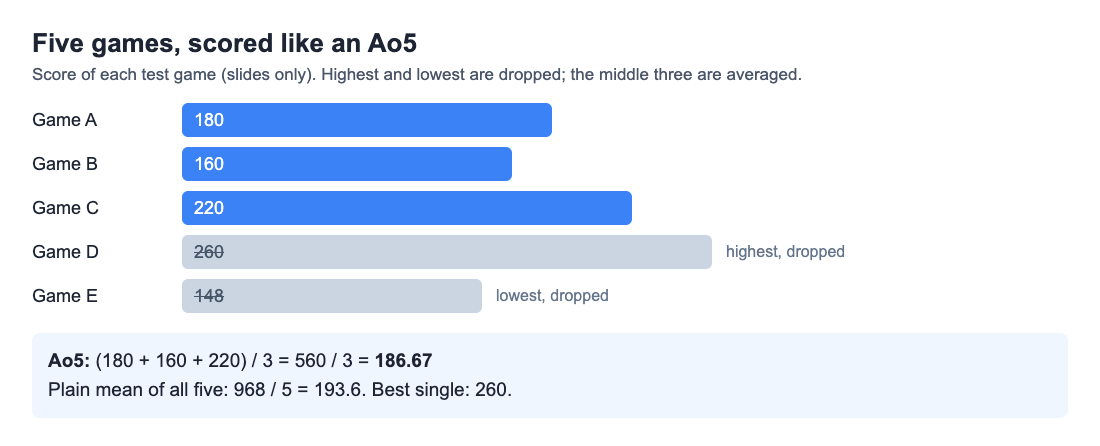
The plain mean of all five is 968 divided by 5, or 193.6, and the best single is 260. The Ao5 sits below both, because it ignored the best game and the worst. Five games from a script are far too few to say how any player does, so read this as a way to see the sum, not a result.
The game itself keeps only a Best. The New game box says "This game ends and its score of {score} is kept only if it is your best." That is the single, not the average. If you want to know more about it, read 2048 best score: where it is kept and when it resets.
An average is one way of counting, and cube moves have their own ways. Half turn metric vs quarter turn shows how the same moves give different totals, and cube permutations explains how many positions a scramble can start from.
Frequently asked questions
What does Ao5 stand for?
Ao5 means "average of 5". You do five solves, drop the fastest and slowest, and average the middle three.
What happens to a DNF in an Ao5?
One DNF counts as your worst solve and is dropped, so you still get an average. Two or more DNFs in the five make the average a DNF.
What is the difference between Ao5 and mean of 3?
Ao5 drops your best and worst of five. A mean of 3 adds all three solves and divides by 3 with nothing dropped, and one DNF makes it a DNF.
Which cube events use mean of 3?
In the WCA's regulations, the 6x6x6 and 7x7x7 use Mean of 3. The 3x3x3 and most other events use Average of 5.
Why does my Ao5 change after every solve?
Timers use a rolling window. Each new solve pushes the oldest one out, so the five solves behind the number keep changing.
Get started
An average rewards steadiness over one lucky result, and a 2048 game on a cube asks for some of the same patience. Evolved 2048 is free to play in your browser on a computer or a phone, and you can start without an account. It will not improve your solve times, but you can try the five-game sum on your own scores. Play Evolved 2048, or see how to play 2048 online free on a cube.
Comments
No comments yet.
Sign in or make an account to comment.