Cube colour scheme: white opposite yellow, and the rest
The standard cube colour scheme puts white opposite yellow, blue opposite green and orange opposite red. One more rule fixes the rest: where red, white and blue meet at a corner, they run clockwise in that order. This post shows the whole scheme in one picture, explains where it came from and the older layout you may still find, and gives a four-step check you can run on your own cube in under a minute.
The standard cube colour scheme at a glance
A standard 3x3 cube has six colours, one per face: white, red, blue, orange, green and yellow. They pair up across the cube like this:
- White sits opposite yellow.
- Blue sits opposite green.
- Orange sits opposite red.
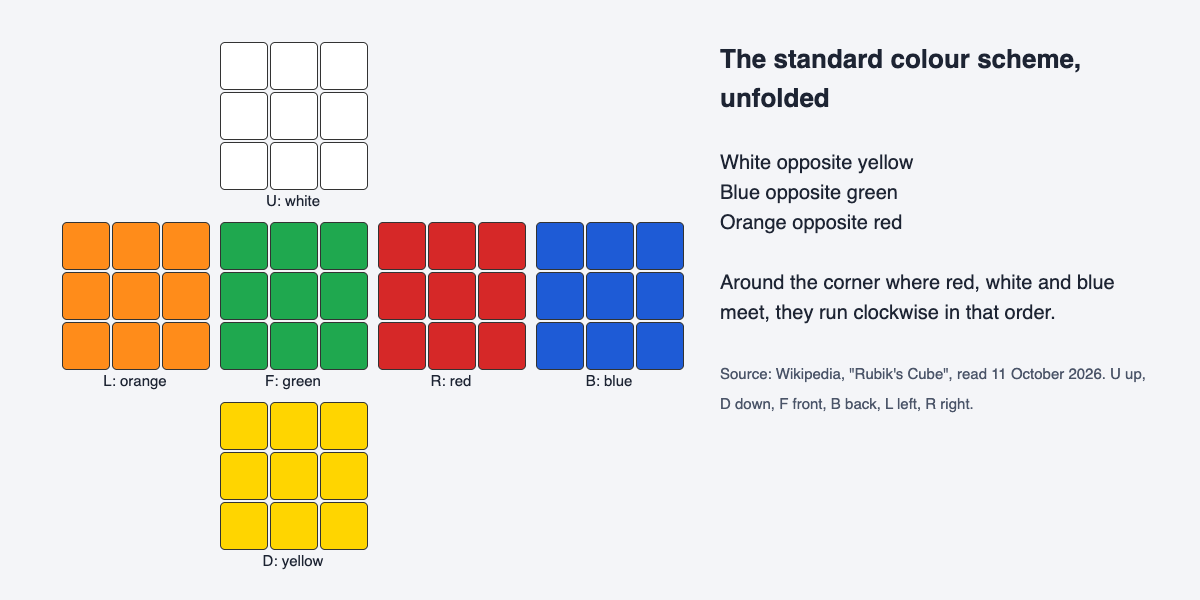
The standard scheme unfolded, with white on top and green in front. Based on Wikipedia's Rubik's Cube page.
Knowing the pairs is not quite enough to place every colour. Three pairs can be arranged around a cube in two ways that are mirror images of each other. The clockwise rule picks one: at the corner where red, white and blue meet, reading round the corner clockwise gives red, then white, then blue. Put another way, white, green and red run anticlockwise round their shared corner. Both statements describe the same cube.
Where the scheme came from
The arrangement has been standard since 1988. On early cubes the position of the colours varied from one cube to the next, so two cubes bought at different times could disagree about which colour sat where.
One variant has its own name. In what is called the Japanese colour scheme, blue and yellow are switched compared with the Western one. That means white sits opposite blue instead of yellow, and yellow sits opposite green. The six colours are the same; only the layout differs.
If you own more than one cube, it is worth checking each one, since an older or unbranded cube may follow a different layout from a newer one. The history of the scheme, and the dates above, are on Wikipedia's Rubik's Cube page. Whatever layout your cube has, the opposite pairs are what you will lean on most, because they tell you which colours can never share a piece.
Why opposite colours matter when you read a cube
A 3x3 has six centre pieces with one colour each, twelve edge pieces with two colours and eight corner pieces with three. Each piece shows its own combination of colours, but not every combination exists. Two colours that sit on opposite faces never meet on a piece: on a standard cube there is no edge with both red and orange.
That gives you a quick test while solving. If a piece shows white, it cannot also show yellow. If you think you see red and orange on one edge, look again in better light: one of them is the other colour.
The centres are what hold the scheme in place. They spin when their face turns, but they never leave it, so the colour of a centre tells you which colour that face will be when it is solved. Why centre pieces never move explains how the core keeps them there. A 2x2 has no centres, so on a 2x2 you work the scheme out from the corners themselves; 2x2 vs 3x3 cube covers that difference.
A worked example: check your own cube in four steps
You do not need a solved cube for this. The centres and one corner are enough, because centres never move.
- Find the white centre and hold the cube with it facing up.
- Look at the bottom centre. Yellow means your cube follows the Western pairs. Blue means it follows the Japanese layout, with blue and yellow switched.
- Check the other two pairs by turning the whole cube: blue should sit opposite green, and orange opposite red.
- Find a corner piece with red, white and blue on it. Look straight at that corner and read its colours going clockwise. Red, white, blue means the standard scheme. Red, blue, white means a mirror-image cube.
A mirror-image cube solves exactly the same way. Only the pictures in a guide will look flipped compared with yours.
Colours and the letters of cube notation
Cube notation does not use colours at all. The letters name faces by where they are: R is whichever face is on your right, U whichever is on top, and so on. A plain letter is a clockwise turn as you look at that face, and a prime, as in R', is anticlockwise.
Whole-cube turns have letters too: x turns the entire cube the way R turns, y the way U turns, and z the way F turns. Cube rotations x, y and z goes through each one.
So why do guides talk about colours? Because they tell you how to hold the cube before the letters start. "White on top, green in front" puts the faces where the guide expects them, and from then on R and U mean the same thing on your cube as in the pictures. If your cube follows a different scheme, the moves still work; you only need to translate the starting grip.
A cube with numbers instead of colours
3D 2048 is the 2048 puzzle on a cube you turn like a Rubik's cube, with six faces of nine squares. It is a number puzzle and will not teach you to solve a cube. Its faces have no colours to tell them apart: the tiles carry numbers, and the aim is to merge equal ones up to 2048.
Without colours, the game keeps you oriented by position, just as notation does. The face you slide is always the front. Shift and an arrow key turns the whole cube to bring another face to the front, much like a y or x rotation, and turning is free: in a test on 11 October 2026, Moves did not change on any turn. So the habit you build reading a colour cube, keeping track of which face is where, is the same habit the game asks for.
Frequently asked questions
Is white always opposite yellow?
On the standard scheme, yes. On the older Japanese layout, blue and yellow are switched, so white sits opposite blue.
What colour is opposite red?
Orange. On a standard cube no piece shows both, because the two sit on opposite faces.
When did the colour scheme become standard?
In 1988. Before that, the position of the colours varied from cube to cube.
Does the colour scheme change the moves?
No. Notation names faces by position, not colour, so the same moves work on any scheme once you hold the cube the way the guide says.
Get started
Run the four-step check on your own cube. Then open 3D 2048 and try keeping track of faces with numbers instead of colours: turn the cube with Shift and an arrow key and watch which face comes to the front. It plays in your browser on a computer or a phone.
Comments
No comments yet.
Sign in or make an account to comment.