Cube permutations: 43 quintillion positions explained
Cube permutations is the count of every way a 3 by 3 cube can be mixed up by turning its faces, and the answer is exact: 43,252,003,274,489,856,000, or about 43 quintillion. This guide builds that number one step at a time, so you can check it on a calculator, then explains why the count is not bigger, why a cube you take apart can be put back wrong, and what changes on a cube where every square holds a 2048 tile instead of a sticker.
What cube permutations means
A permutation is an arrangement. For a cube, one position means one arrangement of all the moving pieces: where each piece sits, and which way it is turned. Two positions are different if any piece is in another slot or twisted another way.
The 43 quintillion figure, from Wikipedia's Rubik's Cube article, counts only positions you can reach by turning faces from a solved cube. It also treats the six centres as fixed. Holding the cube a different way does not make a new position: Wikipedia notes that if you did count every way of holding it, each number would be multiplied by 24.
The pieces you count: 8 corners and 12 edges
Wikipedia describes a 3 by 3 cube as six centre squares held on a core, plus 20 smaller pieces. Those 20 are the ones that move between slots:
- 8 corners, each with three stickers. A corner can sit in its slot three ways.
- 12 edges, each with two stickers. An edge can sit in its slot two ways, flipped or not.
The six centres turn in place but never change slots, so they act as a fixed frame. That is why they drop out of the count. We explain why in Rubik's cube centre pieces: why they never move.
Worked example: build 43 quintillion on a calculator
Follow these four counts in order, then multiply. Each line is from Wikipedia's article; the arithmetic is yours to check.
- Place the corners. Any of the 8 corners can go in the first slot, any of the 7 left in the next, and so on. That is 8 factorial, written 8!, which is 40,320.
- Twist the corners. Each corner has 3 ways to sit, but only 7 can be twisted freely. The 8th corner's twist is forced by the other seven. So this is 3 to the 7th: 2,187.
- Place the edges. 12 edges in 12 slots is 12!, which is 479,001,600. Only half of these can happen, because the edges must be swapped an even number of times exactly when the corners are. So this is 12! divided by 2: 239,500,800.
- Flip the edges. Each edge has 2 ways to sit, but only 11 can be flipped freely. The 12th is forced. So this is 2 to the 11th: 2,048.
Now multiply in two halves. Corners: 40,320 times 2,187 is 88,179,840. Edges: 239,500,800 times 2,048 is 490,497,638,400. Multiply those two results and you get 43,252,003,274,489,856,000.
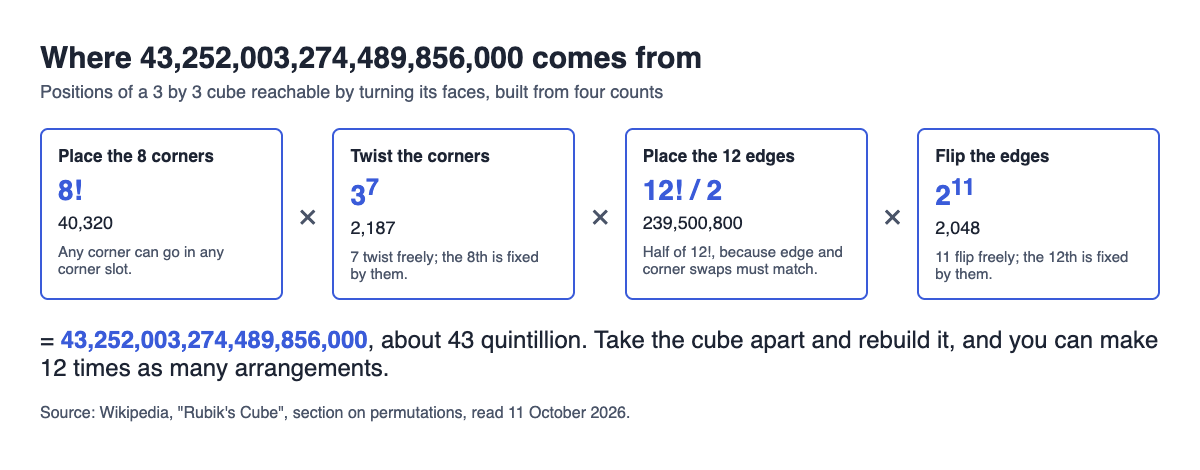
The four counts behind the number, from Wikipedia's Rubik's Cube article.
Notice step 4. The edge flips give exactly 2,048, the same number a 2048 puzzle is named after, and for the same reason: it is 2 multiplied by itself 11 times.
Why the count is not bigger: three locks
If you took the cube apart and put the pieces back at random, every corner could twist and every edge could flip, and any swap would be allowed. Wikipedia gives that count as 519,024,039,293,878,272,000. That is exactly 12 times the reachable count, and only one in twelve of those rebuilds can be solved by turning faces.
The 12 comes from three locks that face turns can never break:
- Corner twist (3). No sequence of moves twists a single corner on its own. That is why the 8th corner's twist is forced. See Rubik's cube corner twist: the rule of three turns.
- Edge flip (2). No sequence flips a single edge. See flipped edge on a Rubik's cube: why it takes a pair.
- Swap (2). No sequence swaps a single pair of pieces and leaves the rest alone.
3 times 2 times 2 is 12. Wikipedia calls the 12 separate sets of positions "orbits". A cube that was taken apart and rebuilt carelessly can land in the wrong one, and then no amount of turning will solve it.
How big is 43 quintillion?
Written out it has 20 digits. Wikipedia gives two pictures of the size: one standard cube for each position would cover the Earth's surface 275 times, or stack into a tower 261 light-years high.
The count grows again if you change what counts as different. Counting how each centre square is turned, which matters when the centres carry a mark that shows which way they face, takes the total to 88,580,102,706,155,225,088,000.
Yet the space is shallow. In July 2010 a team of researchers, working with computers provided by Google, proved that every one of those positions can be solved in 20 face turns or fewer. That limit is called God's number, and we cover it in God's number explained.
Cube permutations on a 2048 cube
Evolved 2048 is the 2048 puzzle on a cube you turn like a Rubik's cube: six faces of nine squares, 54 in all. It is a number puzzle, not a cube to solve, and its counting works differently in three ways.
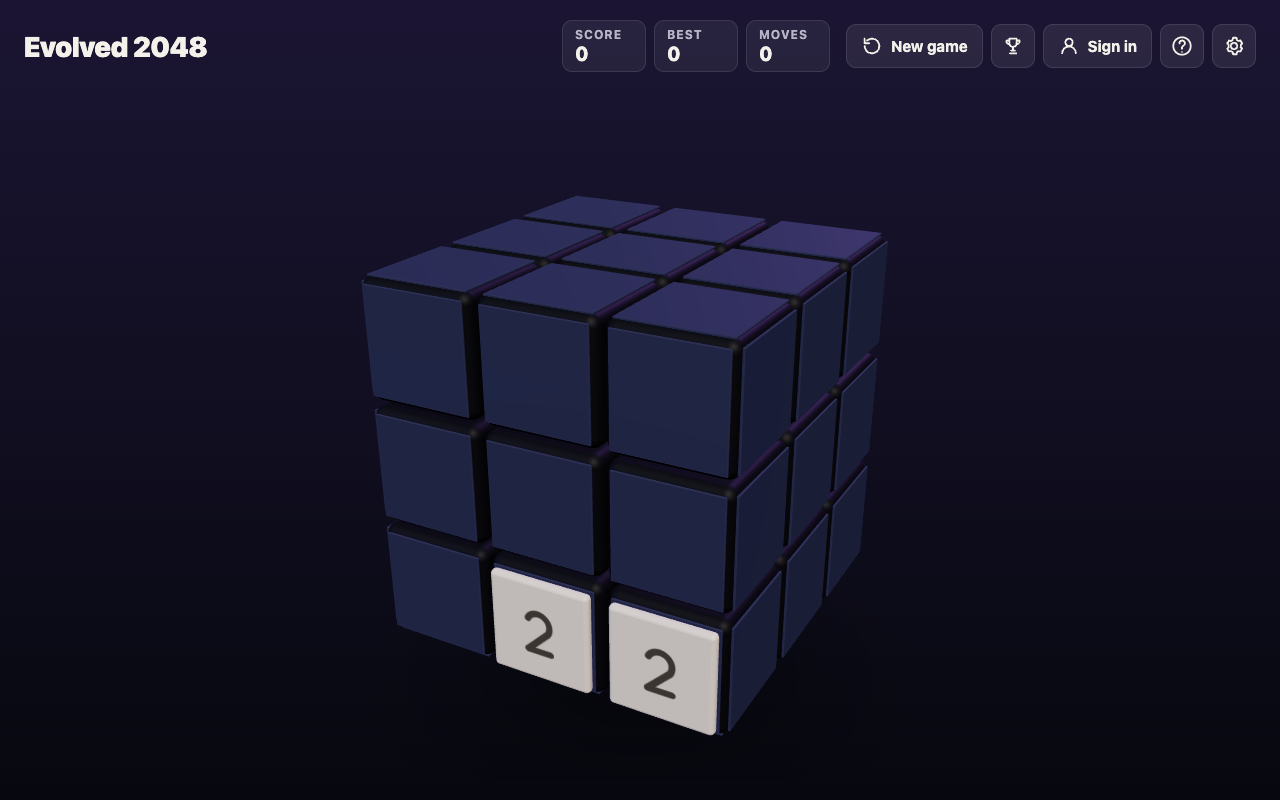
A new game on the live page: two tiles on the front, 52 empty squares.
- Squares, not pieces. The game keeps its board as 54 squares, front first, then right, back, left, top and bottom. Each square is empty or holds a tile, so what you track is tiles, not corner and edge pieces.
- Middles move too. On a real cube the centres stay put. Here, dragging the right face's middle row to the left carried its tiles, 16, 32 and 64, onto the front's middle row, and sent the front's middle row to the left face, for one move.
- Holding it differently is free. Just as the count ignores the 24 ways to hold a cube, the game does not charge for turning the whole cube. In our test, Shift and Left brought the right face to the front with Moves and Score unchanged, and four of those turns brought the cube back to where it started.
The game has a lock of its own, too. Every slide or twist adds a new 2 or 4, and a twist needs one empty square for it, so a full cube refuses twists until you merge something.
Frequently asked questions
Is it exactly 43 quintillion positions?
The exact number is 43,252,003,274,489,856,000 positions reachable by turning faces. That counts the centres as fixed and ignores how you hold the cube.
Why do some sources give a bigger number?
They usually count every way to put a cube back together after taking it apart, which is 519,024,039,293,878,272,000, twelve times more. Some also count how the centres are turned.
Can you get a cube into an unsolvable position by turning it?
No. Turning keeps the cube in the orbit it started in. Only taking it apart, or moving stickers, can put it in one of the other eleven.
What is 2,048 doing in the count?
It is the number of ways to flip the edges: 2 to the 11th, because 11 edges flip freely and the 12th is forced.
Get started
The quickest way to feel how a cube moves tiles between faces is to play with one. Open the game, slide the front face with the arrow keys or W A S D, twist a row with the keys 1 to 6, and press Shift and an arrow key to turn the whole cube for free. You can play without an account, and your game, best score and settings are saved on your device.
Play Evolved 2048: it is free and plays in your browser on a computer or a phone.
Comments
No comments yet.
Sign in or make an account to comment.