Customer Discovery Questions to Ask Before You Build
Customer discovery questions are the questions you ask real people before you write a line of code, so you learn whether a problem is worth solving. The right ones are about the past and the present, not about your idea. If you want the full process of who to talk to and how to read the results, the post How to validate a business idea by talking to customers covers it. It helps first-time founders plan interviews and spot polite praise. One thing worth knowing from it: what people say they would do matters far less than what they already do. This post is the question bank that goes with it.
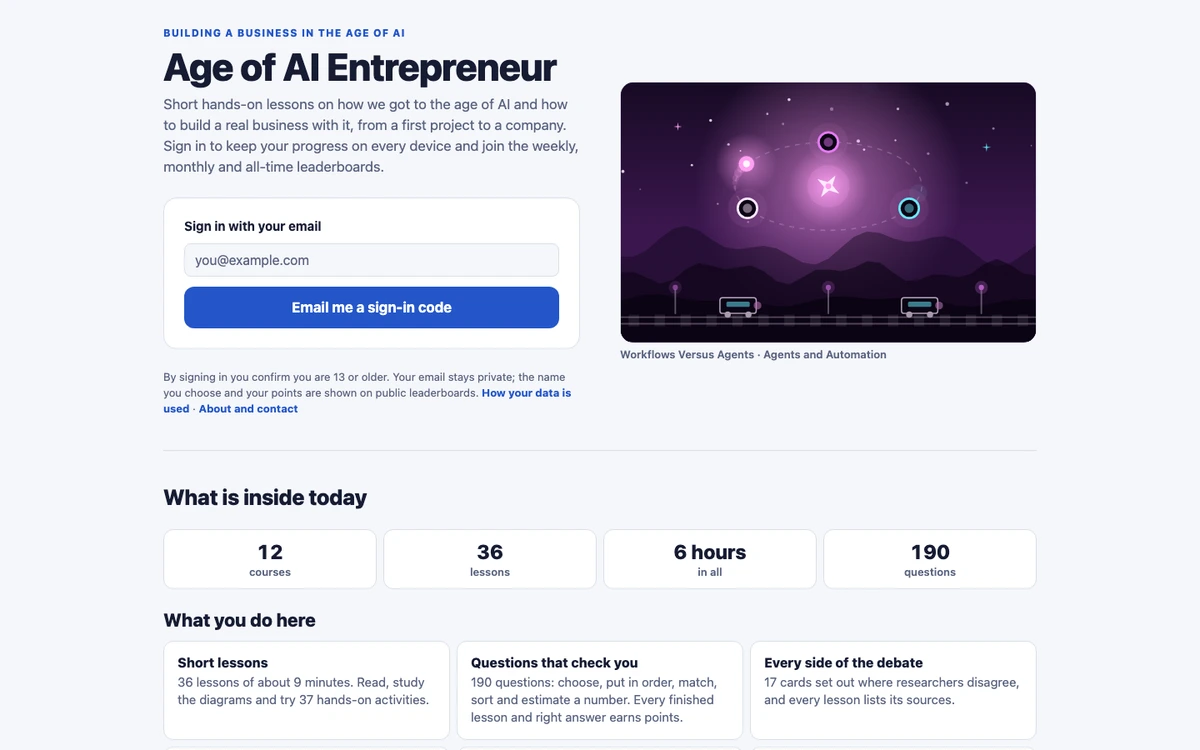
Age of AI Entrepreneur teaches this skill in short hands-on lessons, including one called Talking to Customers Without Fooling Yourself, so you can practice before your first real conversation.
What customer discovery questions are meant to do
A discovery question has one job: to find out what is true about someone's life or work. It is not a pitch. It is not a poll about your feature list. You are collecting evidence about a problem, and you are trying to find out early if you are wrong.
That framing changes how you ask. If you want to hear "great idea," you will get it. People are kind. If you want to know how they handle a task today, how often it goes wrong and what they have tried, you get facts you can use.
Good questions share three traits:
- They ask about a specific time, not a general opinion.
- They can be answered with a story or a number.
- They do not reveal what answer you hope for.
Ground rules for asking questions that get honest answers
Before the list, a few habits matter more than any single wording.
- Do not mention your idea first. Start with the person's world. Bring up a solution only at the end, if at all.
- Ask about the last time. "Tell me about the last time you did this" beats "how do you usually do this." Memory of one event is more honest than a summary of a habit.
- Follow the story. When someone says "it was annoying," ask what happened next. Details are where the signal lives.
- Stay quiet after they answer. A pause often draws out the real answer.
- Write down their words. Keep exact phrases. You will want them later for your landing page and your own memory.
The lesson on talking to customers in the Finding AI Opportunities course goes deeper on this. You sign in with your email and an emailed code to open it.
Questions about the problem and how often it happens
Start here. You are testing whether the problem is real and frequent, not whether your solution is clever.
- "Walk me through the last time you had to deal with this."
- "What was the hardest part?"
- "How often does this come up in a normal week or month?"
- "When did it last go wrong, and what happened?"
- "Who else is involved when it happens?"
Listen for frequency and feeling. A problem that appears once a year and causes a shrug is weak. A problem that appears daily and makes someone sigh as they describe it is worth a second look.
Worked example. Say you are exploring an AI tool that drafts replies to customer emails for small shops. Do not ask "Would you use an AI email helper?" Ask: "Tell me about the last time a customer emailed you with a question. What did you do?" You may hear that the owner answers from a phone in the evening, copies old replies and loses an hour. That is a story with a cost, and it tells you more than any yes.
Questions about what people do today and what it costs
Every real problem already has a workaround, even if the workaround is "suffer." Your real competitor is whatever people do now.
- "What do you do about this today?"
- "What tools, spreadsheets or people do you use?"
- "What have you tried that did not work? Why not?"
- "How much time does this take you each week?"
- "What does it cost you when it goes wrong?"
Try to turn answers into numbers. Two hours a week, three missed orders a month, one assistant paid to do it. You do not need exact figures, only a rough size. A problem with no workaround and no cost often means nobody cares enough to pay.
If someone has built an ugly spreadsheet system on their own, pay attention. People who have already spent effort on a fix are the strongest early signal you will find. For more on how a business turns a problem into revenue and costs, see the Business Basics lesson on problems worth paying for in the Business Basics for Builders course.
Questions about budget, buyers and urgency
Many founders skip this part because it feels awkward. Ask anyway. A real problem with no buyer is still a dead end.
- "Who decides to spend money on something like this?"
- "Is there a budget for it, or would it come from somewhere else?"
- "What do you pay for today that solves part of it?"
- "If this were fixed, what would change for you?"
- "Where does this sit on your list of problems right now?"
- "What would have to be true for you to switch from what you use?"
The last two test urgency. If the problem is third on a list of ten, it will lose to the first two. Also note whether the person you are talking to can say yes. Users and buyers are often different people, and you need to talk to both.
Questions to avoid because they invite polite lies
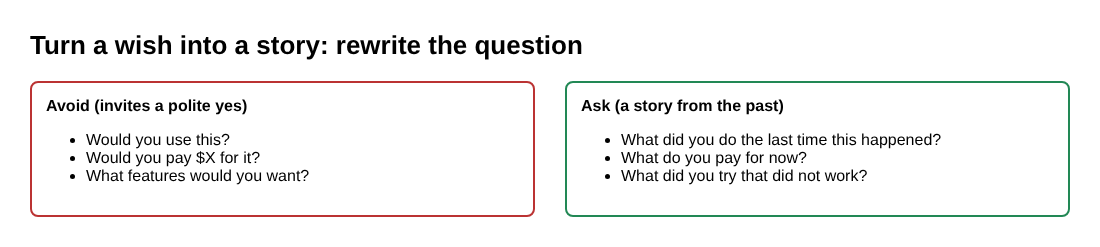
Some questions feel useful and return nothing. Cut these from your script.
- "Would you use this?" Hypothetical, and people say yes to be nice.
- "Do you think this is a good idea?" You are asking for a compliment.
- "Would you pay $X for it?" People guess, and the guess costs them nothing.
- "Don't you find it frustrating when...?" A leading question plants the answer.
- "What features would you want?" You get a wish list, not a priority.
Fix each by moving it to the past. Swap "Would you use this?" for "What did you do the last time this happened?" Swap "Would you pay?" for "What do you pay for now?" Compliments, vague promises to "check it out later" and offers to "introduce you to someone" with no name attached are all polite noise. A concrete next step, such as a second call, a shared sample file or an introduction by name, counts as a real signal.
How to turn the answers into a build decision
After five to ten conversations, lay your notes side by side. Look for patterns, not for one great quote.
- Mark the repeats. Which problems did several people describe unprompted?
- Score the pain. Note frequency, time lost and money spent for each.
- Check for workarounds. Did people already try to fix it themselves?
- Check for a buyer. Is there someone who can approve a purchase?
- Pick the smallest test. Do not build the full product. Build the cheapest thing that tests demand.
That smallest test is often a landing page and a waitlist. The course covers it as Project 1 in Your First Builds: Simple Projects. If people from your interviews sign up, you have behavior to go with their words. If none do, you learned that cheaply.
Be honest about what the answers do not prove. Interviews reduce risk. They do not promise that a business will work. Treat them as evidence, and stay ready to change your mind. If you are new to the AI side of the work, AI explained for non-technical founders is a useful companion read.
Frequently asked questions
How many customer discovery questions should I prepare?
Five to eight is enough for a 20 to 30 minute conversation. Prepare a few more as follow-ups, but let the person's story decide where you go.
How many people should I interview?
Keep going until the same problems repeat. Five to ten conversations with the right kind of person often show a pattern. If answers are all over the place, your audience may be too broad.
Should I tell people about my idea?
Not at the start. Learn about their problem first. If you describe a solution later, treat their reaction with care, since polite agreement is common.
What if people say the problem is real but will not pay?
Ask what they pay for now and who holds the budget. A real problem with no money behind it may need a different buyer or a smaller, cheaper first offer.
Can AI help me prepare for interviews?
You can use an AI assistant to draft a question list or to rewrite leading questions into neutral ones. The conversations and the judgment about what you hear still have to be yours.
Get started
Pick one group of people with a problem you can describe in a sentence. Write six questions from the sections above, all about the past. Book three conversations this week and take notes in their own words. The guide on validating a business idea with customer interviews shows how to choose who to talk to and read the results.
To practice first, Age of AI Entrepreneur has short hands-on lessons on finding ideas, talking to customers and building your first tests. Every lesson is free to anyone with an account, as set out on the terms page, and you sign in with your email and an emailed code.
Comments
No comments yet.
Sign in or make an account to comment.