Darwin's theory of evolution: what he actually argued
Darwin's theory of evolution is known by its slogans, but the book that set it out, On the Origin of Species (1859), makes a careful step-by-step case. This guide follows that case as the Stanford Encyclopedia of Philosophy describes it: how the idea took shape, how the book builds its argument, what critics said, and what Darwin changed in later editions. You will come away able to explain the argument in five steps and to say which famous phrases are his.
Darwin's theory of evolution in one paragraph
Darwin argued that species are not fixed. They descend from common ancestors and change over long stretches of time, and the main force that shapes that change is natural selection. Living things vary, more are born than can survive, and in the struggle for existence some variations are kept and others lost, much as a breeder keeps the animals they want. Over many generations, populations split and diverge, and most lines end in extinction. That is the theory as the 1859 book presents it, before any of the later revisions.
The Stanford Encyclopedia's entry on Darwinism notes that Darwin's name still marks "a core set of concepts, principles and methodological maxims" that he first set out in the Origin. That is why it is worth knowing what the book actually says.
How the theory took shape, 1831 to 1859
Darwin (1809 to 1882) sailed on HMS Beagle from December 1831 to October 1836. According to the Stanford entry on Darwin, from the Origin to the Descent of Man, his theory first took written form in notebooks he began near the end of the voyage. His first notes on the possibility that species change are dated March 1837.
The turning point came in August 1838, when he read Thomas Malthus's Essay on the Principle of Population. Malthus held that people multiply faster than their food supply, so there is always a struggle to survive. Darwin's move was to apply that principle to all of nature. The entry compares it to Newton's first law: a starting assumption the theory does not try to explain, which then drives everything else. (Our post on why Isaac Newton was so important covers that law.)
Then he waited. Over the next years he published on geology and wrote four volumes on fossil and living barnacles. He was still working on a long manuscript called "Natural Selection" when, on 18 June 1858, a letter and manuscript arrived from Alfred Russel Wallace setting out remarkably similar views. Darwin condensed his work in a hurry, and John Murray issued the Origin in London on 24 November 1859.
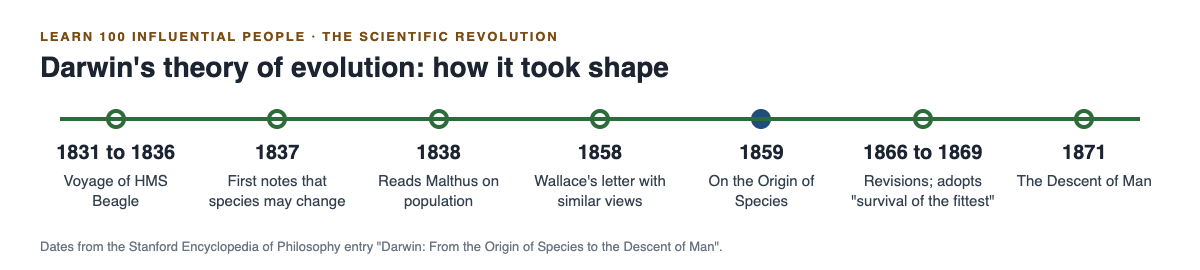
From the Beagle to the Descent of Man: the dates the Stanford entry gives.
The argument of the Origin, step by step
Darwin called the book "one long argument". The Stanford entry warns that its exact structure "is not immediately transparent", and scholars read it in different ways. One plain way to follow it is in five steps, in the order the book takes them:
- Breeding. The first chapter starts with something every reader knew: breeders shape domestic animals and plants by keeping the forms they want from small differences between individuals.
- Variation in nature. The second chapter shows that wild species vary too, so much that naturalists struggled to say where a variety ends and a species begins.
- Struggle. By the end of the first three chapters, Malthus's point is in place too: more are born than can live.
- Natural selection. Only in Chapter Four does Darwin put these together into natural selection, with its role for isolation, extinction and divergence.
- The diagram. The book's single diagram, kept in every edition, shows species branching from common ancestors, with most branches dying out.
The entry points out that the breeding comparison is more than decoration. It is the main example Darwin returns to, again and again, to help readers picture selection working in nature.
What critics said, and what Darwin changed
Darwin revised the Origin through six editions, partly in reply to critics. Three changes stand out in the Stanford entry:
- Steady change or stops and starts? In the fourth edition (1866) he wrote that the smooth branching of his diagram was misleading: "It is far more probable that each form remains for long periods unaltered, and then again undergoes modification".
- The engineer's objection. In 1867 the Scottish engineer Fleeming Jenkin argued that crossing between individuals would swamp small new differences, and, using Lord Kelvin's figures for the age of the sun, that there had not been enough time. The time problem was only solved in the twentieth century, by the discovery of radioactivity.
- A theory of inheritance. In 1868 Darwin offered a "provisional hypothesis" called pangenesis, in which tiny invisible "gemmules" carried traits to the next generation. He also never gave up the idea that the use or disuse of a part could be inherited.
The best-known change is a phrase. "Survival of the fittest" was Herbert Spencer's, from 1864. After criticism from Wallace, Darwin adopted it in the fifth edition of 1869 as another name for natural selection.
The Descent of Man: the theory applied to us
The Origin says little about humans. Darwin turned to them in The Descent of Man in 1871. There, the Stanford entry says, sexual selection, "the choosing of females by males or vice versa for breeding purposes", takes up most of the book, and natural and sexual selection together are used to explain the origin of human beings from ape-like ancestors.
Darwin's theory left one large gap: how traits are passed on. The Stanford entry on the gene describes how, around 1900, followers of Mendel, whose pea experiments came out in 1866, focused on sudden, separate differences, while biologists who held to Darwin's gradual view did not. On Learn 100 Influential People, Darwin and Mendel share a lesson in The Scientific Revolution.
A worked example: explain the argument in five minutes
Here is a short exercise to check you understand the theory, not just the slogans.
- Write the five steps above from memory: breeding, variation, struggle, natural selection, the diagram.
- Next to each, write one sentence in your own words. For "struggle", for example: "More are born than can survive, so not every variation lasts."
- Put these dates in order without looking: Wallace's letter, the Malthus reading, the Origin, the Beagle's return, the Descent of Man. Then check them against the timeline above.
- Finally, sort three phrases into "Darwin's own" and "added later": "one long argument" (his), "survival of the fittest" (Spencer's, adopted in 1869), and the stop-and-start line from 1866 (his, but not in the first edition).
If you can do all four, you can answer most exam questions on what Darwin argued. For a comparison with another scientist who changed how people saw nature, read Galileo's discoveries and why they mattered.
Frequently asked questions
What was Darwin's main argument?
That species descend with change from common ancestors, and that natural selection, working on variation in a struggle for existence, is the main cause. He built it from domestic breeding, natural variation and Malthus's principle of population.
Did Darwin coin "survival of the fittest"?
No. The phrase is Herbert Spencer's, from 1864. Darwin adopted it as another name for natural selection in the fifth edition of the Origin, in 1869.
When was On the Origin of Species published?
John Murray issued it in London on 24 November 1859. Darwin hurried it out after Alfred Russel Wallace sent him similar ideas in June 1858.
What did Darwin get wrong?
His theory of inheritance, pangenesis, did not hold up, and he kept the idea that use and disuse can be inherited. The time objection raised in 1867 was only answered in the twentieth century, by radioactivity.
Get started
Darwin appears in The Scientific Revolution, a Basic course on Learn 100 Influential People, alongside Copernicus, Galileo, Kepler, Newton and Mendel; Basic courses need no background. Each lesson takes about 9 minutes, with questions where you choose, put in order, match, sort and estimate a number, and questions from finished lessons come back later, up to 5 a day. Every lesson lists its sources, which the about page says is "so you can read the original work", and 38 cards set out where researchers disagree. You sign in with your email and an emailed sign-in code.
Comments
No comments yet.
Sign in or make an account to comment.