Decision matrix: pick a fix when options tie
A decision matrix helps you pick a fix when you have several options and no clear winner. You list the fixes, score each one against the things you care about, and add up the totals. Sometimes two fixes land on the same number. This guide covers how to build the matrix, how to score it honestly, and what to do when the math leaves you stuck.
What a decision matrix is and why fixes end up tied
A decision matrix is a grid. Each row is a possible fix. Each column is a criterion, like cost, time or how long the fix will last. You give every fix a score on every criterion. You multiply each score by a weight that shows how much that criterion matters to you. Then you add up each row.
Ties can happen for three reasons:
- Coarse scales. With a 1 to 5 scale and only four criteria, the number of possible totals is small. Two different fixes can easily share one.
- Real tradeoffs. One fix is cheap but weak. The other is strong but costly. If you weighted cost and strength about equally, the strengths cancel out.
- Honest uncertainty. When you do not know how a fix will play out, a middle score is the honest choice, and middle scores pull totals together.
A tie is not a failure of the method. It tells you that, by your own standards, both fixes are reasonable. Now you need a rule for picking one.
The matrix fits one step of a wider method. The Lean Enterprise Institute's page on the A3 report lists "the range of possible countermeasures" and then "the best countermeasure" as separate parts of solving a problem, followed by who will do what when, and the evidence that the issue has actually been addressed. A decision matrix is one way to get from the range to the best.
Build the matrix: list fixes, pick criteria, set weights
Start with the problem in one line. "Kitchen tap drips after I close it" is enough. A vague problem makes vague scores.
Then list the fixes you would actually do.
Pick three to five criteria. Good ones are things you can judge for each fix separately:
- Cost
- Time to finish
- Ease, or how likely you are to do it without a mistake
- Durability, or how long the fix should hold
- Reversibility, or how easily you can undo it
Write every criterion so that a higher score is better. Score "cost" as "cheapness," so a cheap fix gets a 5. Mixing directions breaks the totals.
Last, set weights. A simple method: give your most important criterion a 3, the next ones a 2, and minor ones a 1. Set the weights before you score anything. If you set them after, it is easy to tune them toward the answer you already wanted.
Score each fix honestly with a simple 1 to 5 scale
Use a short scale and define it once:
- 1: bad on this criterion
- 3: fine, nothing special
- 5: as good as it gets
Score one column at a time, not one row at a time. Compare all fixes on cost, then all fixes on time. This keeps your scores consistent across options.
When you are unsure, write down why. "Durability 3, because I do not know if the seat is worn too" is far more useful later than a bare 3. Your notes are where a tie usually gets broken.
When the totals tie: five tie-breaker rules
Pick your tie-breaker rule before you look closely at which fix it favors. Otherwise you are just choosing the one you liked and calling it a rule. Here are five to choose from.
1. Go with the top-weighted criterion
Look only at the criterion you weighted highest. Whichever fix scores better there wins. You already said that criterion matters most, so let it decide.
2. Try the cheaper test first
If one fix is quick and cheap, and doing it does not block the other fix, do it first. If it fails, you have lost little, and you still have the second fix ready. It is the same thinking as choosing between a quick fix or a deep fix.
3. Pick the one you can undo
A fix you can reverse keeps your options open. A fix you cannot reverse locks you in. When everything else is equal, keep the door open.
4. Pick the one that teaches you more
Some fixes tell you something about the problem even when they fail. If a fix will reveal the real cause, it is worth more than its score shows.
5. Check your history
Have you, or someone you trust, tried either fix before on a similar problem? A fix that worked last time beats a fix you are guessing about. This rule only works if you wrote the result down, which is the point of the last section below.
Worked example: two home repair fixes with the same score
Problem: kitchen tap drips after I close it.
Two fixes:
- Fix A: replace the cartridge inside the tap.
- Fix B: replace the whole faucet.
Criteria and weights, set first:
- Durability: weight 3
- Cheapness: weight 2
- Time: weight 2
- Ease: weight 1
Scores for Fix A, the cartridge:
- Durability 3, because the rest of the tap is old. 3 × 3 = 9
- Cheapness 5. 5 × 2 = 10
- Time 4. 4 × 2 = 8
- Ease 2, because the old cartridge may be seized. 2 × 1 = 2
- Total: 29
Scores for Fix B, the new faucet:
- Durability 5. 5 × 3 = 15
- Cheapness 2. 2 × 2 = 4
- Time 3. 3 × 2 = 6
- Ease 4, because nothing old has to come apart. 4 × 1 = 4
- Total: 29
A tie. Now apply the rules in the order you chose. Say you decided on "try the cheaper test first," with "top-weighted criterion" as backup.
Rule 2 fits cleanly. The cartridge is cheap and fast, and doing it does not stop you from buying a faucet later. If the drip stops, you are done. If it keeps dripping, you have learned the problem is not only the cartridge, which also satisfies rule 4.
Had you picked rule 1 instead, the new faucet would win on durability. That is also a fine answer. The matrix told you both are reasonable. The rule you picked in advance tells you which one to do today.
Set a check date before you start. "If it still drips in two weeks, the cartridge counts as failed and I move to Fix B." Without that, a half-working fix can sit there for months.
Log the result so the next tie breaks itself
Tie-breaker 5 only works if you remember what happened. That is where a journal helps, such as Problem Graph.
Problem Graph is a problem and solution journal drawn as a knowledge graph. Here is how the tap example looks in it:
- Open the app and type the problem in one line: "Kitchen tap drips after closing." Put it in the personal lane and press Enter. It lands on the graph right away.
- Add both fixes as solutions in the idea state. Mark the cartridge as the one you are trying.
- Add a requirement for it, such as "matching cartridge part," so you can see what the fix depends on.
- After your check date, record the outcome: worked, partly or failed.
Say the drip is slower but still there after two weeks. By the check rule you set, the cartridge counts as failed, so you mark it failed and mark the faucet as the one you are trying. Next time a tap in your house drips, you do not start from zero. You have a record of what failed and why.
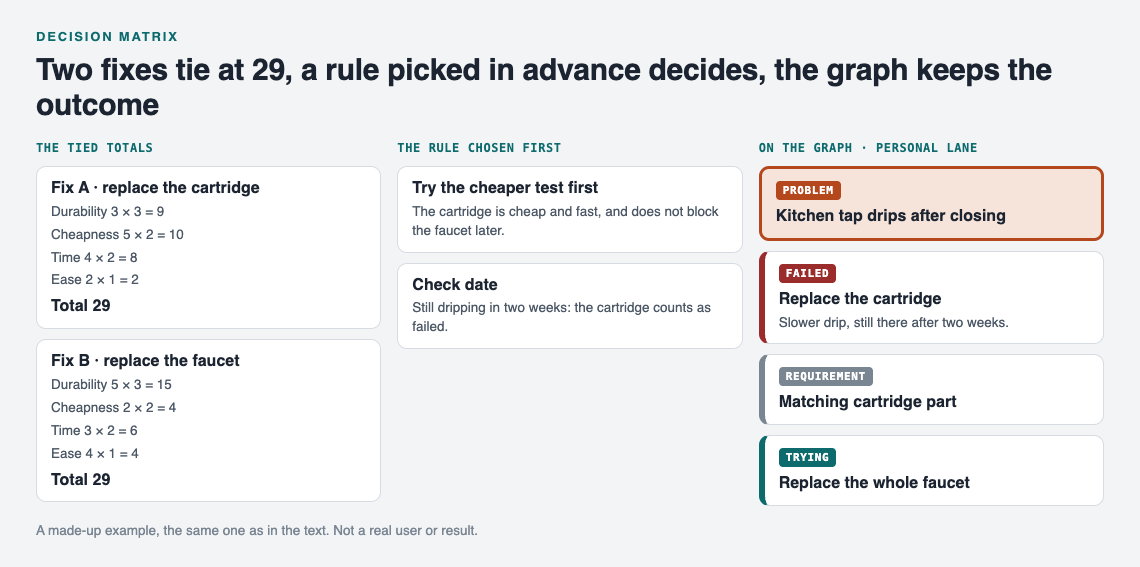
The worked example: the tied totals, the rule chosen in advance, and the outcomes on the graph. A made-up example, not a real user or result.
You can also link problems that belong together. If the bathroom tap starts dripping a month later, link it to the kitchen one. Patterns show up on a map that you would miss in a list, like "every tap on this side of the house is failing." For more on keeping this kind of record, see the home repair log guide.
Your problems are private by default. Only you see them. When you look for ideas, the app shows similar problems other people have shared and which of their solutions worked, and you can borrow one into your own graph with one tap. You can also ask for AI suggestions. Treat those as proposals to score in your matrix, not as answers.
Recording failures matters as much as recording wins. A fix that failed stays on the map as failed, and that is exactly what you, or the next person, needs to see before scoring it high again.
Frequently asked questions
Should I just flip a coin when options tie?
A coin flip is fine when both fixes are cheap and reversible. When they are not, use a tie-breaker like "try the cheaper test first" or "pick the one you can undo," because those rules add real information the coin does not.
How many criteria should a decision matrix have?
Three to five is enough for most fixes. Each extra criterion is one more score to judge honestly.
What if my weights are causing the tie?
Do not adjust weights after you see the totals, since that bends the matrix toward the answer you wanted. Instead, use the top-weighted criterion as your tie-breaker, which respects the weights you already chose.
Get started
Next time your decision matrix ends in a tie, write the problem down, add both fixes, and record what happened. Your next tie gets easier because your own history becomes the tie-breaker.
Try Problem Graph: it is free, and you can look around the public network without an account. Write one problem down in a line and attach the first thing you will try.
Comments
No comments yet.
Sign in or make an account to comment.