Descartes vs Locke: reason or experience?
Descartes vs Locke is the classic way to ask one of philosophy's oldest questions: are we born knowing some things, or does everything we know come from experience? Descartes is the standard example of a rationalist, Locke of an empiricist. This guide sets out their answers on three questions, using the Stanford Encyclopedia of Philosophy, and then explains why scholars now think the usual split is too neat.
Descartes vs Locke: who they were
The Stanford entry on Descartes says he was born on 31 March 1596 in La Haye, in the Touraine region of France, and died on 11 February 1650. His best-known work is the Meditations, where he tries to find something he cannot doubt.
The Stanford entry on Locke calls John Locke (1632 to 1704) "one of the greatest philosophers in Europe at the end of the seventeenth century". After returning from exile he published An Essay Concerning Human Understanding and the Two Treatises of Government. Readers who know Locke from politics can start with Locke vs Rousseau; this post is about the Essay.
The question they disagree on
The Stanford entry on rationalism and empiricism places the dispute "primarily within epistemology, the branch of philosophy devoted to studying the nature, sources, and limits of knowledge". It breaks the dispute into three claims, or theses, you can test any thinker against:
- Innate Knowledge: we know some truths "as part of our nature".
- Innate Concept: some of our concepts are "not gained from experience".
- Intuition/Deduction: we can know some things by intuition, and by deducing from what we intuit.
Empiricism, in the entry's words, is the claim that "We have no source of knowledge in S or for the concepts we use in S other than experience", where S is a subject area such as mathematics or ethics.
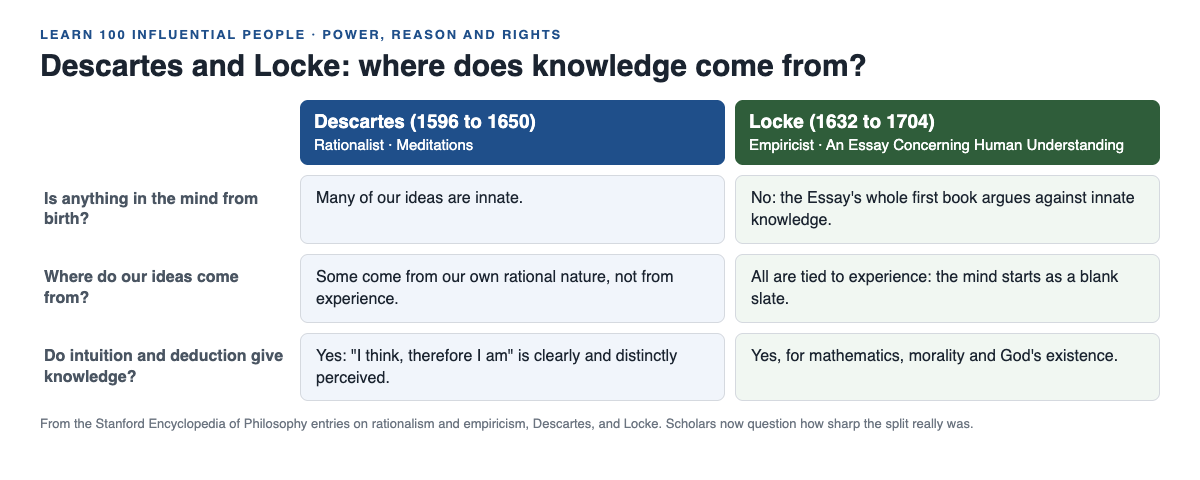
Descartes and Locke on three questions, from the Stanford Encyclopedia of Philosophy.
Descartes: reason first
In the second Meditation, the Stanford entry says, Descartes finds "an initial truth, the cogito", summed up as "I think, therefore I am". He knows it with certainty because it is "clearly and distinctly" perceived by the intellect. From there he argues to the trustworthiness of the intellect and to the existence of God.
On ideas, the rationalism entry says Descartes "takes many to be innate". That is the rationalist move: some of what you know, and some of the ideas you think with, come from your own rational nature rather than from the senses.
The idea is far older than Descartes. The rationalism entry says "Plato presents an early version of the Innate Knowledge thesis in the Meno as the doctrine of knowledge by recollection", in which Socrates guides a young slave "from ignorance to mathematical knowledge". If you want that earlier chapter of the story, read Plato vs Aristotle.
Locke: experience first
Locke rejects innate knowledge. The rationalism entry says he "dedicates the whole first book of the Essay" to showing that such knowledge, "even if it existed, would be of little use to us". He "rejects rationalism in the form of any version of the Innate Knowledge or Innate Concept theses".
His famous picture is the mind as "a blank slate on which experience writes". The rationalist Leibniz answered with a different picture: a block of marble whose veins decide which figures can be carved from it.
Even a later empiricist found a crack in the slate. The entry quotes Hume's puzzle: imagine someone who has seen every colour except one particular shade of blue, and is shown all the other shades in order from deepest to lightest. Hume asks whether that person could, "from his own imagination", raise up the idea of the missing shade, though it "had never been conveyed to him by his senses". As the entry puts it, "Even when it comes to such simple ideas as the image of a particular shade of blue, the mind seems to be more than a blank slate on which experience writes."
Where the textbook split goes wrong
Here is the part most summaries leave out. The rationalism entry says Locke "nonetheless adopts the Intuition/Deduction thesis" for our knowledge of God's existence, mathematics and morality. And it says scholars "now mostly agree" that most rationalists and empiricists accept that thesis.
It goes further. "Descartes and Locke have remarkably similar views on the nature of our ideas, even though Descartes takes many to be innate, while Locke ties them all to experience." The Locke entry adds that in the Essay Locke "adopted Descartes' 'way of ideas'". And the rationalism entry calls the old picture of Continental Rationalists improving on each other against British Empiricists doing the same "mistaken".
So the honest answer to "reason or experience?" is: they disagreed sharply on innate ideas and innate knowledge, and agreed more than you might think on how reasoning works.
A worked example: test them on three theses
- Write the three theses down. Innate Knowledge, Innate Concept, Intuition/Deduction.
- Mark each thinker yes or no, with a source line. Descartes: many ideas innate, and the cogito known by intuition. Locke: no innate knowledge, no innate concepts, but yes to intuition and deduction.
- Look at where the marks match. Both say yes to intuition and deduction. That is the overlap the textbooks miss.
- Look at where they differ. Innate ideas. That is the real disagreement.
- Write your paragraph from the table, not from the labels.
This table method works for any pair; how to compare two historical figures in an essay shows how to turn it into a full essay.
Frequently asked questions
What is the main difference between Descartes and Locke?
Descartes held that many of our ideas are innate; Locke rejected innate knowledge and innate concepts and tied all our ideas to experience.
Was Locke a rationalist or an empiricist?
An empiricist, but not a pure one: he accepted that intuition and deduction give knowledge of mathematics, morality and God's existence.
What does "I think, therefore I am" mean?
It is Descartes' first certain truth in the Meditations: while he is thinking, he cannot doubt that he exists, because he perceives it clearly and distinctly.
What does "blank slate" mean?
It is Locke's picture of the mind before experience: nothing written on it until experience writes.
Get started
Descartes and Locke are both in Power, Reason and Rights, an Advanced course on Learn 100 Influential People, with Machiavelli, Hobbes, Rousseau, Kant and Wollstonecraft. Advanced means "Modern power, modern physics and the debates still running today." Lessons take about 9 minutes, 38 cards set out where researchers disagree, and every lesson lists its sources, as the about page says. Sign in with your email and an emailed code, and questions from finished lessons come back for review, up to 5 a day.
Comments
No comments yet.
Sign in or make an account to comment.