Did castles use boiling oil? What defenders really poured
Did castles use boiling oil? Hardly ever, according to English Heritage. The picture of defenders tipping cauldrons of boiling oil over the battlements is common in films, but English Heritage says hot oil was rarely used as a weapon. Defenders did pour hot things on attackers, and they did store oil. The real story is stranger, and it involves a lot more water.
This post sets out what the sources say, what defenders actually dropped and where from, and gives you four questions to test any boiling oil story you hear on a castle tour.
Did castles use boiling oil? The short answer
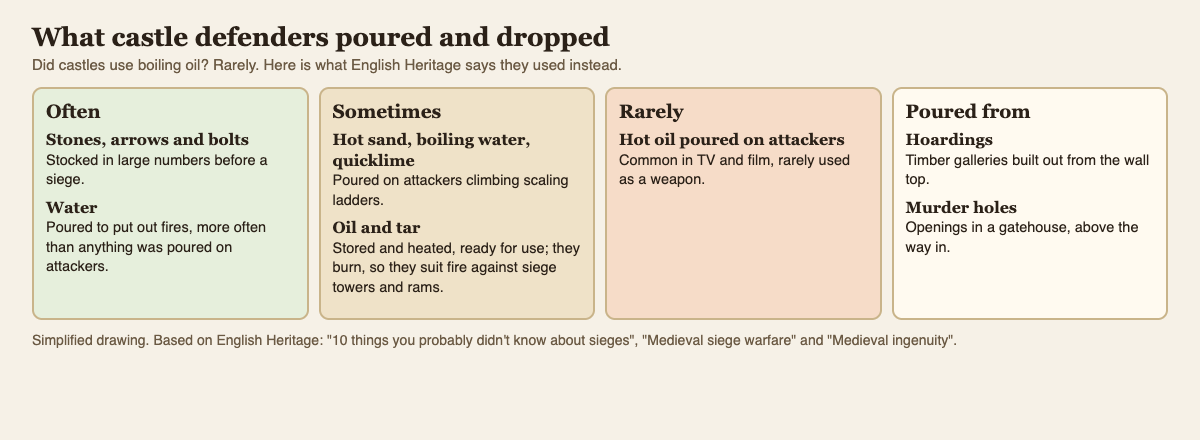
English Heritage's 10 things you probably didn't know about sieges puts it first on its list: hot oil was rarely thrown at attackers. Instead, defenders would sometimes pour hot sand, boiling water or quicklime on soldiers climbing the walls on scaling ladders.
The same page adds something most films leave out. It was more common to pour water to put out fires than to dump unpleasant things on attackers. Gates, floors, galleries and shutters were made of wood, so keeping a castle from burning mattered as much as hurting the people outside.
What the two English Heritage pages say about oil
There is a second page to read before you decide. English Heritage's guide to medieval siege warfare lists what a garrison prepared before a siege. One item is "supplies of inflammable liquids, such as oil and tar, ready for use, with facilities for heating them."
So the two pages give different weights. One says hot oil was rarely used as a weapon. The other says oil and tar were stored and heated as part of the defence. They can both be true: oil and tar burn, and a liquid that burns is useful for setting fire to a siege tower or a ram, not only for pouring on someone's head. The guide also lists flaming barrels of tar among the things siege engines threw. Neither page says exactly how often heated oil was poured from a wall, and medieval sources are patchy, so the best reading of the evidence is "sometimes stored, rarely poured".
What defenders really poured and dropped
Putting the two pages together, here is what a defender on the wall had to hand:
- Stones and missiles. The first item on the guide's list is a large stock of arrows, bolts and stones.
- Hot sand, boiling water and quicklime. Poured on attackers who were climbing ladders.
- Scalding liquids in general. The guide says climbing a wall by ladder, called escalade, left soldiers very exposed to the defenders' arrows, stones and scalding liquids.
- Oil and tar. Stored and heated, and good for fire.
- Water. Most of all, to put fires out.
- Tools, not liquids. Long poles to push ladders over, and cranes with chains and hooks to grab battering rams and turn them over.
Where they poured it from: hoardings and murder holes
A plain wall top makes pouring hard. To drop anything on the foot of the wall, a defender would have to lean out over the edge and be shot. Castle builders solved this in two ways that English Heritage describes.
The first was the brattice, also called a hoard or hoarding: a timber gallery built out from the top of the wall. Its floor hung over the drop, so defenders could let missiles, stones and hot liquids fall straight down on attackers below. Hoardings were made of timber, so they could burn too.
The second was the murder hole. English Heritage's page on medieval ingenuity says powerful gatehouses like Brougham Castle's often had portcullises to trap attackers and murder holes for dropping nasties on their heads. The page does not list what the nasties were. For how the gate itself was built to trap people, read what a portcullis was.
Along the top of the wall, the crenellations, the familiar up-and-down shape, let archers shoot through the gaps. Hinged wooden shutters dropped shut while they reloaded. Most of those shutters have not survived, so the stone gaps you see today were once partly closed with wood.
Worked example: test a boiling oil story in four questions
Next time a guide, a book or a film shows boiling oil, run these four questions. Take a typical scene: attackers climb ladders at the gate, and defenders tip a cauldron of boiling oil on them.
- Which liquid? English Heritage names hot sand, boiling water and quicklime for ladder attacks. If the story says oil, ask why not water, which a castle had in its wells and cisterns.
- Poured from where? Look for a hoarding, a murder hole over a gate passage, or a gap in the battlements. A cauldron balanced on an open wall top is the film version.
- Against what? Liquids that burn make most sense against wooden things: a siege tower, a ram's shed, a gate the attackers are trying to burn. English Heritage says defenders tried hard to set siege towers on fire before they could be used.
- What is the source? A named siege in a record is evidence. "They used to pour boiling oil from here" with no siege named is a story.
Run the scene through and it changes. The ladder climbers get stones, sand or boiling water. The oil and tar, if they are used at all, make more sense thrown at the siege tower. And somebody on the wall is busy with buckets of water, because the attackers are throwing fire too.
Fire and water in Two Towers
Two Towers is a free tower defense game that plays in your browser, on a computer or a phone. Fire works both ways in it, as it did on a real wall.
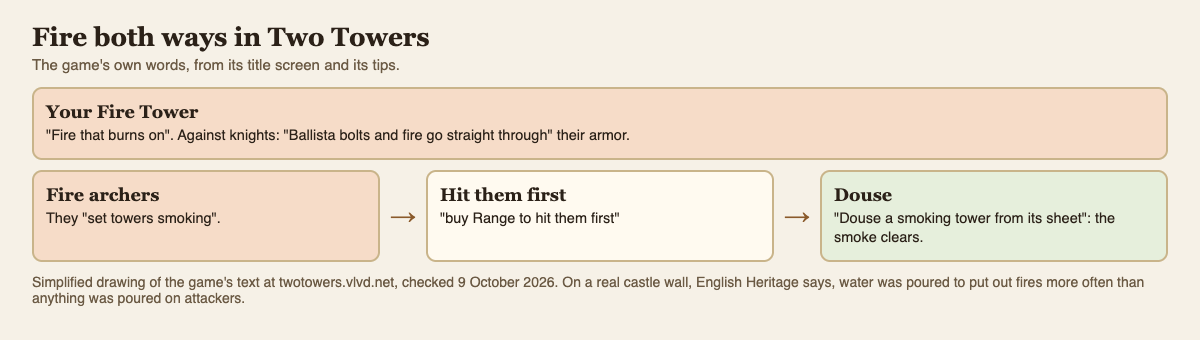
On your side, the Fire Tower is described as "Fire that burns on", and the game's tip for knights says their armor turns arrows, but "Ballista bolts and fire go straight through it." On the attackers' side, Fire archers set your towers smoking. The game's tip: "buy Range to hit them first, and Douse a smoking tower from its sheet." Press Douse and the smoke clears.
That is the water bucket from the castle wall, turned into a button. The game is not a history lesson, and the history in this post comes from English Heritage, but the habit it teaches is the real one: putting out fires is as much a part of holding a gate as starting them.
Frequently asked questions
Was boiling oil ever used in castle sieges?
English Heritage says hot oil was rarely used as a weapon. Its siege warfare guide does list oil and tar stored and heated for a siege, which were also useful for setting fire to siege engines.
What did defenders pour on attackers instead?
Hot sand, boiling water and quicklime on attackers climbing ladders, plus stones and other missiles. Water was poured more often to put out fires.
What is a murder hole?
An opening in a gatehouse through which defenders dropped things on attackers below. English Heritage mentions them at gatehouses like Brougham Castle's, alongside portcullises.
What was a hoarding on a castle wall?
A timber gallery built out from the top of a wall, also called a brattice or hoard. Its overhanging floor let defenders drop missiles, stones and hot liquids straight down.
Get started
Play Two Towers: it is free and plays in your browser on a computer or a phone. Pick a Fire Tower for the gate, keep Douse ready for the Fire archers, and hold as many stages as you can.
Comments
No comments yet.
Sign in or make an account to comment.