What is a portcullis and how did it work?
A portcullis is a heavy grille of wood or iron that drops down in grooves to close a castle's gate passage. You have seen one in every castle picture: the latticed gate hanging above an archway. What is harder to picture is how it was raised and lowered, where it was kept, and why many castles had two of them in the same passage.
This guide explains how a portcullis worked, using English Heritage's material, and walks through the gatehouse at Goodrich Castle in Herefordshire, where the room that held the lifting machinery survives. At the end it shows the gate you defend in the free browser game Two Towers.
What a portcullis is
English Heritage's Goodrich Castle glossary for schools defines a portcullis as a heavy wooden or iron grille protecting an entrance to the castle. Unlike a door, it did not swing. It slid straight down in vertical grooves cut into the walls of the gate passage, and was pulled back up from a room above.
Goodrich itself shows why a castle needed one. The same teachers' material says the castle was first built to be defended with crossbows, swords and spears, and that its rooms, towers and latrines designed for armed guards and sentries show a need for permanent, 24-hour security. A gate that could be shut without opening a door to the outside was part of that.
How a portcullis worked
The mechanism was simple. The portcullis hung from the room directly above the gate passage. Its sides ran in grooves in the stone, so it could only move up and down. A winch in the room above, a horizontal axle turned by handles, wound it up or let it down.
The same glossary lists the features usually found nearby:
- Drawbars: sliding wooden bars used across a door to bolt it closed.
- Murder holes: holes in the roof of the passage through which missiles and liquids were dropped onto attackers.
- Drawbridge: a bridge over a moat, hinged at one end so it could be raised.
A portcullis was rarely on its own. It was one part of a passage designed to be a trap.
A worked example: the gatehouse at Goodrich Castle
English Heritage's teachers' material on Goodrich Castle describes the traces still visible in its gatehouse. Walk through them in order:
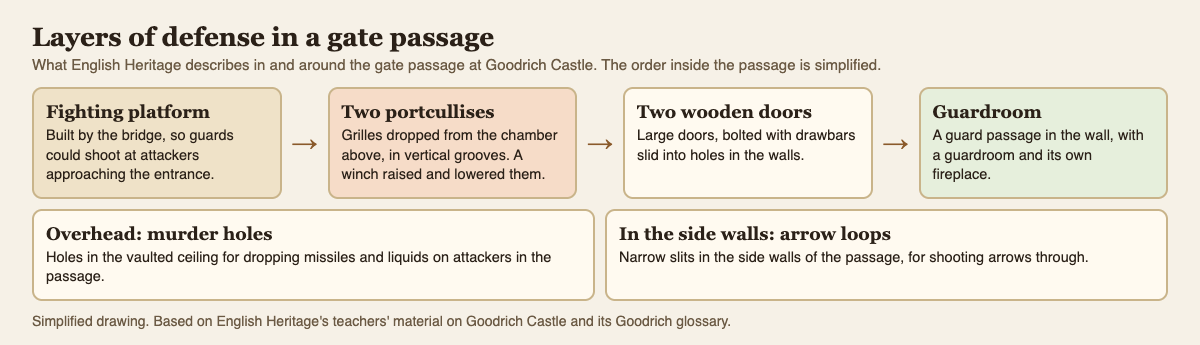
The layers of Goodrich's gate passage, simplified.
- The approach. Stubs of arches on either side of the bridge show where a fighting platform stood, from which guards could shoot arrows at attackers approaching the entrance.
- The doors. In the gate passage are holes for the drawbars of two large wooden doors.
- The portcullises. Vertical grooves show where two portcullises dropped from the chamber above.
- Overhead and alongside. There are murder holes in the vaulted ceiling and arrow loops in the side walls. A guard passage in the wall leads to a guardroom with its own fireplace.
- The winch room. In the room above the gatehouse is what English Heritage calls a rare survival: evidence of the mechanism used to raise and lower the portcullis. There are recesses giving room to turn the winch handles, a long round hole where the horizontal axle sat, slots in the floor for a second portcullis, and murder holes between the slots.
One more detail shows how closely it was all planned. Goodrich has a chapel beside the gatehouse, possibly unique, and a socket in the wall near the altar allowed the door's drawbar to be withdrawn when the gates were opened.
Why two portcullises?
English Heritage's guide to medieval ingenuity gives the reason in a phrase: powerful gatehouses like Brougham Castle's were often equipped with portcullises "to trap attackers", and murder holes "for dropping nasties on their heads".
The idea of a trap is easy to picture: attackers who got past one grille could find a second closed in front of them, in a stone corridor with murder holes overhead and arrow loops in the walls. English Heritage does not describe how Goodrich's two portcullises were used in a real attack, but its doubled features fit that purpose.
Portcullises in other castles
The portcullis turns up in many of English Heritage's castle descriptions, not only at the main gate:
- Castle Acre, Norfolk. The west gate, added around 1200, had a portcullis, massive gates and a guardroom to one side. The town's Bailey Gate, built at about the same time, could be closed with gates and a portcullis.
- Rochester, Kent. The keep was entered on the first floor, up an external stair, into a waiting room. From there an inner door, protected by a portcullis, led into the keep itself.
- Dunstanburgh, Northumberland. In the great gatehouse begun in 1313, a portcullis stood at the inner part of the gate passage.
English Heritage's page on life in a castle adds the everyday side. In peacetime a small castle might have only a dozen soldiers or fewer, just enough to open the gate, operate the portcullis and drawbridge, and patrol the walls. When attack threatened, the same page says, you packed as many soldiers into the castle as you could.
The gate in Two Towers
In Two Towers, a free tower defense game in your browser, your whole job is a city gate. If it falls, the game is over. Between attacks you repair the gate or reinforce it with gold, and its card says: "The gatehouse was a castle's weak point, so it was usually built as its strongest part."
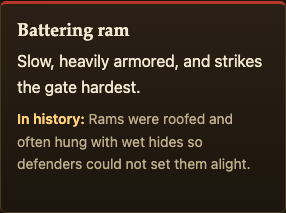
The attacker built to break it is the Battering ram: slow, heavily armored, and the one that strikes the gate hardest. Its card notes that rams were roofed and often hung with wet hides so defenders could not set them alight.
Your answers are a Ballista, whose bolt ignores armor, or a Fire Tower, whose fire burns through it. The game gives one line of history per card, not a full account. For the rest of a garrison's preparations, see our guide to how castles defended against a siege.
Frequently asked questions
What is a portcullis made of?
English Heritage's glossary says wood or iron: a heavy grille protecting an entrance to the castle.
How was a portcullis raised?
By a winch in the room above the gate passage. At Goodrich you can still see the recesses for the winch handles and the hole for its axle.
Why did some gates have two portcullises?
English Heritage says gatehouse portcullises were there to trap attackers. Two gave defenders a second barrier, with murder holes overhead and arrow loops in the walls.
Get started
Play Two Towers: it is free and plays in your browser on a computer or a phone. Keep your gate repaired, stop the rams before they reach it, and read the history line on each card as you go.
Comments
No comments yet.
Sign in or make an account to comment.