DNA Helix Loops for a Biotech Explainer Video
If you are looking for DNA helix loops for a biotech explainer video, you want a short, quiet, repeating shot that sits behind your narration while you explain a mechanism. Wavecrate has one: a Free clip called DNA helix Loop. This guide shows what it is, how to repeat it cleanly under a script, where it fits in an explainer, and which license covers your use.
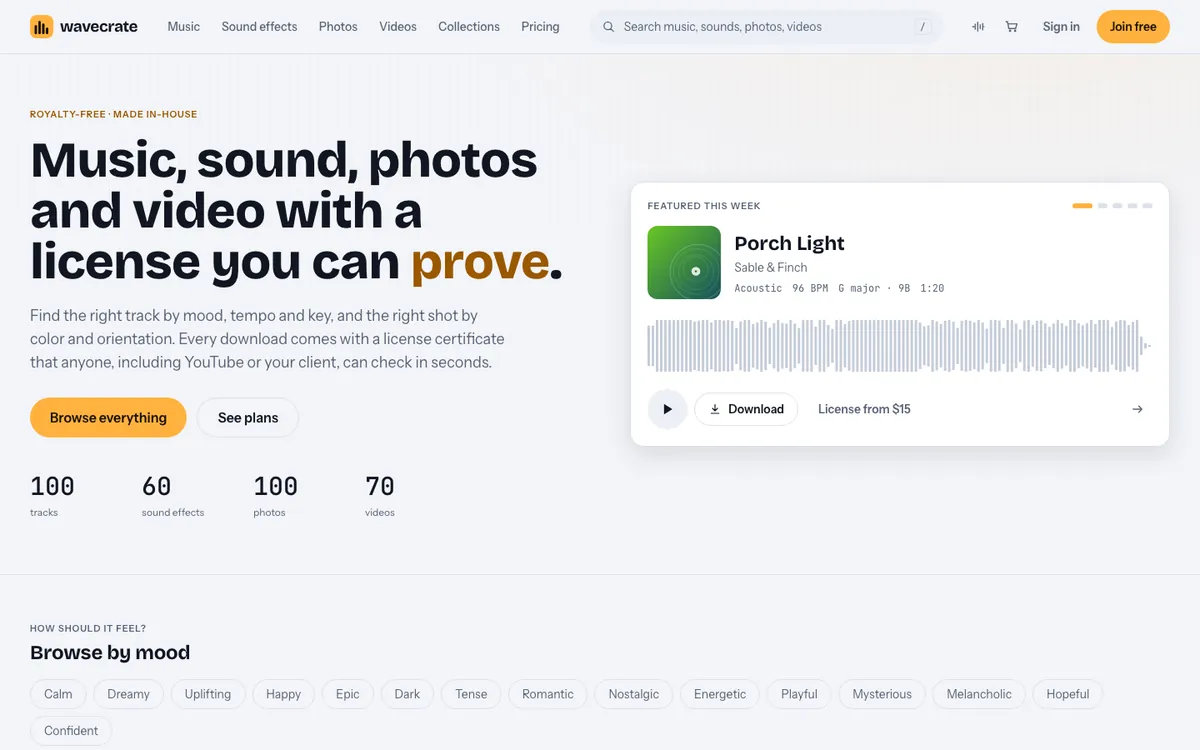
Wavecrate licenses royalty-free music, sound effects, photos and videos, and every download comes with a license certificate and a code anyone can check on its verify page.
I read the clip's page on 13 October 2026, and every detail below comes from that page unless I say otherwise.
What the DNA helix Loop is
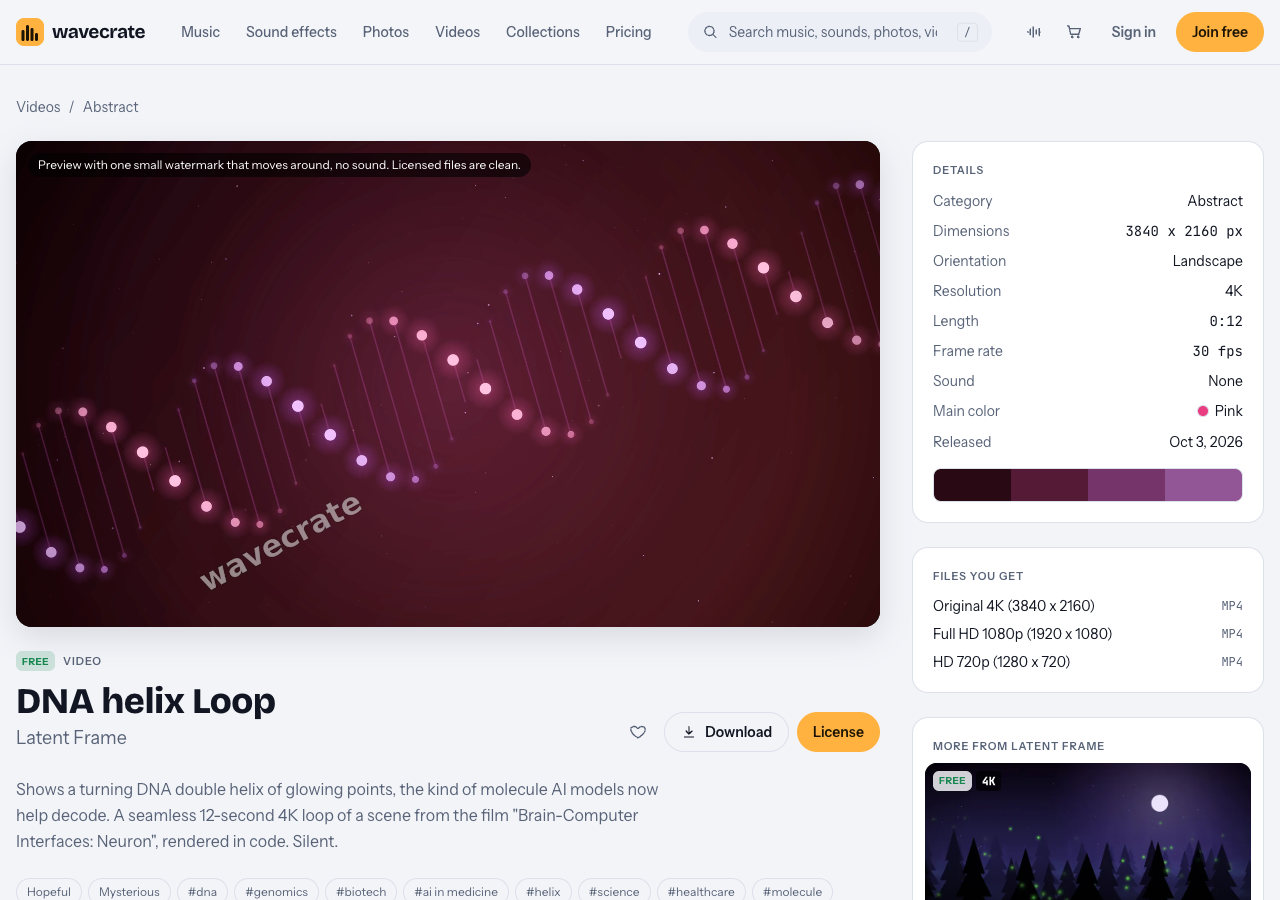
The page describes it as a turning DNA double helix of glowing points, a seamless 12 second 4K loop from the film "Brain-Computer Interfaces: Neuron", rendered in code. It is silent. It was released on 3 October 2026 by Latent Frame, and it is marked Free.
The details table gives the facts you need for an edit: 3840 x 2160 pixels, landscape, 30 frames a second, no sound, main color pink. You get three mp4 files: the original 4K, a Full HD 1080p and an HD 720p. The tags include dna, genomics, biotech, helix, loop and seamless.
The preview you see has one small watermark that moves around. The page says licensed files are clean, so judge the look from the preview and expect no watermark in the file you license.
It is a stylized drawing, not a lab image. It shows glowing points on two turning strands joined by thin lines, on a dark pink background. That suits a talk about biotech, a startup pitch or a science channel intro. It does not suit a lecture on molecular structure.
Check the science before you commit
A biotech audience notices errors, so give the clip a quick check against what your script says.
- Two strands. The US National Human Genome Research Institute describes DNA as two linked strands that wind around each other, a shape known as a double helix. Make sure your clip shows that and not a single spiral.
- Base pairs. The same glossary says adenine pairs with thymine, and cytosine pairs with guanine. The Wavecrate clip is stylized, so do not point at one of its glowing points and call it a specific base.
- Direction and pitch. The page says nothing about which way the helix turns or how many base pairs make one turn. If your audience is other scientists, compare the clip with your own figure and say "illustration" on screen.
A short "illustration" label costs you nothing. It beats a correction in the comments.
Fill a narration with a 12 second loop
The page calls the clip seamless, so the end of the 12 seconds joins the start without a jump. What you need to do is repeat it well. Here is a worked example for one section.
- Time your narration for the section. Say the part that explains how DNA is copied runs 36 seconds.
- Divide by the loop length. 36 divided by 12 is 3, so you need 3 copies.
- Place the copies back to back on the timeline with no transition between them.
- Play the joins at full speed, then at half speed. A hitch shows as a tiny pause or a brightness shift.
- If you see a hitch, check that you did not change the clip's speed or trim a frame off a copy.
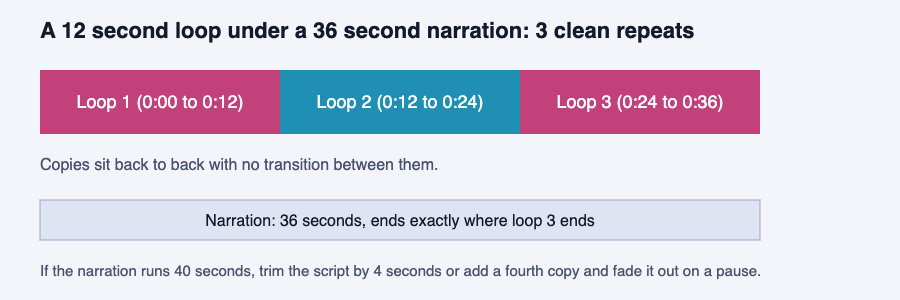
If the narration runs 40 seconds, you have two honest choices. Cut 4 seconds from the script, or add a fourth copy and let it fade out on a pause in your voice. Do not stretch one copy to fit. Changing the speed of one copy breaks the repeat.
Keep the 30 frames a second of the clip in your project, and do the repeat in the editor, then export once. Do not export a loop, import it again and export a second time.
Pace, color and what the viewer should look at
A loop should never be the star. If viewers watch the helix instead of reading your text, it is too busy. The clip is a slow turn of glowing points, which helps: it keeps the eye resting while your voice carries the idea.
The main color is pink. If your explainer already uses blue for a healthy cell and orange for a target, a pink backdrop will fight your palette. You have three ways around that: build the palette around the clip, dim it behind a solid shape that holds your text, or choose a different clip. The Wavecrate motion backgrounds list has other loops, and the video filters include color.
Where DNA helix loops for a biotech explainer video fit
A typical biotech explainer runs: problem, science, product, proof, call to action. The helix has a natural place in two of those.
- Opening. A loop behind your title card, with the narration or music starting under it.
- The science section. This is where it earns its place. Run it under the definition, then cut to your own diagrams.
- Not the proof section. Data and charts need a clean background.
For the move from the science to the product, Wavecrate has transitions that start from a helix. The Free Iris Transition: DNA helix to Friendly robot is a 2 second 4K stinger, meant for use between sections. Crossfade and Soft Wipe versions also exist, and they are not marked Free. Browse them all on the transition videos page.
If you need a still for a slide or a thumbnail, Wavecrate also has a photo called DNA helix in Pink. It is a square 4K image by Pixel Foundry and it is Premium, not Free: its page lists Standard at $9 and Extended at $39.
Which license covers your explainer
Every download comes with a license certificate and a code. You can paste the code into your video description, and anyone can check it on the verify page with no account. Paid licenses are not on sale yet (Wavecrate says purchases open soon), so the prices below are the listed prices for when sales open; items marked Free, like this clip, can already be downloaded with a free account. The video license cards read like this:
- Free. For online and social posts with credit: websites, blogs and social media posts, and monetized channels. You must put credit text next to the clip or in the description. A free account gets 3 free downloads a month.
- Standard, listed at $29. Your own websites, social media, apps and presentations, and your own marketing and brand content, with no credit needed. It is also included with Pro.
- Extended, listed at $99. Everything in Standard plus paid advertising, TV broadcast, products for resale and client work.
Here is how that plays out for three explainers that use the DNA helix Loop. A lab or startup that posts its own explainer on its website and social accounts fits the Free card, with credit. The same company that wants no credit line on screen or in the description needs Standard. And an agency that makes the explainer for a biotech client needs Extended, because client work is listed there.
The Free card does not list paid ads, so if you plan to promote the video with paid ads, treat that as an Extended use. Pro, listed at $99 a year or $12 month to month and not on sale yet, gives Standard licenses on the whole catalog and never Extended. See the pricing page for the full table.
Wavecrate has no separate terms page today, so the cards and the pricing table are what you can read. If your use sits on the line between two cards, plan for the larger one.
A quick pre-flight list
- Does the clip show two strands, and does your script avoid claims the stylized drawing cannot back up?
- Do the narration length and the 12 second loop line up, with no stretched copy?
- Does the pink fit your palette, or have you dimmed it behind your text?
- Is the explainer for yourself, for a client, or for paid ads, and does the card you picked cover that?
- If you use the Free card, is the credit text in place?
- Have you replaced the watermarked preview with the licensed file?
Frequently asked questions
Does Wavecrate have a DNA helix loop?
Yes. DNA helix Loop is a Free, seamless 12 second 4K clip by Latent Frame, and it is silent. Catalog contents change, so search for "helix" on the day you work.
Can I use it in a monetized biotech explainer?
The Free card covers monetized channels, with credit text next to the clip or in the description. If you want no credit line, the Standard card says no credit is needed.
Do I need Extended if I make the video for a client?
Yes. The Extended card lists client work, and Pro does not include Extended.
Does the clip include sound?
No. The page lists the sound as none, so add your own voice-over and music.
Is it scientifically exact?
No. The page calls it a turning double helix of glowing points, rendered in code. Treat it as an illustration and label it as one.
Get started
Browse Wavecrate: you can join free and download items marked Free now, paid licenses are not on sale yet (purchases open soon), and every download comes with a license certificate and a code anyone can check on its verify page.
Open the DNA helix Loop, check the license cards, and drop it under your science section. You can join free to download items marked Free, such as this clip.
Comments
No comments yet.
Sign in or make an account to comment.