Do Short Breaks Help You Study Better? What Research Says
Do short breaks help you study better? They help you feel better, and they can keep your focus from fading, but on their own they do less for memory than most advice suggests. This post sets out what three studies found, where breaks help and where they do not, and a study hour that uses breaks for energy and self-testing for memory.
Do short breaks help you study better? The short answer
Short breaks reliably help with energy and tiredness. Their effect on how well you perform is smaller and less certain, and for remembering what you studied, a break of quiet rest did no better than other activities in a recent classroom study. So take breaks to keep going, and test yourself to remember.
What a review of micro-breaks found
A 2022 meta-analysis pulled together 22 groups of people, 2,335 in total, who took short breaks of up to 10 minutes between tasks. Breaks gave a small boost in energy and a small drop in fatigue. The effect on overall performance was smaller and not statistically significant.
Two details matter for studying. Breaks helped performance mainly on less demanding tasks, and longer breaks helped more than shorter ones. The authors suggest that recovering from hard mental work may need more than 10 minutes. Most of these studies were about work tasks, not studying, so treat them as a guide, not a rule.
Why focus fades, and how brief switches help
If you have ever reread the same paragraph three times, you know focus drops over a long stretch. A 2011 lab study tested one idea about why. People watched a screen for a long time while holding a few digits in memory. When they only recalled the digits at the end, their attention to the screen fell steadily. When they were asked to recall the digits now and then during the task, the drop did not happen.
The authors' reading is that brief switches away from a goal, then back, keep it fresh. That was a lab watching task, not a study session, but it fits a common experience: a short change of activity can make the next block easier to focus on.
You can use the same idea inside a block. Instead of reading for 40 minutes straight, stop every page or two and ask yourself what you just read, without looking. It is a tiny switch away from reading, it shows you whether you took anything in, and it is a form of self-testing too. If you cannot answer, that is a sign to slow down, not to push on.
Do breaks help you remember what you studied?
This is where the evidence is weakest. In a 2026 study of 161 university students, everyone read a text and then spent 8 minutes either resting quietly, using social media, doing a math task or reading something else. A week later, all groups had forgotten a lot, and quiet rest did not give a consistent advantage over the others.
So a break is not a memory tool by itself. If you want the material to last, the stronger habit is testing yourself on it after the break and again days later. Our post on why testing yourself beats rereading your notes covers that research.
A study hour that uses breaks well
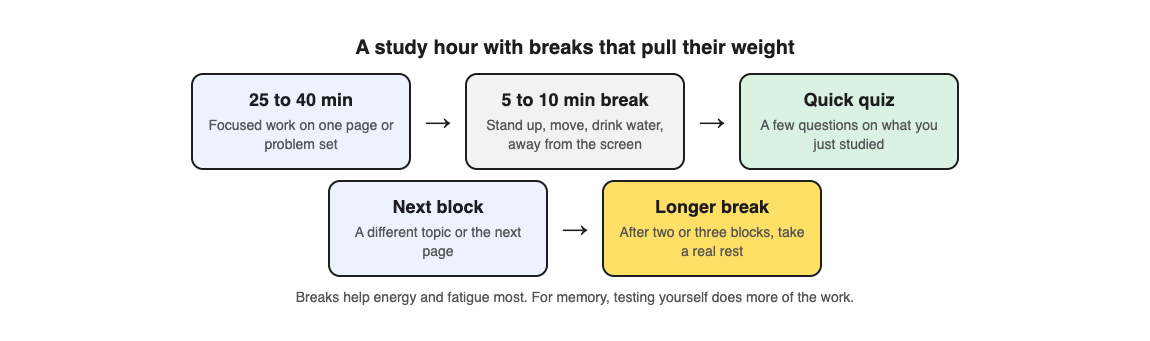
Here is a worked example for an evening with a biology chapter.
- Block 1, 25 to 40 minutes. Read the first section and take notes, phone in another room.
- Break, 5 to 10 minutes. Stand up, walk, get water. Stay off your phone if you can, mainly so the break does not stretch into an hour.
- Quick quiz. Open Study Shot in your browser, tap Make a new quiz, then Take photo, and photograph the page you just studied. Hold it flat and fill the frame. Choose 5 questions, keep the Tiered ladder from basic to advanced, and press Create questions. Answer each one and press Check answer to see the right answer and a short explanation.
- Block 2. The next section, or a different subject if you are tired of this one.
- Longer break after two or three blocks. The review above suggests longer breaks help more after hard work.
- Two days later. Open your library, where each quiz is saved with its page photo and best score, and tap Retake quiz before you reread anything. Use the Look at these again list to find what to review.
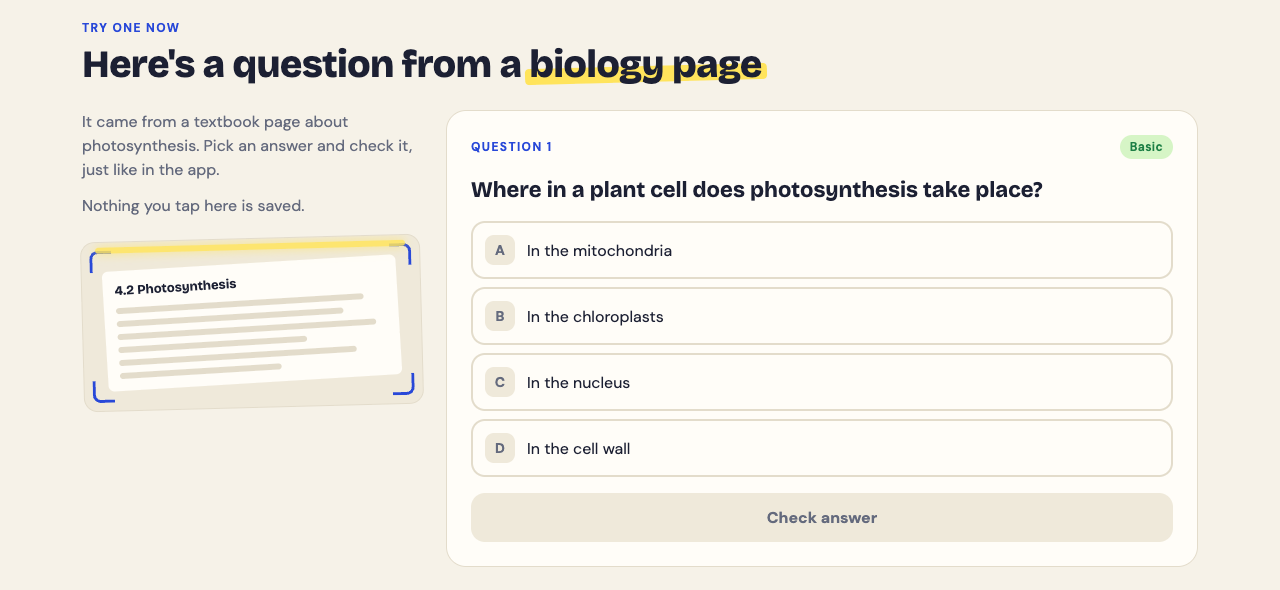
The questions are written by an AI model and can contain mistakes. Check each explanation against your page, and use Report a problem with this question if one looks wrong.
What to do in a study break
- Move. A short walk or stretch is an easy way to change activity.
- Look away from screens. If you study on a screen, give your eyes something else.
- Keep it short and planned. Set a timer for the break, not just for the work.
- Eat or drink something small. Water or a snack is a simple reset, especially in a long evening.
- Be careful with your phone. In the 2026 study, social media did no worse than rest for memory, but it is easy for a 5-minute scroll to become 30.
If you feel worn out even after breaks, the fix is often fewer hours, not more breaks. Spread the work across more days, and protect your sleep. For more on where you study and when, see does studying in the same place help you remember.
Frequently asked questions
How long should a study break be?
Five to ten minutes between blocks is common, with a longer break after two or three blocks. The micro-break review found longer breaks helped performance more after demanding tasks.
How often should I take a break when studying?
Many students work in blocks of 25 to 40 minutes. Notice when you start rereading without taking anything in; that is a good time to stop for a few minutes.
Is it bad to use my phone during a study break?
For memory, one study found social media did no worse than quiet rest. The risk is time: set a timer so the break stays a break.
Do breaks help with cramming?
They can help you keep going, but they do not fix the main problem with cramming, which is that it leaves no time for retakes on later days.
Get started
Tonight, study in two short blocks with a 5-minute break between, and end each block with a quick quiz on the page you just read.
Try Study Shot: it is free to start. Photograph the page you are studying tonight and get 10 practice questions on it, from basic to advanced.
Comments
No comments yet.
Sign in or make an account to comment.