Does a Growth Mindset Help You Study Better? What Research Shows
If you have wondered does a growth mindset help you study better?, the honest answer is: a little, and mostly for some students. Believing you can improve does not do the studying for you. It can change what you do after a bad result, and that is where the benefit comes from.
The short answer: does a growth mindset help you study better?
Yes, but the effect is modest. Large reviews find weak average effects on grades, and the clearest gains show up for students who are struggling. It is not a switch that raises every score.
Think of it as a starting condition. If you believe ability can grow, you are more likely to review your mistakes, try a harder problem and keep going after a low mark. Those behaviours help you learn. The belief only matters to the extent that it leads to them.
What a growth mindset actually is (and what it is not)
A growth mindset is the belief that abilities such as maths, writing or memory can be developed through effort, good strategies and feedback. A fixed mindset is the belief that those abilities are mostly set, so a poor result says something permanent about you.
It helps to be clear about what it is not:
- It is not "just try harder." Effort that uses poor methods, like rereading, can feel busy and teach you little.
- It is not praise for effort alone. Praising a student who is stuck, without changing how they study, does not help.
- It is not permanent. Most people hold different beliefs about different subjects. You might feel flexible about history and fixed about maths.
- It is not a personality type. It is a belief, and beliefs shift with experience.
What the research says about grades and learning
The picture is mixed, and it is worth knowing both sides.
A 2018 paper in Psychological Science pooled two sets of studies: 273 studies with 365,915 students on the link between mindset and achievement, and 43 studies with 57,155 students on lessons designed to change mindset. The authors report that overall effects were weak in both. They also note that some results fit the theory: students from low-income families or who are academically at risk might benefit from mindset lessons.
A 2019 study in Nature took a different route. It tested a short online lesson, under one hour, in a nationally representative sample of US secondary school students. The lesson improved grades among lower-achieving students and raised enrolment in advanced maths courses. The effect on grades showed up in schools where peer norms matched the lesson's message, which means the surrounding culture seemed to matter.
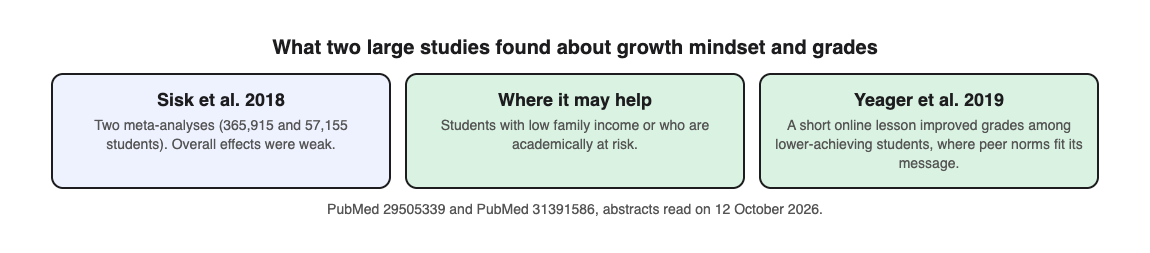
Put together, the research suggests three things:
- The average effect is weak.
- It may be more useful for students who are struggling.
- Context matters. A belief in growth seems easier to act on when the people around you also value learning from mistakes.
Researchers still argue about how much weight these results deserve, and this post takes no side. Read the two abstracts and decide how far they apply to you.
Why the effects may be small and uneven
These are possible explanations, not findings from the two studies above. They are still useful if you want to use the idea well.
A belief is not a method. You can be sure that you can improve and still study in ways that do not work. If your routine is highlighting and rereading, a better attitude gives you a more optimistic version of the same routine.
The environment can cancel it out. If every test is high stakes and mistakes are punished, "mistakes help me learn" is hard to believe and harder to act on.
People already differ. A student who already bounces back from setbacks has little to gain. A student who gives up after a bad grade has more room to change.
Measurement is hard. Mindset is usually measured with a short questionnaire, and what you say you believe is not always what you do when a test goes badly.
How a growth mindset changes the way you study
The useful part is behavioural. A growth mindset changes what you do at three moments.
Before you start
You are more willing to pick material that is slightly too hard. You also feel less threatened by not knowing something yet. "I don't get this yet" is a more useful sentence than "I'm bad at this."
When you get something wrong
This is the big one. A wrong answer is information about what to study next. If you treat it as a verdict, you avoid the topic. If you treat it as a pointer, you go back to it.
After a result
You look at what happened and change one thing. You do not just decide you are or are not a good student.
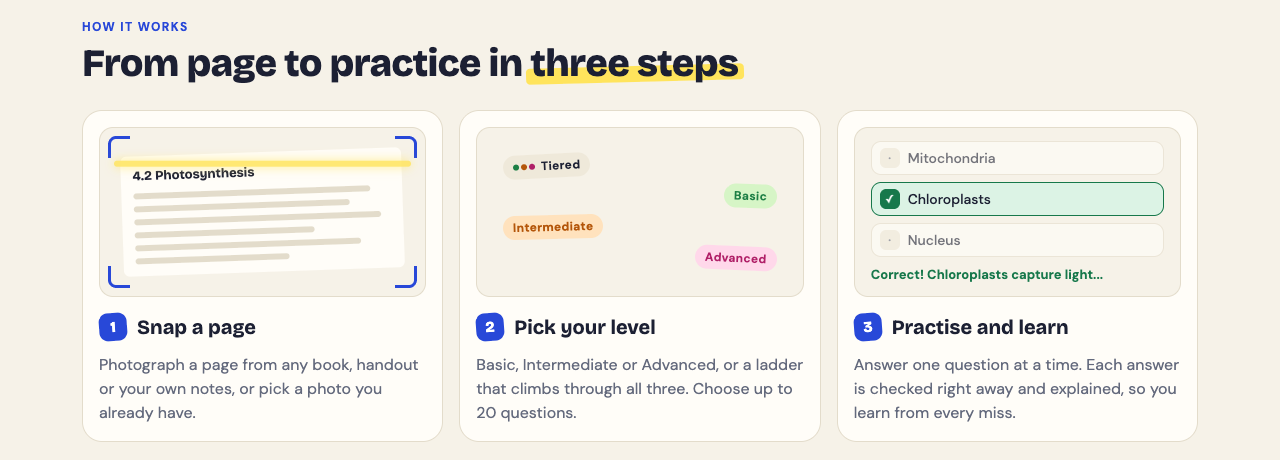
A worked example shows how this looks in practice. Say you are studying a page on photosynthesis. You photograph the page in Study Shot, choose the Tiered level and 10 questions. Tiered splits the questions across basic, intermediate and advanced, so you start with key terms and work up to applying ideas in new situations.
You finish and the results screen shows a score for each level. Maybe you did well on Basic and missed several on Advanced. That pattern tells you something specific: you know the vocabulary but cannot yet apply it. A fixed mindset reads that as "I'm not a science person." A growth mindset reads it as "I need to practise application," and the results screen helps you act on it. It lists each missed question with your answer and the right answer under Look at these again.
The quiz is saved to your library with your best score, so you can retake it later and see whether the number moves. That is the growth loop in small form: try, see where you stand, fix a gap, try again.
Mindset alone is not enough: pair it with proven study methods
If you want the mindset to pay off, attach it to methods that have good evidence behind them. Three are worth starting with.
- Retrieval practice. Test yourself instead of rereading. Answering questions forces you to pull information out of memory, which is what an exam asks you to do.
- Spaced repetition. Come back to the same material over several days instead of cramming it in one night.
- Learning from errors. Review what you missed and work out why, not just what the right answer was.
Making your own questions is one way to do retrieval practice, and there is research on whether writing your own practice questions helps you learn. If you prefer to organise notes visually, see what research says about colour coding your notes. And if you are curious about small memory tricks, there is a post on whether closing your eyes helps you remember things.
Study Shot covers the retrieval part. You photograph a page from a textbook, your notes or a whiteboard, and an AI model writes multiple-choice questions about it, checks your answers and explains each one in a sentence or three. Because the questions are written by an AI model, they can contain mistakes. Use the explanation to check the answer against your page, and if a question looks wrong, use Report a problem with this question.
A simple weekly routine to put a growth mindset into practice
This routine takes about an hour a week plus short daily sessions. Adjust it to your schedule.
- Monday: pick one hard topic. Choose something you find difficult, not something comfortable. Write one sentence: "I can't do this yet."
- Monday: take a first quiz. Photograph the page and make a quiz. A first score that is low is normal. It is your baseline.
- Tuesday: review the misses. Open the missed questions and, for each, write down in your own words why the right answer is right.
- Thursday: retake the quiz. Use Retake quiz from your library. Compare the new score with the first one.
- Weekend: go one level up. If Basic and Intermediate felt solid, make a new quiz on the Advanced level for the same page.
- Sunday: note one change. Write down one thing you will do differently next week, such as starting earlier or testing yourself before you reread.
The point is not to hit a grade. Study Shot labels scores from Needs another try (below 50%) up to Mastered (90% and up), but the more useful signal is the change between your first and second attempt.
Frequently asked questions
Does a growth mindset improve grades?
On average, only slightly. The clearest gains show up for students who are struggling, especially in environments that support learning from mistakes.
Is a growth mindset the same as believing anyone can learn anything?
No. It is the belief that your abilities can improve with effort, good strategies and feedback. It does not promise that every goal is reachable or that every method works.
Can I change from a fixed mindset to a growth mindset?
Beliefs can shift, especially when you see evidence. Watching your own quiz scores rise after you review mistakes is a concrete way to build that evidence.
What should I do instead of just "believing in myself"?
Test yourself on the material, review what you got wrong, and repeat the test after a gap. The belief makes it easier to keep going, but the methods do the learning.
Get started
You do not need to change how you think before you change how you study. Take one page you find hard, quiz yourself on it, look at what you missed and try again in a few days. The score change is your evidence.
Try Study Shot: it is free to start. Photograph the page you are studying tonight and get 10 practice questions on it, from basic to advanced.
Comments
No comments yet.
Sign in or make an account to comment.