Does Chewing Gum Help You Concentrate When Studying? The Evidence
Does chewing gum help you concentrate when studying? A little, for a short while, and not for every kind of task. A review of 21 studies found a weak lift in attention. Another study found the lift lasted about 15 to 20 minutes. And for memorising lists, chewing made things worse. Here is what the research found and how to use it without fooling yourself.
Does chewing gum help you concentrate when studying? The short answer
Gum may give you a small, brief nudge in attention. It is not a study method, and it does nothing for material you have not practised. If you feel flat at the start of a session, chewing for a few minutes before you test yourself is a fair thing to try. Chewing all the way through a memory task is not.
What the attention studies found
A 2019 systematic review and meta-analysis looked at 21 papers on chewing and sustained attention, which is the ability to stay focused on a dull task over time. It found a weak but real improvement in attention while chewing. It also found a tendency for alertness to drop less during hard tasks, though that result fell just short of the usual bar for significance. The authors said more research is needed.
"Weak" matters here. The effect was small enough that you would not notice it in a single study session.
Timing: before the task, not during it
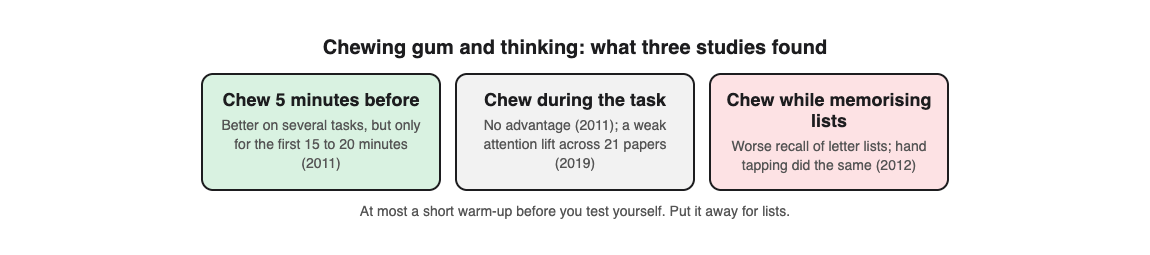
The most useful study for students is a 2011 paper with a fitting title: "Now you see them, now you don't". People who chewed gum for 5 minutes before a set of thinking tasks did better on several of them. People who chewed all the way through the tasks did not.
Even the benefit from chewing first was short. It lasted for the first 15 to 20 minutes of testing, then faded, and it did not show up on every kind of task.
The authors offered two reasons. Chewing raises arousal, your general level of alertness, for a short time. And chewing during a task competes with the thinking for the same mental resources.
When gum gets in the way: memorising lists
A 2012 study called "Gummed-up memory" tested short-term memory for lists of letters. Chewing gum made people worse at recalling the letters in order, and worse at remembering which letters were on the list at all. Tapping a hand had the same effect. The researchers suggested that any steady rhythm like this reduces your ability to hold a sequence in mind.
So if you are memorising steps in order, a list of terms, or a formula, put the gum away.
Does chewing the same gum at the exam help recall?
You may have heard that chewing gum while you study and again during the exam helps you remember. That idea comes from a 2004 study where switching between gum and no gum, from learning to recall, led to worse recall of a word list.
Later studies did not find it. A 2007 re-examination ran two experiments and found no effect of gum at learning or recall, and no matching effect. A 2009 study of 101 people that held the flavour constant also found none. On the evidence so far, chewing gum at the exam is not a memory trick.
What does more for focus than gum
Concentration is easier when the task asks something of you. Rereading a page is passive, so your mind drifts. Answering questions about it is not. In a well-known 2006 study, students who tested themselves on a passage remembered much more two days and a week later than students who reread it, even though the rereaders felt more confident. If gum helps you start a self-test, fine. The self-test is what does the work.
How to use gum in a study session
If you want to try it, give it one small job.
- Chew before, not during. Chew for about 5 minutes as a warm-up when you feel flat, then put it away when the hard thinking starts.
- Use the first 20 minutes well. Any lift is short, so start with the most demanding part of the session: testing yourself.
- No gum for lists. When you rehearse steps, terms or anything in order, keep your mouth and hands still.
- Check it on yourself. Compare a few sessions with and without the warm-up. Your own scores tell you more than a lab average.
A worked example: one page, two evenings
Say you are reviewing a biology chapter at 9 p.m. and feeling flat.
- Read the page once. Turn it over and write the main points from memory. Check them against the page.
- Chew a piece of gum for about 5 minutes while you set up, then put it away.
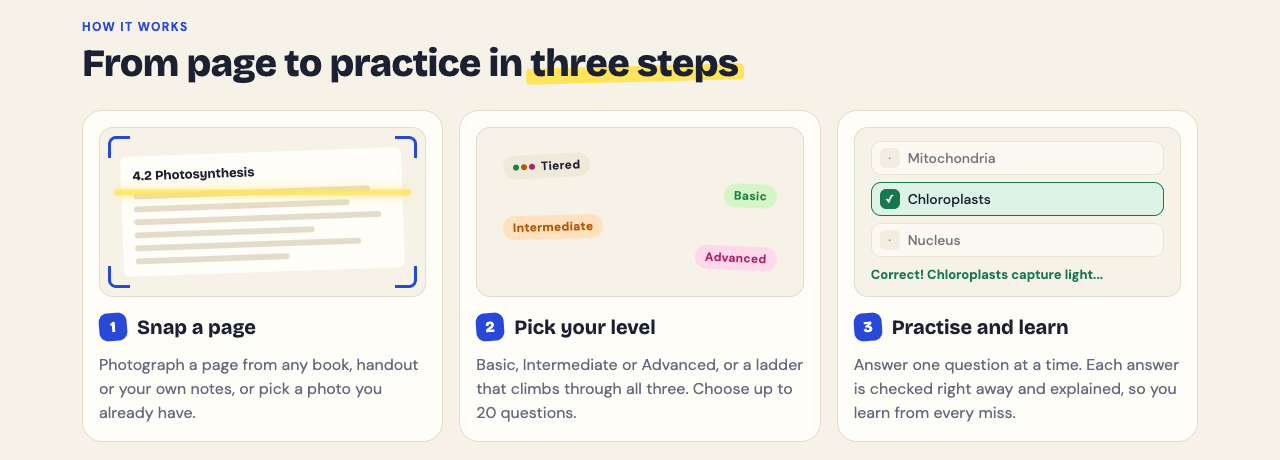
- Open Study Shot, choose Make a new quiz, then Take photo. Hold the page flat and fill the frame.
- Keep 10 questions and the Tiered level, which climbs from basic to advanced. Press Create questions; it can take up to a minute.
- Answer one question at a time and press Check answer. Each answer is checked right away and explained.
- On the results screen, note your score for each level and read Look at these again, the list of questions you missed.
The next evening, skip the gum, write the main points from memory again, and press Retake quiz from your library, where each quiz is saved with its page photo and your best score. That is a tiny experiment, not proof, because the second try also benefits from the first. It still tells you whether the warm-up made any difference you can feel.
The questions are written by an AI model and can contain mistakes. Read each explanation against your page, and use Report a problem with this question if one looks wrong.
If you want a warm-up with more evidence behind it, read does exercise before studying help you learn.
Frequently asked questions
Should I chew gum while I study?
Chewing for a few minutes before a task helped in one study, and chewing throughout did not. Chewing also hurt memory for lists, so put it away when you memorise.
How long does the gum effect last?
In the 2011 study, the benefit lasted for the first 15 to 20 minutes of testing and then faded. Plan for minutes, not hours.
Does chewing gum during an exam help you remember?
One 2004 study suggested it, but two later studies, one with 101 people, found no such effect. Your preparation matters far more.
Get started
Try Study Shot: it is free to start. Photograph the page you are studying tonight and get 10 practice questions on it, from basic to advanced.
Comments
No comments yet.
Sign in or make an account to comment.