Does Closing Your Eyes Help You Remember Things? The Science
Does closing your eyes help you remember things? In studies of eyewitnesses, yes, in one specific way: it helped people pull up details they had already stored. Staring at a blank screen helped about as much, so the real benefit is cutting out what you see. These studies tested recall, not putting new material into memory in the first place. Below you will find what the research shows, why it works, when it fails, and how to use it while you study and during exams.
Does closing your eyes help you remember things? The short answer
The studies tested recall, not learning. When you try to remember something, your brain has to search for it. Everything you see while you search competes for attention. Close your eyes and that competition drops away, so the search goes better.
Learning is a different job. To learn a page, you have to read it, think about it, and then test yourself on it. Closing your eyes does nothing for the reading. It helps at the moment you reach for the answer.
So treat eye closure as a retrieval tool. Use it when you are trying to bring something back, not when you are taking something in.
What the research shows: eye-closure studies on memory and eyewitness recall
Much of the evidence comes from eyewitness research, where people watch an event on video and are then asked about it.
In a 2011 study by Vredeveldt, Hitch and Baddeley, 80 eyewitnesses were interviewed while they either closed their eyes, looked at a blank screen, or faced visual or sound distraction. Recall was significantly better with minimal distraction, eyes closed or blank screen, than with either kind of distraction. Pictures hurt memory for things seen, and sounds hurt memory for things heard. Basic facts about the event held up well, while specific details were easier to disrupt.
A 2014 study by Mastroberardino and Vredeveldt tested 120 children aged 8 to 11 after a five-minute video of a theft. Children with eyes closed or a blank screen gave more correct and fewer incorrect answers about visual details than children facing distraction. There was no advantage for details they had heard.
A 2026 study by Parkin, Parker and Dagnall found that closing the eyes made people's personal memories richer when they recalled them, though the authors say the reasons are not yet fully understood.
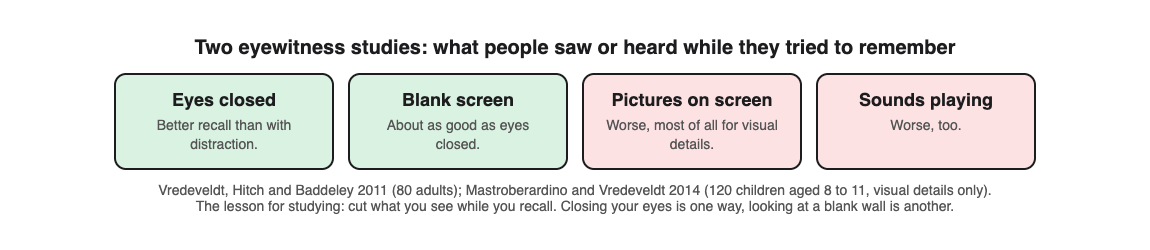
Two limits are worth knowing. These studies tested recall of an event or a personal memory, not long-term memory for textbook content. And none of them show that studying with your eyes closed makes you learn faster.
Why it works: cognitive load, visual distraction and mental imagery
Three ideas explain most of the effect.
Cognitive load
Vredeveldt's team read their results as evidence that closing the eyes lowers the load on your mind: any distraction hurt recall, and removing it helped.
Visual distraction
A busy room pulls at your attention. A person walks past. A screen lights up. Each one breaks your focus for a moment. With your eyes shut, those interruptions mostly stop.
Mental imagery
Pictures hurt memory for visual details more than sounds did, which the authors took as a sign that people picture what they are trying to remember. Close your eyes and you can rebuild the page or the diagram in your head with less getting in the way.
When closing your eyes helps most, and when it does not
Eye closure helps most when:
- The memory is visual, like a diagram, a map, or a layout of notes.
- Your surroundings are busy or noisy to look at.
- You are recalling something on your own, without needing to read anything.
It helps little or not at all when:
- You never learned the material. You cannot recall what was never stored.
- You need to read options or a diagram to answer. You have to look.
- Closing your eyes makes you sleepy or anxious. Then it costs more than it gives.
How to use eye closure in your study sessions and exams
Here is a simple routine you can try tonight.
- Read one page. Read it properly once. Do not reread it three times.
- Close the book and your eyes. Try to say the main points out loud or in your head. Picture where each point sat on the page.
- Open your eyes and check. Note what you missed.
- Test yourself with questions. For each question, close your eyes for a few seconds before you look at the choices. Try to produce the answer yourself first.
- Repeat the misses later. Come back to the items you got wrong the next day.
In an exam, the same move works on a stuck question. Read the question. Close your eyes for five to ten seconds. Picture the page or lecture slide where that topic came up. Then open your eyes and answer. If nothing comes, move on and return later.
In an exam room, closed eyes can look odd. Looking down at a blank part of your desk cuts distraction too, much like the blank screen in the studies.
Pair it with proven techniques: retrieval practice, doodling and color coding
Eye closure helps at the moment of recall. The bigger gain comes from recalling often: in a 2006 study by Roediger and Karpicke, students who took recall tests on a passage remembered more of it two days and one week later than students who reread it.
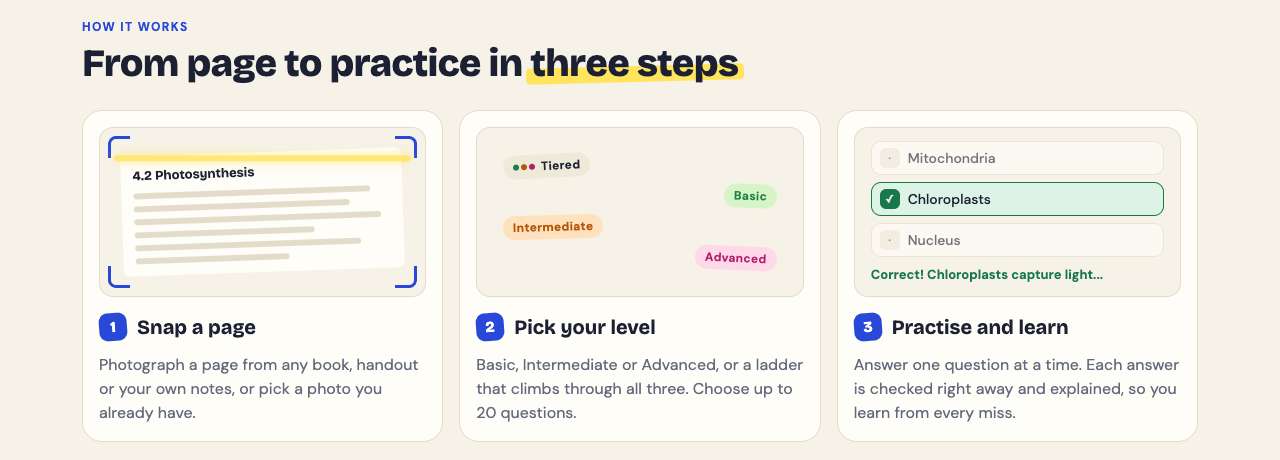
That is where Study Shot, a web app, fits. You photograph a page from your textbook, notes or a whiteboard, and an AI model writes multiple-choice questions about it. You get 10 questions by default, or you can pick 5, 15 or 20. Each one has four choices and one right answer.
Here is a worked example. Say you are revising a biology page on photosynthesis.
- Open Study Shot in your phone or computer browser and choose Make a new quiz, then Take photo. Hold the page flat and fill the frame.
- Pick 10 questions and leave the level on Tiered. Tiered is a ladder: basic questions first, then intermediate, then advanced.
- Press Create questions. It can take up to a minute.
- For each question, read the question line only. Close your eyes. Say your answer in your head. Then open your eyes, pick the matching option, and press Check answer.
- Read the explanation, even when you get it right. It tells you why, in one to three sentences.
If a question leaves you completely blank, you can tap Show page during the quiz to see your photo again. Try the eyes-closed attempt first, though. The effort of searching is part of what makes the memory stronger.
At the end, the results screen shows your score for each level and a Look at these again list of the questions you missed, with your answer and the right answer. That list is your plan for tomorrow. Your quiz is saved to your library, so you can press Retake quiz and do the same eyes-closed routine on it.
The questions are written by AI, so they can contain mistakes. The explanation helps you check each answer against your page, and you can use Report a problem with this question if one looks wrong.
Two more techniques work well alongside this. Sketching while you learn can help some material stick, as we covered in does doodling help you remember what you study. And a simple color system in your notes gives you a visual layout that is easier to picture with your eyes closed. See does color coding your notes help you remember for what works and what does not.
Frequently asked questions
Does closing your eyes help you memorize faster?
Not directly. The research shows a benefit when you recall something, not when you first learn it. Use eye closure during self-testing, where each successful recall makes the memory stronger.
Is it better to close your eyes or look at a blank wall?
In two eyewitness studies, a blank screen worked about as well as closed eyes. A blank wall or your desk is a good choice if closing your eyes makes you drowsy or would look odd in an exam room.
Can closing your eyes help during a test?
The studies did not test exams, but the same idea applies: pause for a few seconds with your eyes closed or on your desk, picture where you studied the topic, then answer. It will not help if you never learned the material.
Get started: build daily recall practice with Study Shot
Closing your eyes is a small habit that helps you reach for answers. It works best when you give yourself plenty of chances to reach. A short daily quiz on the page you just studied gives you those chances, and your library keeps every quiz ready to retake with your best score.
Study Shot runs in your browser on a phone or a computer, and quizzes come in 50 languages. You need an account to use it, and it is free to start.
Try Study Shot: it is free to start. Photograph the page you are studying tonight and get 10 practice questions on it, from basic to advanced.
Comments
No comments yet.
Sign in or make an account to comment.