Does Doodling Help You Remember What You Study? The Research
Does doodling help you remember what you study? In the controlled studies we could find, doodling that has nothing to do with the material did not help, and free-form doodling often made recall worse. Drawing the material itself is a different habit, and it did help. This post walks through what four studies found, when to put the doodle down, and how to turn a page of sketches into review that sticks.
Does doodling help you remember what you study? The short answer
The popular idea is that doodling keeps a bored mind from wandering, so you catch more of a dull lecture. Recent studies have tested that idea directly, and it mostly did not hold up. Doodling did not lower boredom, did not raise attention, and did not improve recall compared with taking notes.
Drawing the ideas you are learning is another story. When people drew the words or terms they had to learn, they remembered more than when they wrote or copied them. So the honest answer has three parts:
- Idle doodling, shapes and patterns unrelated to the lesson, did not help in these studies, and detailed free doodling hurt.
- Drawing the material, a sketch of the cell, the process or the term, helped recall, even weeks later.
- Testing yourself afterwards is what makes what you learned last.
What the research says about doodling during a lecture
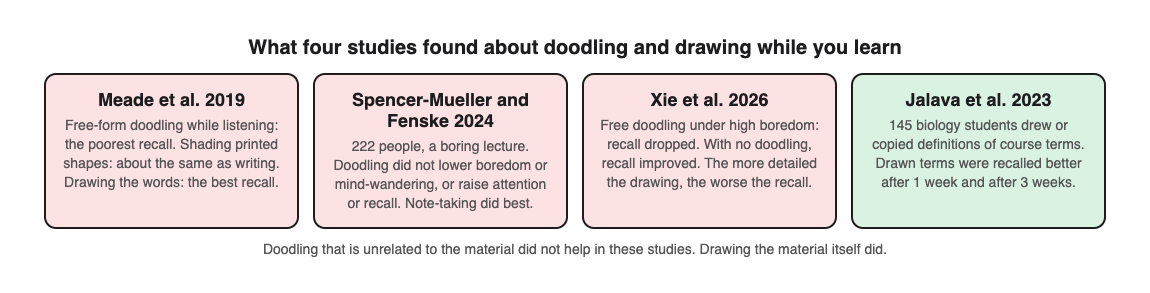
In 2019, Meade, Wammes and Fernandes ran three experiments where people listened to words, either in a list or inside a story. While listening, they either doodled freely, drew a picture of each word, or wrote each word out. Free-form doodling led to the poorest recall in both of the first two experiments. In a third, people shaded in printed shapes instead, a structured doodle, and recalled about as much as people who wrote. Drawing the words gave the best recall each time.
In 2024, Spencer-Mueller and Fenske tested the boredom idea head on, with 222 people across two experiments. People listened to a lecture section chosen because it is boring, for 15 minutes in the first experiment and 45 in the second. Some doodled, structured or free, some took notes, and some only listened. Across both studies, doodling did not reduce boredom or mind-wandering, and it did not improve attention or recall. The note-takers had the highest attention and test scores, and the least boredom.
A 2026 study by Xie and colleagues adds one more detail. People who doodled freely while very bored recalled less, and the more complex and polished their drawings became, the worse their recall was.
Doodling vs. drawing to learn: why drawing the material works
The same research group that found costs for doodling found benefits for drawing. The difference is what the pen is doing. A doodle is unrelated to what you are learning. A drawing of the idea forces you to work with the idea.
The strongest classroom evidence comes from a 2023 study by Jalava, Wammes and Cheng. In the tutorials of an introductory biology course, 145 students either drew or copied definitions of terms from the course textbook, with no training in how to draw. One week and three weeks later, they were shown the definitions and asked for the terms. Drawn terms were recalled better at both points.
To draw an idea, you have to:
- Think about what it means, not only what it is called.
- Choose which parts matter enough to show.
- Turn words into a picture, which gives you a second way back to the idea.
You do not need to be good at art. The biology students had no scaffolding, and the Xie study suggests that polishing a drawing is where the cost begins. If you like visual notes, our post on whether mind mapping helps you study looks at the research on diagrams that link ideas.
When to put the doodle down
The studies above point to a few clear signs that the pen is costing you:
- The doodle is getting detailed. Detail went with lower recall. If you are shading a dragon's scales, your attention has moved to the dragon.
- The lesson is on screen. If the lecture depends on slides or diagrams, eyes on your own page means you miss them.
- You are bored. This is exactly when people reach for the pen, and it is when free doodling hurt recall in the 2026 study. Taking notes beat doodling in the 2024 lecture study.
- You cannot say what was just said. If you could not explain the last two minutes right now, swap the doodle for a note.
How to turn doodling into drawing that helps
You do not have to give up the pen. Change what it draws. Here is a simple routine for a lecture or a chapter.
- Take notes first. Write the key point in a few words. Notes beat doodling in the lecture study.
- Add one small sketch per key idea. A stick figure pushing a box for force, a cell with the chloroplasts marked, a timeline with three dates.
- Label it in your own words. One or two labels and a short caption. The caption holds the meaning; the drawing is the hook.
- Keep it rough. Stop as soon as the sketch shows the idea. Polishing is doodling again.
- Redraw from memory later. Cover the page and sketch the idea again. What you cannot redraw is what you do not know yet.
If you study in timed blocks, a short sketch-and-redraw round fits at the end of a block. Our post on whether studying with a timer helps you focus covers how to set those blocks up.
Pairing your sketches with practice tests
Drawing helps you take an idea in. It does not tell you whether you can get it back out a week later. For that, you need to test yourself. In a 2006 study by Roediger and Karpicke, students who took recall tests on a passage remembered more of it two days and one week later than students who reread it, even though rereading made them feel more confident.
That makes a page of sketches useful twice: once when you draw it, and again when you quiz yourself on it. Here is one way to do that with Study Shot, a web app that turns a photo of a page into a multiple-choice practice quiz. It runs in the browser on your phone or computer.

A worked example: a biology page with your sketches
Say your notes on photosynthesis include a rough drawing of a plant cell, with the chloroplast, nucleus and cell wall labelled and a one-line caption for each.
- That evening, open Study Shot, choose Make a new quiz, then Take photo. Hold the page flat and fill the frame. The app says textbooks, notes, diagrams and whiteboards all work. You can also Choose photo if you already took one.
- Choose 10 questions, the default. You can pick 5, 10, 15 or 20.
- Keep the level on Tiered, a ladder from basic to advanced. Basic sticks to key terms, facts and definitions. Advanced asks you to apply and predict in new situations.
- Press Create questions. It can take up to a minute.
- Before you start, cover your page. Answer each question from memory, then press Check answer to see whether you were right, the correct answer and a short explanation. Show page brings your photo back, but use it only after you answer.
The results screen shows your score for each level and a Look at these again list of the questions you missed, with your answer and the right answer. Each miss points to a part of your sketch to redraw from memory. Then press Retake quiz in a day or two. The quiz stays in your library with its page photo and your best score.
Multiple choice asks you to recognise an answer. Your redraw-from-memory step is the recall half, so keep both.
One caution. The questions are written by an AI model and can contain mistakes. The explanation under each answer helps you check it against your notes and textbook, and you can use Report a problem with this question under a question that looks wrong.
Frequently asked questions
Is doodling during lectures bad for focus?
In a 2024 study of 222 people listening to a boring lecture, doodling did not lower mind-wandering or raise attention, and note-takers did best. Free, detailed doodling has also been linked to lower recall.
Do you need to be good at art for drawing to help memory?
No. Biology students who drew course terms with no training remembered them better a week and three weeks later. In another study, more detailed drawings went with worse recall, so keep sketches rough.
Is shading in shapes better than free doodling?
In one study, shading printed shapes led to about the same recall as writing the words, while free doodling led to the poorest recall. Neither beat drawing the words themselves.
Does doodling help people with ADHD concentrate?
The studies in this post did not test people with ADHD, so they cannot answer that. If you find a pen helps you listen, check yourself by trying to explain the last few minutes of the lecture, and ask your doctor or school's learning support for advice that fits you.
Get started
Swap idle doodles for rough drawings of the ideas, then test yourself so each drawing does its job a second time. A photo of tonight's notes page is enough to start.
Try Study Shot: it is free to start. Photograph a page of your notes and sketches and get 10 practice questions on it, from basic to advanced.
Comments
No comments yet.
Sign in or make an account to comment.