Does Exercise Before Studying Help You Learn? The Evidence
Does exercise before studying help you learn? A little, according to the research, and the timing matters more than most advice admits. A short workout before you sit down gave a small memory boost across dozens of experiments. Exercising while you study did not help. This post sets out what the reviews found, what they cannot tell you, and a 10-minute routine that pairs a walk with the study method that does most of the work.
Does exercise before studying help you learn? The short answer
Yes, modestly. Researchers call a single session of exercise "acute exercise", and two meta-analyses (studies that pool many experiments) found that acute exercise before learning improved memory for what was learned next. The effects were small to moderate. Exercise during learning did not help, and in one review it slightly hurt.
So treat exercise as a warm-up, not a study method. What you do after the walk still matters most.
What the research found about exercise and memory
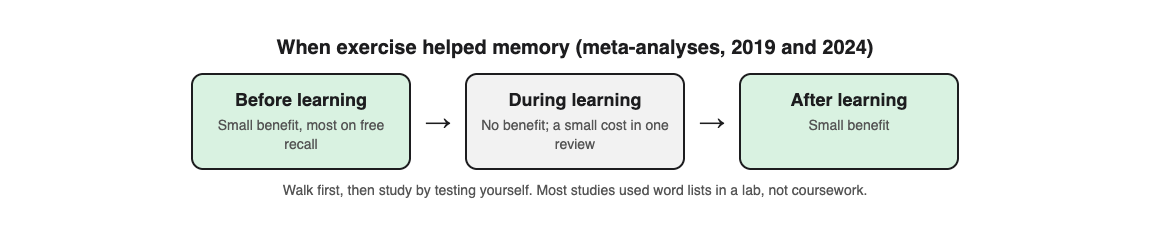
A 2024 meta-analysis of 42 experiments compared exercise before, during and after learning:
- Before learning: a small benefit overall. It showed most on free recall, where you write down what you remember with no prompts, and hardly at all on recognition tests, where you pick the right answer from options.
- During learning: no effect.
- After learning: a small benefit, strongest on recognition.
An earlier meta-analysis of 25 articles found the same shape: exercise before learning helped, exercise during learning had a small negative effect, and exercise some time after learning helped too. In that review, vigorous exercise and young adults showed larger effects before learning.
Intensity is less clear. A review of nine studies suggested that before a task, hard exercise may help memory for events and facts but may be less good for working memory, the kind you use to hold a few things in mind while solving a problem.
What the studies cannot tell you
Three honest limits. First, most of these experiments test memory for word lists or short events in a lab, not a chapter of coursework, so "better grades" is a guess the studies do not test. Second, the effects are small; the 42-experiment review measured an overall effect of 0.23 standard deviations before learning. Third, results varied with age, type of exercise and when the memory test came, so your own results may differ.
The study method you use after the walk makes a much bigger difference. In a classic 2006 study, students who tested themselves on prose passages remembered much more a week later than students who reread them.
How much exercise before studying, and when
The reviews pooled many kinds of exercise, so there is no single proven dose. A sensible starting point, based on what is easy to repeat:
- Before: 10 to 20 minutes of brisk walking, cycling or stairs, then start studying soon after.
- During: do not study on a treadmill or bike. The reviews found no gain during learning, and one found a small cost.
- Between blocks: a few minutes of walking is a fine break; see do short breaks help you study better.
- After: an evening walk after studying is harmless and may help, as both reviews found some benefit for exercise after learning.
A 10-minute pre-study routine you can try today
- Minutes 0 to 7: brisk walk. Fast enough that your breathing picks up.
- Minutes 7 to 9: recall on the move. Slow down and list what you remember from last time, with no notes. Notice the gaps.
- Minute 9 to 10: set up. Sit down, phone on silent, and open the one page you will work on.
- Then: test, do not reread. Answer questions on that page before you read it again.
Step 4 is where Study Shot fits. It turns a photo of a page into a multiple-choice practice quiz. Say you are studying a biology page on cell respiration tonight. After your walk:
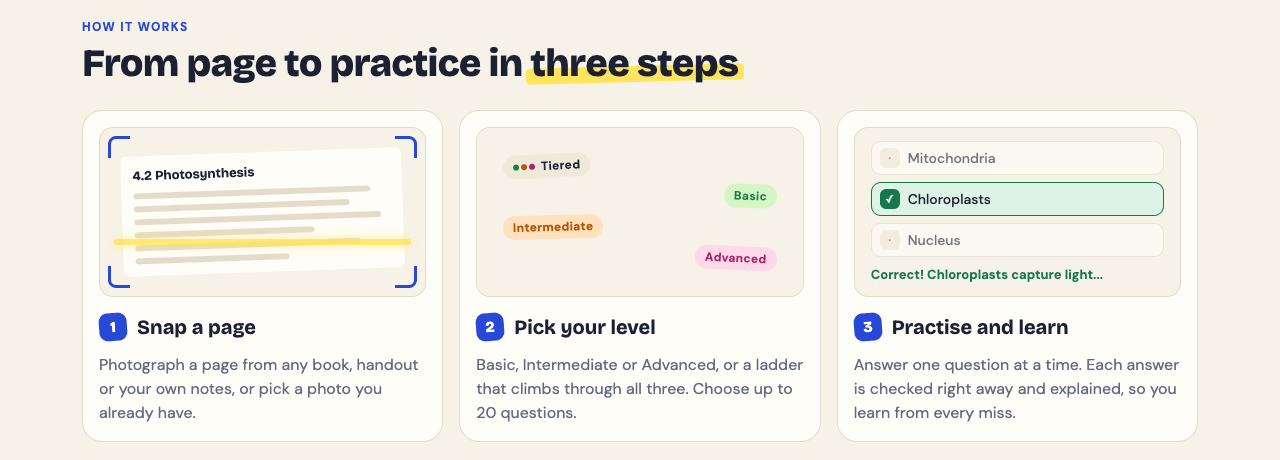
- Tap Make a new quiz, then Take photo. Hold the page flat and fill the frame.
- Pick 10 questions and leave the level on Tiered, which climbs from basic to intermediate to advanced, split as evenly as possible.
- Press Create questions. It can take up to a minute.
- Answer one question at a time. Press Check answer and read the explanation after each one, right or wrong.
The results screen shows your percentage, a grade, a score for each level, and a Look at these again list with every miss. The quiz is saved in your library with its page photo and your best score, so tomorrow you can walk again and press Retake quiz. The questions are written by an AI model and can contain mistakes, so check the explanation and use Report a problem with this question if one looks wrong.
Because the benefit of exercise before learning showed most on free recall, add one paper step too: after the quiz, close the page and write down the main points from memory.
Try it on yourself for a week
Because the effect is small and varies from person to person, the best test is your own. Here is a simple way to run it over one week of normal homework:
- Pick six similar pages from the same subject, one for each study day.
- On three of the days, take your 10-minute walk first. On the other three, start studying straight away. Mix the order, so walk days are not all at the start of the week.
- Each day, make a 10-question Tiered quiz from that day's page and answer it after 20 minutes of study.
- Two days later, retake each quiz before looking at the page, and write down the score.
Compare the retake scores for walk days and no-walk days. Six days is far too few to prove anything, so look for a clear pattern rather than a point or two. If walking first makes you more willing to sit down and start, that alone may be worth keeping.
Frequently asked questions
Does exercise before studying help you learn?
A little. Two meta-analyses found a small to moderate memory benefit from exercise before learning, and none from exercising while learning.
Can I study while walking on a treadmill?
The reviews found no benefit from exercise during learning, and one found a small cost. Walk first, then sit down to study.
Is a hard workout better than a walk before studying?
One review found larger effects for vigorous exercise before learning, and another suggested hard exercise may be less good for working memory. A walk is the easier habit to keep.
Does exercise after studying help?
Both meta-analyses found some benefit from exercise after learning, so an evening walk after a study session may help it stick.
Get started
Try Study Shot: it is free to start. Photograph the page you are studying tonight and get 10 practice questions on it, from basic to advanced.
Comments
No comments yet.
Sign in or make an account to comment.