Does Mind Mapping Help You Study? What the Research Shows
Does mind mapping help you study? The research gives a mixed answer. One small study found a modest recall benefit after a week, another found no difference from ordinary notes, and a well-known experiment found that practising recall beat building concept maps. This post sets out those findings, when a map is worth your time, and how to pair it with practice that builds memory.
Does mind mapping help you study? The short answer
Maybe a little, and it depends how you use it. The studies below do not show that a map on its own makes ideas stick, but building one from memory and then testing yourself combines two useful steps.
A mind map makes you decide what matters, what belongs under what, and how two ideas link. But looking at a finished map is a lot like rereading notes: everything looks familiar, and familiar is not the same as recalled.
So treat a mind map as a tool for building your picture of a topic. Then use a different tool to check that picture is in your head and not just on the paper.
What a mind map is and how it differs from linear notes
A mind map puts one central topic in the middle of the page. Main branches come off it for the big subtopics. Smaller branches carry details, examples and keywords. You use short phrases, not full sentences, and often colour or small drawings.
Linear notes run top to bottom, in the order you heard or read them. A link between point 3 and point 14 is easy to miss.
A close cousin is the concept map. It also uses boxes and lines, but each line has a label, such as "causes" or "is part of". One of the studies below tested concept maps, not mind maps, so keep that difference in mind.
What the research says about mind maps, recall and understanding
The evidence is mixed, and the details matter.
- A modest benefit after a week. In a 2002 study of 50 medical students, those trained to mind map a 600-word passage recalled about 10% more facts a week later than students who used their own methods. The range of likely results ran from slightly worse to clearly better, and the mind map group felt less motivated by the technique.
- No difference from ordinary notes. In a 2010 study of 131 first-year medical students, mind mapping and standard note-taking gave similar quiz scores and similar critical thinking scores. The authors noted that students new to mind maps were at least not put at a disadvantage.
- Recall practice beat concept mapping. In a 2011 experiment with science texts, students who practised recalling the text learned more than students who built concept maps, including on questions that required inferences, and even when the final test was to draw a concept map. The paper drew a published comment, and the debate over mapping continues.
So the evidence for mind maps alone is small and mixed, while the evidence for pulling information out of memory is stronger. The practical answer is to use both: let the map build structure, and let recall do the remembering.
When mind mapping works best and when it falls short
It works best when
- The topic has lots of connected parts. History causes, a novel's themes, body systems in biology, or the parts of a business plan.
- You are starting a new unit. A first map shows you the shape of the topic and where the gaps are.
- You build it from memory. Close the book, draw what you remember, then open the book and add what you missed in a different colour. This turns the map into a recall exercise.
- You are planning an essay. Maps are good for grouping arguments before you write.
It falls short when
- The material is a fixed sequence. Steps in a proof or a lab method read better as a numbered list.
- You copy the textbook into branches. That is rereading with extra steps.
- You spend most of the time on colours and drawings. Decoration feels productive, but it is time away from the content.
- You never test yourself on it. A beautiful map you only look at will fade fast.
How to make a study mind map in five steps
Here is a worked example. Say you are studying photosynthesis for a biology test.
- Write the topic in the centre. "Photosynthesis". Keep it to one or two words.
- Add four to six main branches from memory. Before you open the book, try: "Where it happens", "Inputs", "Outputs", "Light reactions", "Calvin cycle", "Limiting factors". Do not look anything up yet.
- Fill in details you can recall. Under "Where it happens", write "chloroplasts" and "thylakoids". Under "Inputs", write "CO2, water, light". Use keywords, not sentences.
- Check the source and fix gaps in a second colour. Open your notes. Add what you missed in red. Those red words are your weak spots, and they tell you what to review first.
- Draw links across branches. Connect "Limiting factors" to "Light reactions" with a line and write why. Cross links are where the real understanding shows up.
Aim for one page per topic. If it spills over, split it into two maps.
Pair mind maps with retrieval practice and spaced review
Once you have a map, quiz yourself on it, more than once and with gaps in between. Our post on retrieval practice explains why testing beats rereading, and spaced repetition for exams gives a schedule.
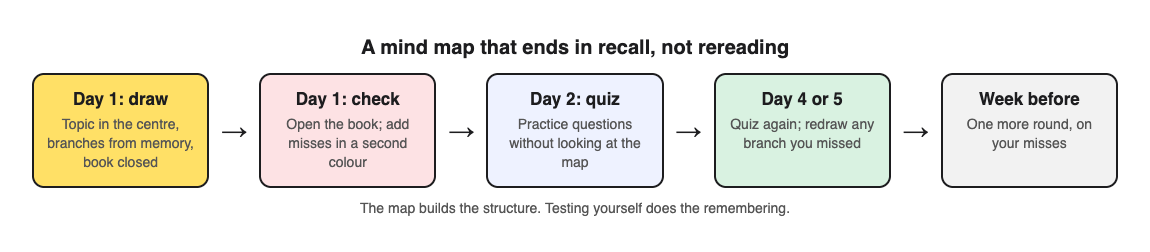
A simple routine:
- Day 1: build the map from memory, then fix it from the book.
- Day 2: answer practice questions on the topic without looking at the map.
- Day 4 or 5: answer questions again. Redraw any branch you got wrong.
- The week before the test: one more round of questions, focused on your misses.
Writing good questions for yourself takes time. This is where Study Shot fits. You take a photo of a page, and it writes multiple-choice questions about it, checks your answers and explains each one. Its own photo tips say that textbooks, notes, diagrams and whiteboards all work, so a hand-drawn mind map is a fair thing to try. Hold the page flat and fill the frame.
A worked example with your photosynthesis map:
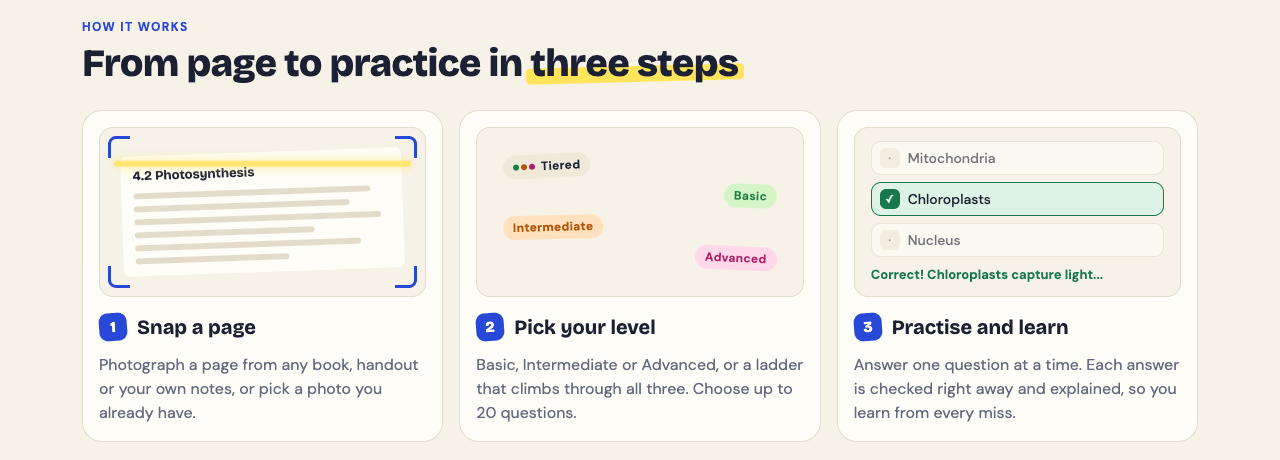
- Open Study Shot in your phone or computer browser and choose Make a new quiz, then Take photo or Choose photo.
- Pick 10 questions (the default) or up to 20.
- Pick a level. Tiered is the default and climbs from basic to advanced. Basic covers key terms and definitions. Intermediate asks you to explain, compare and connect ideas. Advanced asks you to apply and predict in new situations. For a mind map, Intermediate lines up well with the cross links you drew.
- Press Create questions and answer one question at a time. Each answer is checked right away with a short explanation.
The results screen shows your score for each level in the quiz, so you can see whether you know the terms but struggle to connect them. A Look at these again list shows each missed question with your answer and the right answer. Those misses tell you which branches to redraw. The quiz is saved to your library with your best score, so you can come back on day 4 and press Retake quiz for spaced review.
Two honest notes. The questions are written by an AI model and can contain mistakes. The explanation under each answer helps you check, and you can use Report a problem with this question if one looks wrong. Also, a map with only a few words gives little to ask about, so photograph the textbook page it came from as well.
You can use Share this quiz to send a link to a study group. Each person needs a Study Shot account and gets their own copy of the questions, without your photo.
Build your next map from memory, fix the gaps from the book, then test yourself on it a few days apart.
Frequently asked questions
Is mind mapping better than taking notes?
The two studies above disagree: one found a modest recall benefit after a week, the other no difference. Whichever you use, follow it with practice questions.
Are hand-drawn or digital mind maps better for studying?
The studies in this post did not compare them. Digital maps are easier to edit; paper is quicker to photograph for a quiz. Pick the one you will actually build from memory.
Does mind mapping work for maths and science?
A map can show how the concepts in a science topic relate. For maths methods and step-by-step procedures, keep working practice problems on paper.
How long should a study mind map take to make?
No study sets a time. If it takes much longer than reading the section did, you may be copying the textbook or decorating, so spend the extra time on self-testing instead.
Get started
Try Study Shot: it is free to start. Photograph the page you are studying tonight and get 10 practice questions on it, from basic to advanced.
Comments
No comments yet.
Sign in or make an account to comment.