Does Reading Out Loud Help You Remember? What Science Says
Does reading out loud help you remember? Yes, for a specific kind of material and when you use it on purpose. Research on what psychologists call the production effect shows that words you say aloud are remembered better than words you read silently. The catch is that the boost comes from contrast. If you read everything aloud, much of the advantage goes away. This post explains what the studies found, why it works, where it fails, and how to build it into a study session that also tests you.
Does reading out loud help you remember? The short answer
Reading aloud helps you remember the specific parts you say aloud, compared with the parts you read silently. It works best on short, key items: definitions, terms, formulas, a list of steps. It works less well when you read whole chapters aloud, and it is weaker than testing yourself.
So treat it as a highlighter you use with your voice. Pick the few lines that matter, say those out loud, and read the rest quietly.
The production effect: what the research found
In a set of eight experiments published in 2010, people studied lists of words. A cue told them to say some words aloud and read others silently. On a later memory test, they recognised the spoken words better. Mouthing the words without sound also worked.
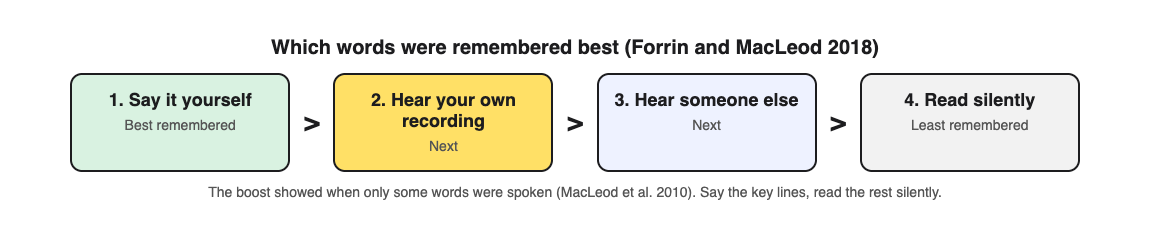
One finding matters a lot for how you study. In those experiments, the benefit showed up only when spoken and silent words were mixed in the same list. When one group read everything aloud and another read everything silently, it did not appear.
A 2018 study compared four ways to take in words: reading aloud yourself, hearing a recording of yourself, hearing someone else, and reading silently. Memory followed that order, best to worst. And a 2026 study found that even getting ready to say a word, without saying it, helped a little. Keep in mind that most of this research uses word lists and recognition tests, not textbook chapters.
Why saying words aloud makes them stick
The leading explanation is distinctiveness. When you say a word, you add extra features to the memory. You move your mouth. You hear your own voice. You make a small decision that this item is worth speaking. Later, when you try to remember, you can use those features as a clue: "I remember saying that one."
That also explains the catch above. A feature only helps if it sets an item apart. If every line in your notes was spoken, "I said it" no longer separates the important line from the filler. The voice becomes background.
When reading aloud helps and when it backfires
It tends to help when:
- You are learning short items you must recall word for word, like vocabulary, definitions, or the name of a process.
- You choose a small share of the page to say aloud, so those lines stand out.
- Your attention drifts during silent reading and you need something to keep you on the line.
It tends to backfire when:
- You read a full chapter aloud. It is slow, tiring, and the distinctiveness boost fades.
- You focus on how it sounds rather than what it means. Fluent speech can feel like understanding when it is not.
- You treat it as the whole study session. Saying something correctly while looking at it does not prove you can produce it later without the page.
That last point is the big one. Reading aloud is still a way of taking information in. Exams ask you to get information out.
Reading aloud vs. other study methods like self-testing and teaching others
Self-testing, also called retrieval practice, means closing the book and answering from memory. In a classic 2006 study, students who tested themselves on prose passages remembered much more two days and a week later than students who reread them, even though rereading made them feel more confident. Reading aloud helps you take lines in; testing trains getting them out. Testing should get more of your time.
Teaching someone else sits close to both. You speak out loud, so you get some production benefit, and you also have to explain ideas without leaning on the page. If that interests you, see what research shows about teaching someone else.
A useful way to rank them for exam prep: read the page once, say the key lines aloud, then spend most of your remaining time answering questions about it. Explaining the topic to a friend is a strong extra step if you have one available.
How to use reading out loud in your study sessions
Here is a workflow you can run on a single page of notes in about 20 minutes. Say you are studying a biology page on photosynthesis.
- Read silently first. Get the overall idea of the page. Do not underline yet.
- Pick five to eight lines. Choose the definitions and facts you must know, such as "Photosynthesis takes place in the chloroplasts." Mark them.
- Say only those lines aloud. Speak at a normal volume, slowly. Say each one twice. Leave the rest of the page silent so the spoken lines stand out.
- Cover the page and test yourself. Ask, "Where does photosynthesis happen?" and answer from memory. If you are stuck, look, then try again later.
- Test again on a different day. Come back two or three days later and answer the same questions before you look.
Step 4 is where most students fall short, because writing good questions for yourself takes time. That is where a quiz tool can help.
Study Shot turns a photo of a page into a multiple-choice quiz. You photograph the page from your textbook, notes or a whiteboard, and an AI model writes questions about it, 10 by default and up to 20. Each question has four choices. After you pick one and press Check answer, the app tells you if you were right, shows the correct answer, and gives a short explanation.
For the photosynthesis page, the sequence looks like this:
- Read the page and say the key lines aloud, as above.
- Open Study Shot in your phone or computer browser, choose Make a new quiz, then Take photo. Hold the page flat and fill the frame.
- Choose 10 questions and leave the level on Tiered. Tiered is a ladder: basic questions first, then intermediate, then advanced.
- Press Create questions and answer one at a time, without looking at your notes.
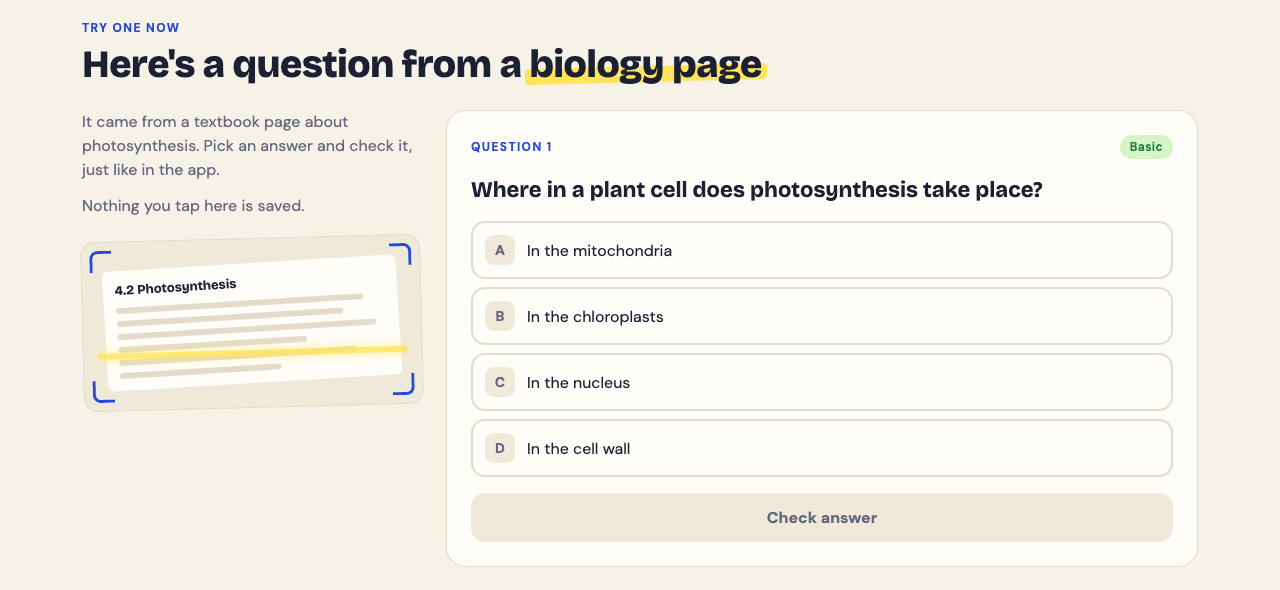
The levels line up well with the read-aloud step. Basic questions cover key terms, facts and definitions, which are exactly the lines you spoke. Intermediate asks you to explain, compare and connect ideas. Advanced asks you to apply and predict in new situations, which reading aloud alone does not train.
On the results screen you get a score for each level and a list called Look at these again with the questions you missed. Those missed items are good candidates for your next round of read-aloud lines. Quizzes are saved in your library with the page photo and your best score, so you can retake the same one a few days later for spaced practice.
A word of caution: the questions are written by an AI model and can contain mistakes. Use the explanation to check against your page, and if a question looks wrong, use Report a problem with this question.
If you already snap photos of the board in class, you can feed those in too. Taking photos of the whiteboard only helps if you do something with the photo later, and quizzing yourself on it is one of the most useful things you can do.
Frequently asked questions
Is it better to read silently or out loud to memorize?
For the key items you need to memorize, reading aloud usually beats silent reading. The best results come from saying only the important lines aloud and reading the rest silently, then testing yourself.
Does mouthing the words work if I cannot speak aloud?
In the 2010 experiments, mouthing words without sound also improved memory compared with silent reading. In a library, mouthing the key lines is a fair substitute.
Should I read my whole textbook out loud?
No. Reading everything aloud is slow, and the memory boost shrinks when nothing stands out. Save your voice for definitions, key facts and steps you must recall exactly.
Does reading out loud help with exams and long-term retention?
It helps you encode key items, but on its own it is not enough for exams. Pair it with self-testing spread across several days, which builds the recall that exams require.
Get started
Try Study Shot: it is free to start. Photograph the page you are studying tonight and get 10 practice questions on it, from basic to advanced.
Comments
No comments yet.
Sign in or make an account to comment.