Does Sleeping After Studying Help You Remember? The Science
Does sleeping after studying help you remember? The studies say yes, with some limits worth knowing. Sleep soon after learning helped students keep vocabulary, and sleeping between two study sessions made the second session shorter. Here is what five studies found, where they stop, and an evening and morning routine that puts them to work.
Does sleeping after studying help you remember? The short answer
Yes, for the kinds of material these studies used. The clearest results are for facts and vocabulary that students studied and then slept on within a few hours.
Sleep does not replace studying. It works on what you already put in. So the useful question is not only "should I sleep?" It is "what should I do before I sleep, and what should I do when I wake up?"
What the research shows about sleep after learning
In a 2006 study, Steffen Gais and colleagues tested high school students learning vocabulary. Memory was better when sleep followed within a few hours of learning. That held whatever the time of day and with the same amount of distraction in between. Students who missed a night of sleep remembered less, and the loss was still there after a night of recovery sleep.
A 2016 study by Stéphanie Mazza and colleagues looked at relearning. Forty people practised foreign vocabulary until they got it all right, then practised again 12 hours later. Half learned in the morning and relearned that evening. The other half learned in the evening, slept, and relearned the next morning. The group that slept needed half as much practice the second time, and remembered much more a week later and six months later.
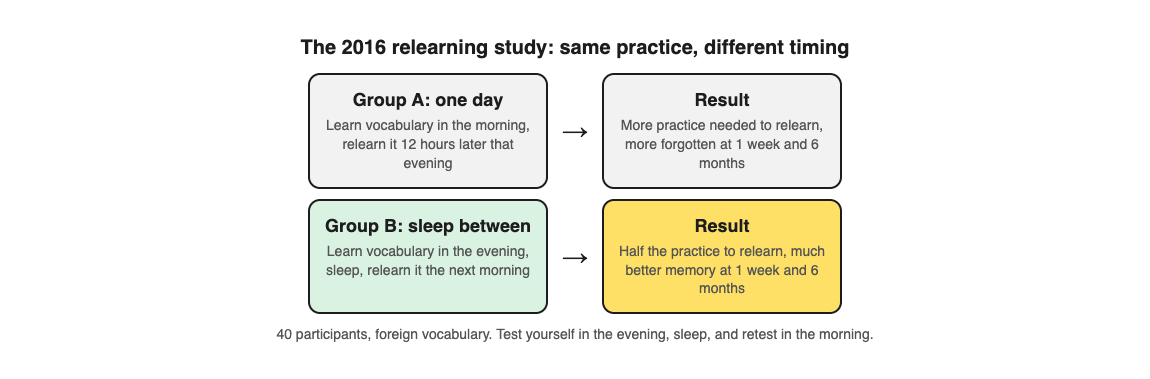
The authors put it simply: sleeping after learning is a good strategy, and sleeping between two learning sessions is a better one.
What sleep before studying does
Sleep matters on the other side of a study session too. In a 2007 brain imaging study, Seung-Schik Yoo and colleagues found that one night without sleep lowered activity in the hippocampus, a brain area that helps form new memories, while people learned. They also remembered less later.
So an all-nighter costs you twice. The material you study late at night does not get a night of sleep after it, and the next day you are worse at taking in anything new.
Where the research stops
These findings are easy to overstate, so here are their limits.
- The material was simple. The sleep studies above used vocabulary and pictures, not a full chapter of biology or a page of proofs.
- One night is not the whole story. A 2019 study gave activity trackers to 88 students in a college chemistry class. Better, longer and more regular sleep went with better grades. But sleep on the single night before a test showed no link. Sleep across the week and month before did. This was a correlation, so it shows a link, not a cause.
- Naps are not a full fix. A study of 58 teenagers on short sleep compared 6.5 hours at night with 5 hours at night plus a 90-minute afternoon nap. The nap group remembered more of what they learned in the afternoon, and no less of what they learned in the morning. The authors say this does not replace enough sleep at night.
The fair reading: sleep soon after study helps you keep what you learned, and steady sleep over weeks matters more than one perfect night before the exam.
Make sleep work for you: test before bed, retest in the morning
The Mazza study gives a simple pattern. Learn in the evening, sleep, then practise the same material again in the morning. Testing yourself is a good way to do both sessions, because it shows you exactly what stuck.
Here is a worked example with one page of notes.
Evening: test yourself (about 20 minutes)
- Pick the one page that matters most tonight. Read it once, then turn it over and write down the main points from memory. Check them against the page.
- Open Study Shot in your phone's browser. Choose Take photo or Choose photo, hold the page flat and fill the frame. Textbooks, notes, diagrams and whiteboards all work.
- Keep the default of 10 questions (you can pick 5, 10, 15 or 20) and the Tiered level, which climbs from basic to advanced. You can also pick the quiz language: questions, answers and explanations come in 50 languages. Press Create questions; it can take up to a minute.
- Answer one question at a time. Check answer shows Correct! or Not quite., the right answer and a short explanation. Show page brings up your photo if you need it.
- On the results screen, read Look at these again, which lists your misses with your answer and the right one. Then stop. Do not start a new subject.
Morning: retest (about 10 minutes)
- Write the main points from memory again before you open anything.
- Open the quiz from your library, where it is saved with the page photo and your best score, and press Retake quiz.
- Compare scores. Grades run from Needs another try (below 50%) through Getting there and Good to Mastered (90% and up). The score for each level tells you whether you are missing basic facts or the harder questions.
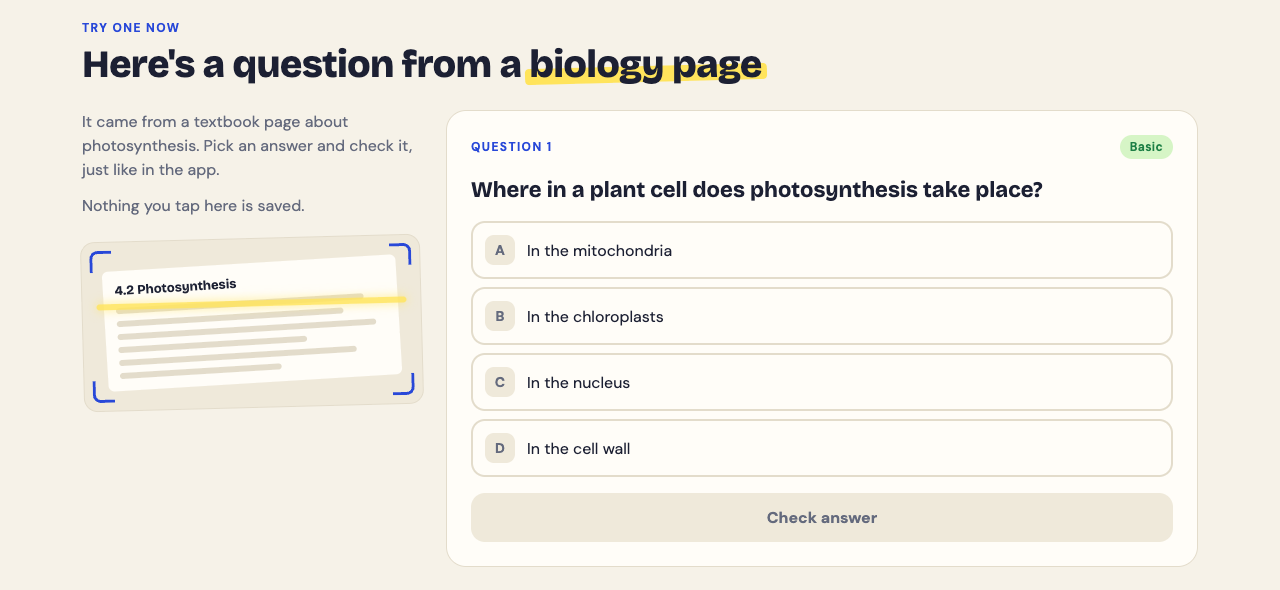
The questions are written by an AI model and can contain mistakes. The explanation helps you check each answer against your page, and if a question looks wrong, use Report a problem with this question.
For more on how timing affects studying, see does exercise before studying help you learn.
Frequently asked questions
Is it better to study right before bed?
In one study, memory was better when sleep came within a few hours of learning, whatever the time of day. So a review session in the evening, followed by sleep, fits the research well.
Does one good night before the exam make up for a bad week?
Not on the evidence so far. In a college chemistry class, sleep in the week and month before a test went with grades, and sleep on the single night before did not.
Do naps after studying help?
In a study of teenagers on short sleep, an afternoon nap helped them remember what they learned later that day. The authors say a nap does not replace enough sleep at night.
Is an all-nighter ever worth it?
The research points against it. A night without sleep lowered memory for what people learned the next day, and missing sleep after learning lowered memory for what came before.
Get started
Try Study Shot: it is free to start. Photograph the page you are studying tonight and get 10 practice questions on it, from basic to advanced.
Comments
No comments yet.
Sign in or make an account to comment.