Does Studying in Short Bursts Beat Long Sessions? The Research
Does studying in short bursts beat long sessions? It depends on what you mean by short. If it means spreading your study time across several days instead of one long sitting, the research is strong and clear: spread it out. If it means a 20-minute session against a 60-minute one on the same evening, the evidence is much thinner. This post separates the two questions, shows where the research stops, and gives you a plan you can follow this week.
Does studying in short bursts beat long sessions? Two questions in one
When students ask about short bursts, they usually mix up two different things:
- Spacing: studying the same material on several days, with gaps between, instead of all at once. This is what most memory research tests.
- Session length: how long you sit in one go before a break. This is what timers and study apps argue about.
Spacing has decades of research behind it. Session length on its own has a handful of recent studies with mixed results. A plan built on spacing will help you whether your sessions are 20 minutes or 50.
What the research says about spreading study out
In 2006, Cepeda, Pashler, Vul, Wixted and Rohrer pooled the research on spaced practice for verbal learning: 839 assessments from 317 experiments in 184 articles. They compared massed study, all in one go, with spaced study, and found that the gap giving the best retention grew as the time until the final test grew.
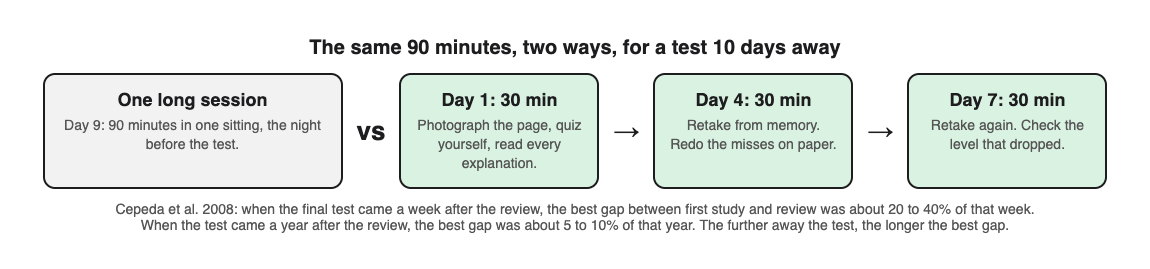
Two years later the same group ran one large study to map that relationship. More than 1,350 people learned a set of facts, got a review after a gap of up to 3.5 months, and took a final test up to a year later. For a test one week after the review, the best gap was about 20 to 40% of that week. For a test one year after, the best gap was about 5 to 10% of that year. Gaps that were too short or too long both did worse.
The practical lesson is simple: the same total time, split across days, beats one long sitting, and the further away your test, the bigger your gaps can be. Our post on spaced repetition for exams turns this into a review calendar.
Why testing yourself matters more than how long you sit
Spacing is half the picture. What you do in each session is the other half. In a 2006 study by Roediger and Karpicke, students read prose passages and then either reread them or took recall tests. Rereading did better on a test five minutes later. Testing did much better two days and one week later, even though rereading made students feel more confident.
So a short session spent rereading is still rereading. The shortness is not what helps. A short session where you answer questions from memory, then check, is the version the research supports.
What we know about session length and breaks
The direct evidence on session length is thinner. In our post on whether studying with a timer helps you focus, three recent experiments compared timed short breaks with breaks students chose themselves. Mood and fatigue went different ways across the studies, and none found a difference in work done or test scores.
That means there is no proven perfect session length. Short sessions have practical upsides: they are easier to start, they fit into a busy day, and they make it natural to come back the next day, which is spacing. Our posts on whether short breaks help you study and whether cramming works cover the research on breaks and on one big session before a test.
When long study sessions still make sense
Short spaced sessions are not the answer for every kind of work. A longer block is often the better choice when:
- The task takes a while to get into. Writing an essay, working a long problem set or planning a project can take a stretch of time before you are really thinking.
- You are building, not remembering. Drafting a report is different from learning definitions.
- You are rehearsing the real exam. If the exam is two hours, sit at least one full timed practice paper to see how your focus holds.
Even then, finish the long block with a few minutes of recall: close the book and write down what you can remember.
How to build a short-burst study plan for one week
The plan below uses the same 90 minutes you might spend the night before, split into three 30-minute sessions across a week, each one a self-test. Here is how to do it with Study Shot, a web app that turns a photo of a page into a multiple-choice practice quiz. It runs in the browser on your phone or computer.
A worked example: one chapter, a test in 10 days
- Day 1, 30 minutes. Photograph the most important page of the chapter, or choose a photo you already have. Choose 10 questions, the default, and keep the level on Tiered, which splits the questions as evenly as it can across Basic, Intermediate and Advanced, in that order. Writing them can take up to a minute. Answer each one, press Check answer, and read the explanation every time, even when you were right.
- Day 4, 30 minutes. Open the quiz from your library and press Retake quiz. Try each question before you peek at Show page. On paper, write out the answers to anything on the Look at these again list in your own words.
- Day 7, 30 minutes. Retake again. Look at the score for each level. If Advanced lags behind Basic, you know the terms but cannot yet use them, so make a new quiz on the same page with the level set to Advanced, which asks you to apply and predict in new situations.
- Day 9, 10 minutes. One last retake. Aim for Mastered, which is 90% and up.
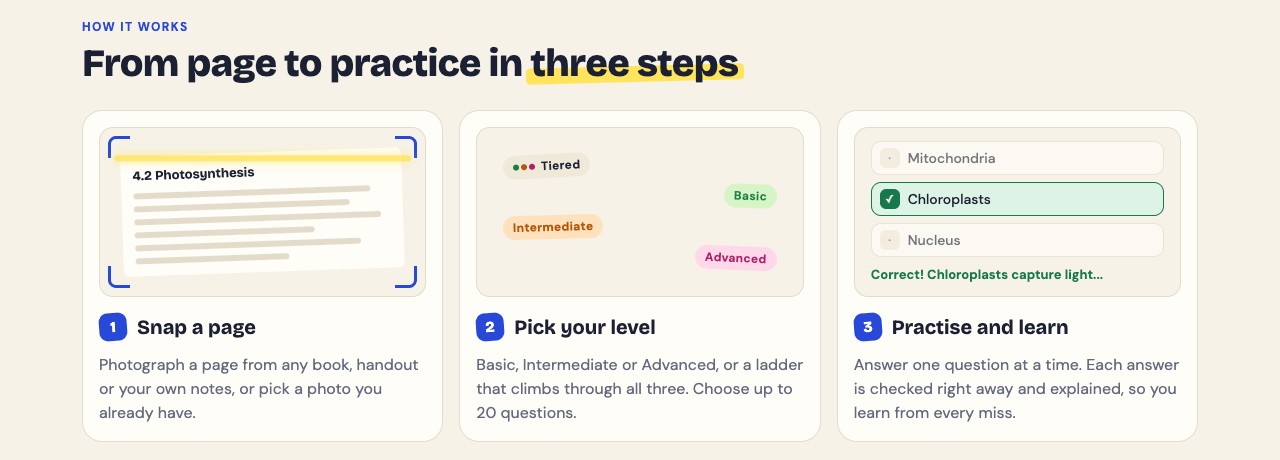
Multiple choice asks you to recognise the right answer. Writing your misses out on paper on Day 4 adds the recall half, so keep both.
The questions are written by an AI model and can contain mistakes. The explanation under each answer helps you check it against your textbook, and you can use Report a problem with this question under any that look wrong.
Frequently asked questions
How long should a short study session be?
There is no proven best length; studies of timed breaks found no difference in test scores. Pick a length that lets you finish one clear task, such as a 10-question quiz on one page, and come back on another day.
Is one long session ever better than several short ones?
For remembering facts and ideas, spreading the same time across days usually wins. For deep work like essays, long problem sets or a full practice exam, a longer block often makes more sense.
How far apart should my study sessions be?
In one large study, the best gap was about 20 to 40% of the time to a test a week away, and about 5 to 10% for a test a year away. For a test in about 10 days, a gap of 2 or 3 days is a fair start.
Does Study Shot keep my page photo?
The photo is sent to the AI model to write the questions and is not stored on Study Shot's server. It is kept on your own device so the quiz can show it again.
Get started
Spread your study across days, and make every session a self-test. One page, one quiz, a retake a few days later.
Try Study Shot: it is free to start. Photograph the page you are studying tonight and get 10 practice questions on it, from basic to advanced.
Comments
No comments yet.
Sign in or make an account to comment.