Does studying in the same place help you remember?
Does studying in the same place help you remember? A little, sometimes, and less than most study advice suggests. Memory does pick up details of the room you learned in, but research finds that effect shrinks when you focus on the material, and one of the most famous studies behind it did not hold up when it was repeated. This post walks through what the studies found, where a fixed spot still makes sense, and a week that uses both.
Does studying in the same place help you remember? The short answer
The room you study in is a small helper, not the main event. How you study matters far more than where. If you test yourself on the material, you build memories that do not lean on any one room.
A fixed study spot still has a job. It helps you start faster and settle in. So a sensible plan is a home base for first learning and focus, and a few other places for short self-testing sessions, so no single room is doing the work.
What context-dependent memory means
Context-dependent memory is the idea that you recall things better when the setting at recall matches the setting where you learned them. "Context" can mean the room, the sounds, the light or the chair. Some of that background gets stored with the memory and can act as a reminder later.
The question for a student is how big that effect is, and when it shows up. That is where the research gets more interesting than the popular version.
What a review of the research found
In 2001, Steven Smith and Edward Vela pulled together studies on how the surrounding environment affects memory and ran a meta-analysis, which combines the results of many studies into one estimate. They found that room effects were reliable across the studies.
They also found three things that made the effect smaller:
- Other cues while learning. When learners had cues other than the room to lean on as they studied, the room mattered less.
- Strong cues at the test. When the test itself gave good cues to the answer, the room mattered less.
- Picturing the original room. When people mentally brought back the place where they had learned, the effect of a new room went down.
Their conclusion was that these effects are less likely when attention is drawn away from the surroundings. For you, that is good news: building your own cues from the material, and picturing your study place when you need it, both make a strange exam hall matter less.
The famous diver study, and the replication
The study most people cite was run by Duncan Godden and Alan Baddeley in 1975. Divers learned lists of words on land or underwater, then recalled them on land or underwater, and the original study reported better recall when the two places matched.
In 2021, Jaap Murre repeated the experiment with sixteen divers. Each diver learned word lists on land or underwater and recalled them four minutes later in all four combinations. This time, recall in the same place was not better than recall in the other place.
One replication does not erase a finding, and the two studies differed in their details. But it is a good reason not to build your study plan around the room. Treat the place as a small extra, and spend your effort on testing yourself.
When a consistent study spot still helps
A fixed spot helps you get started. If you sit at the same desk at the same time, you waste less time deciding where to work and settling in. That is a habit benefit, not a memory one, but it is real for most students.
- First learning. When material is new and hard, you want few distractions. Read and take notes in your quietest place.
- Long sessions. Essays and problem sets go better where your books and tools already are.
- Low-energy days. A familiar routine lowers the bar to begin.
Short review sessions are different. They work fine at a kitchen table, in a library or on a bus, and doing them in a few places means no single room is carrying your memory.
How to combine places with self-testing
Moving rooms does little if you are only rereading. Testing yourself, by pulling the answer out of your head, is the stronger habit; our post on why testing yourself beats rereading your notes covers that research. Rereading a page in three cafes is still rereading. Answering questions about it in three places is practice.
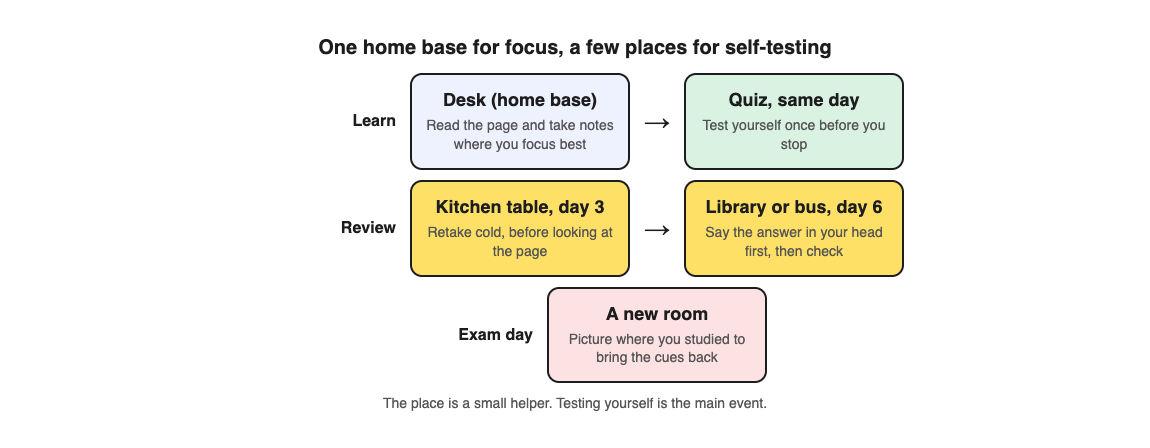
Here is a worked example with one textbook page, say a page on the water cycle for a science test.
- Day 1, at your desk. Read the page carefully. Then open Study Shot in your phone's browser, tap Make a new quiz, then Take photo. Hold the page flat and fill the frame. Leave the level on Tiered, a ladder from basic to advanced, keep the default of 10 questions, and press Create questions.
- Same evening. Answer one question at a time. After each Check answer, read the explanation, even when you got it right. On the results screen, look at the score for each level and the Look at these again list.
- Day 3, kitchen table. Open your library, where the quiz is saved with its page photo and your best score. Tap Retake quiz without looking at the page first. Use Show page only after you have made a guess.
- Day 6, library or bus. Retake it again. This time, say the answer in your head before you look at the four choices. That turns a recognition question into a recall attempt.
- Exam day. If your mind goes blank, picture the desk where you studied. The meta-analysis found that mentally bringing back the original place reduced the effect of a new room.
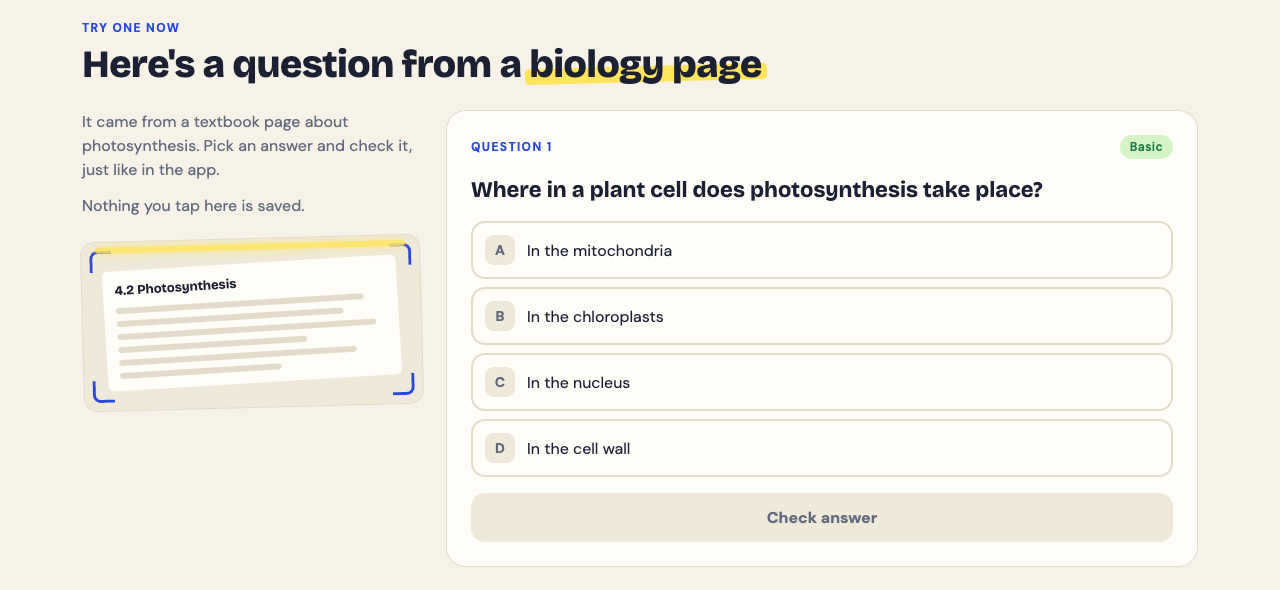
The grades give you a stopping rule. Study Shot labels 90% and up as Mastered, 70% and up as Good, 50% and up as Getting there, and below that as Needs another try. Aim for Mastered on two different days before you move on.
One honest caveat: the questions are written by an AI model and can contain mistakes. The explanation under each answer helps you check the reasoning against your page. If a question looks wrong, use Report a problem with this question.
Studying with friends? Use Share this quiz to send a link. Each person needs a Study Shot account and gets their own copy of the questions, without your photo, so everyone can take it from wherever they are.
Frequently asked questions
Should I study where I will take the exam?
You do not need to. The research review found room effects shrink when other cues are strong and when you picture the place you studied, and a 2021 repeat of the famous diver study found no same-place advantage.
Does the same music while studying act like the same room?
Sound is part of your surroundings, but the research on study music is mixed on its own. Our post on studying with music or in silence sets out both sides.
Does rewriting notes in a new place help more?
Changing places will not turn a weak method into a strong one. See whether rewriting your notes helps you remember for what tends to work better.
How often should I review?
Spread your reviews out over days rather than repeating them in one sitting. Our spaced repetition schedule gives a simple plan.
Get started
Learn in one focused place, then test yourself in a few others. Study Shot runs in the web browser on your phone or computer, so your quiz goes wherever you do.
Try Study Shot: it is free to start. Photograph the page you are studying tonight and get 10 practice questions on it, from basic to advanced.
Comments
No comments yet.
Sign in or make an account to comment.