Does Teaching Someone Else Help You Learn? What Research Shows
Does teaching someone else help you learn? Often, yes, though the research has a few surprises. The benefit seems to come from specific things you do while teaching, not from the act of standing in front of someone. This post walks through what studies found, why teaching works, when it falls flat, and a short routine you can use tonight even if nobody is around to listen.
Does teaching someone else help you learn? The short answer
Teaching helps when it forces you to pull information out of your own memory and put it in order. It helps much less when you read your notes aloud to someone. The listener is optional. The effort of explaining without looking is not.
So the useful question is not "should I teach?" It is "am I explaining from memory, and am I finding the parts I can't explain?" If the answer to both is yes, you are getting most of the benefit.
What studies of learning by teaching found
Teachers often say they only really understood a subject once they had to teach it. Research backs a version of that, with some surprises.
- Imagining it can be enough. In a study of 597 secondary school students, those who explained the material to an imagined listener understood it better both right away and later. Those who taught a real classmate understood it better right away, but the advantage did not last. The authors still advise caution in using imagined teaching.
- Recall may be the active part. One explanation, set out in a review of the research, is that teaching works because you have to pull the material out of memory to explain it. The review lays out how to test that idea and finds the evidence is not complete yet.
- Saying it in your head is not the same. In 8th grade science classes, students who wrote terms down from memory learned more than students who only recalled them silently, and silent recall did no better than restudying.
Put together, these suggest the teaching is a wrapper. The parts doing the work seem to be recalling and putting ideas in order, out loud or on paper.
Why teaching works: retrieval, organizing, and finding gaps
Retrieval
When you explain without notes, you are practicing recall. Pulling a fact out of memory makes it easier to pull out next time. This is the same reason practice tests work so well, a topic we cover in can practice tests help with test anxiety.
Organizing
A listener needs a beginning, a middle and an end. That pushes you to sort facts into a structure: this causes that, this is a type of that, this is an exception. Any part that does not fit the structure shows up quickly.
Finding gaps
The most useful moment in teaching is when you stop mid-sentence and realize you don't know why something is true. Reading your notes rarely produces that moment, because the notes fill the gap for you. Explaining from memory exposes it.
When teaching does not help much
Teaching is not magic. It tends to help less in these cases:
- You read from the page. If your notes are open while you explain, you are mostly reading aloud. That is closer to rereading than to recall.
- You only recite definitions. Saying "osmosis is the movement of water across a membrane" is fine, but it is only the first step. Push to "why" and "what would happen if."
- Nobody checks you. You can explain something confidently and still be wrong. Without a check, teaching can lock in a mistake.
- You haven't learned it yet. Teaching works best on material you have studied at least once. Explaining a chapter you have never read just produces guessing.
The third point matters most. A real listener might catch your error. When you teach alone, you need a different way to check yourself.
How to learn by teaching when nobody is around to listen
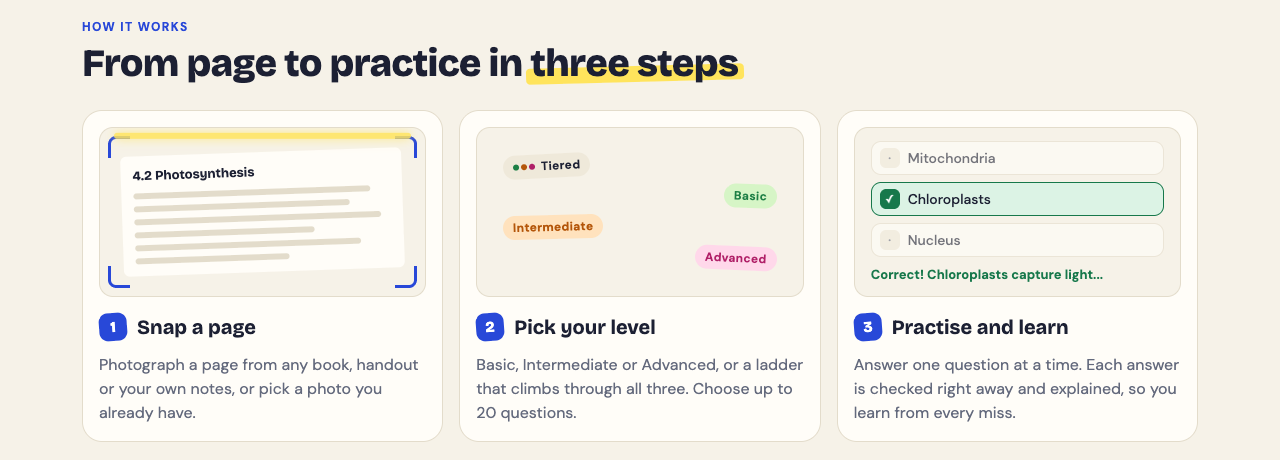
You don't need a study partner. You can teach an empty chair, a pet, or your phone's voice recorder. What you do need is a way to replace the two things a good listener gives you: questions you didn't expect, and a check on whether you got it right.
This is where a quiz fits. Study Shot turns a photo of a page into multiple-choice questions, checks your answers and explains each one. You can use it as the "listener who asks questions" after you teach. The trick is choosing what to photograph.
Photograph the original page, not your explanation. It is tempting to write out your explanation, snap it, and quiz yourself on it. But if your explanation contains a mistake, the questions will be built on that mistake. Quizzing on the source page tests whether your explanation matched the real material. Questions are written by an AI model and can contain errors too, so read the explanation after each answer. If a question looks wrong, use Report a problem under it.
If you do have a study group, you can still teach each other in person, then use Share this quiz to send everyone the same questions. Each person who opens the link needs a Study Shot account and gets their own copy of the questions, without your photo.
A 10-minute teach-back routine for any subject
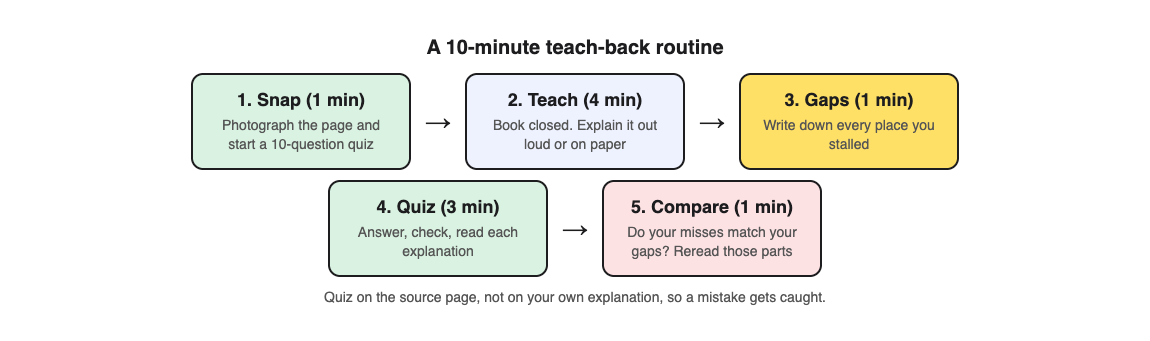
Here is a routine that combines recall, organizing and a check. Use it after you have read a page once.
- Snap the page first (1 minute). In Study Shot, choose Take photo or Choose photo. Hold the page flat and fill the frame. Textbook pages, notes, diagrams and whiteboards all work. Pick 10 questions and leave the level on Tiered, which climbs from basic to intermediate to advanced. Press Create questions and let it run while you move on. It can take up to a minute.
- Close the book and teach (4 minutes). Explain the page out loud, or write it, as if to a classmate who missed the lesson. Start with "The main idea here is..." then cover how the parts connect. Don't peek.
- Write down where you stalled (1 minute). List every spot where you said "um, something about..." These are your gaps.
- Take the quiz (3 minutes). Answer one question at a time. After Check answer, you see Correct! or Not quite., the right answer, and a short explanation. If you need the source, Show page brings up your photo.
- Compare (1 minute). On the results screen, look at the score for each level. Then read Look at these again, which lists the questions you missed with your answer and the right answer. Check whether the misses match the gaps you wrote down.
A worked example: say you are studying a biology page on osmosis. You explain that water moves across a membrane, but you stall when asking which way it moves in salty water. You write "which direction?" as a gap. The quiz then asks an Advanced question about a cell placed in a very salty solution, and you miss it. Now you know exactly what to reread.
The quiz is saved to your library with its page photo and your best score, so you can run the routine again in a few days and press Retake quiz. If you tend to study in one spot, it may also help to vary where you do these reviews, which we discuss in does studying in the same place help you remember.
Frequently asked questions
Does teaching help if nobody is actually listening?
It can. In one study of secondary school students, explaining to an imagined listener helped understanding both right away and later. A quiz afterwards gives you the check a real listener would.
Is it better to teach with notes or without?
Without. The leading explanation is that the benefit comes from recalling the material, which notes do for you.
Can I learn by teaching if I study alone?
Yes. Explain out loud to an empty room, then check yourself with a quiz on the original page. The quiz replaces the questions and corrections a real listener would give you.
Should I quiz myself on my own written explanation?
It is safer to quiz on the source page. If your explanation has an error, questions based on it can repeat that error instead of catching it.
Get started
Study Shot runs in the web browser on your phone or computer. You will need to create an account to use it. Pick the page you most need to explain, teach it from memory, then let the quiz show you what you missed.
Try Study Shot: it is free to start. Photograph the page you are studying tonight and get 10 practice questions on it, from basic to advanced.
Comments
No comments yet.
Sign in or make an account to comment.