Does Writing Your Own Practice Questions Help You Learn? The Research
Does writing your own practice questions help you learn? In one study of 231 university students, writing questions and answers about a text beat rereading it on a test a week later, but only when students could still see the text or its key terms while they wrote. This post covers what that study and the research on testing yourself say, where the limits are, and how to write questions that help instead of wasting your evening.
Does writing your own practice questions help you learn? The short answer
Writing questions with the page in view beat rereading in one study. Answering questions beat rereading in another. Doing both covers you either way.
When you write a question, you have to decide what matters on the page, what the right answer is, and what a wrong answer would look like. That is active work. Rereading feels productive, but your brain can coast through it. The catch is that writing questions takes time, and a badly written question teaches you very little. So the method works, but only if you do it well.
What the research says about generating your own questions
Two studies are worth knowing.
- Writing questions. In a 2020 study by Ebersbach, 231 students read a text with bold keywords and then wrote questions and answers about those keywords, either with the text open, with only the keywords in view, or with nothing in view. Others simply restudied. A week later, the open-book and keywords-only groups did better than the restudy group. The more questions and answers students wrote, the better they did, and students with nothing in view wrote the fewest.
- Answering questions. In a 2006 study by Roediger and Karpicke, students who took recall tests on a passage remembered more of it two days and one week later than students who reread it, even though rereading made them feel more confident. Our post on retrieval practice covers this in more depth.
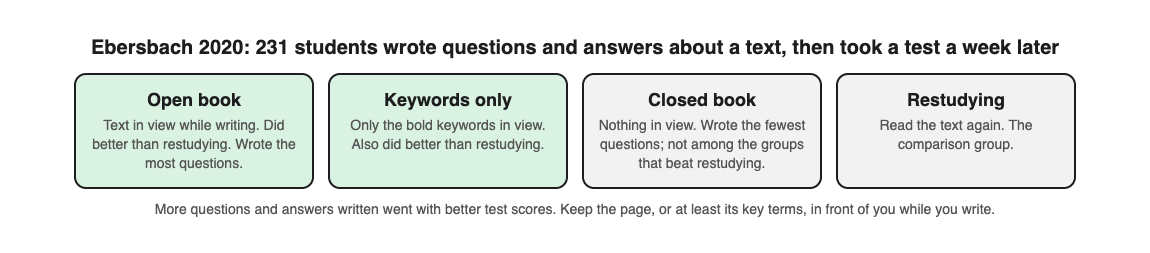
One honest limit: these studies do not tell you whether writing questions beats answering good ready-made ones. Writing takes longer, so in the same time you answer fewer questions. More on that trade below.
Why it works: elaboration, retrieval, and spotting gaps
Elaboration
To ask "Why does X cause Y?" you have to connect X and Y in your own words. That linking is called elaboration, and it gives a memory more hooks to hang on.
Retrieval
If you write questions and answer them a day later, you get the testing effect on top. The question becomes a cue that forces you to pull the answer from memory.
Spotting gaps
This is the underrated part. When you try to write a question and realise you cannot say what the right answer is, you have found a gap. You found it now, at your desk, not in the exam hall.
Writing questions vs. answering ready-made ones: which wins?
It depends on what you are short of.
- Short on understanding? Write questions. The act of writing exposes what you do not get yet.
- Short on time before an exam? Answer questions. You get far more recall practice per minute.
- Short on good questions? Use ready-made ones, then write a few of your own on the topics you missed.
A practical split for most students: write a handful of questions on the hardest ideas, and answer a larger set of ready-made questions on everything else. Your own questions build understanding. The ready-made set builds recall and catches things you would not have thought to ask.
How to write practice questions that actually help you learn
Here is a worked example. Say you are studying a biology page on photosynthesis. A lazy question looks like this:
What is the green pigment in leaves called?
You will get it right, and you will learn almost nothing. Now climb up a level at a time.
- Basic (terms and facts): "Where in a plant cell does photosynthesis take place?"
- Intermediate (explain and compare): "How do the light reactions and the reactions that build sugar depend on each other?"
- Advanced (apply and predict): "A plant is kept in bright light but with no carbon dioxide. What happens to sugar production, and why?"
Notice the pattern. The higher questions ask you to explain, compare, or apply the idea to a new case. Those are the ones that show whether you really understand the page.
A few rules that help:
- Write the answer key at the same time. If you cannot, that is your gap. Go back to the source.
- Write plausible wrong answers. For multiple choice, each wrong option should be a mistake a real student might make. Writing them forces you to know why they are wrong.
- Ask the tricky version. "What is the trickiest way an examiner could ask this?"
- Keep the page in view while you write. In the 2020 study, students who could see the text or its keywords wrote more questions and did better than those with nothing in view.
- Wait before answering. Answer your questions the next day, not five minutes later. The delay is what makes recall work.
Common mistakes that make self-made questions useless
- Copying sentences and blanking out one word. You end up testing whether you recognise the sentence, not whether you understand it.
- Only asking what you already know. It feels good. It changes nothing. Aim your questions at the parts that confused you.
- Answering with the notes open. Then it is just rereading with extra steps.
- Never checking your answers. A wrong answer you never correct becomes a confident wrong memory.
- Writing too many and answering none. Fifty questions you never revisit help less than ten you answer twice.
Pair it with other techniques, from spaced review to doodling notes
Practice questions work best as part of a routine, not on their own.
- Spaced review. Answer the same questions again after a day, then a few days, then a week. Each round that you get right is stronger than the last.
- Visual notes. A quick sketch can help some ideas stick. See what the research says about doodling while you study for when it helps and when it distracts.
- A miss list. Keep every question you got wrong in one place and start your next session with those. Focus on the misses, not the wins.
Frequently asked questions
Is writing questions better than rereading notes?
In a 2020 study, writing questions and answers beat restudying on a test a week later, when students could see the text or its key terms while writing.
How many practice questions should I write per topic?
There is no magic number, but 5 to 10 questions per page or concept is a workable start. Spread them across levels, from basic definitions to applying the idea, and focus extra questions on what confused you.
Should I write multiple-choice or open-ended questions?
Both have a place. Open-ended questions make you produce the whole answer, while good multiple-choice questions with realistic wrong options test whether you can tell close ideas apart, which matters on many exams.
Does it work for math and problem-based subjects?
Yes, but the questions look different. Instead of "What is X?", write new problems that change one detail, or ask "Why does this step work?" and "What happens if this number is negative?"
Get started: turn your notes into practice questions with Study Shot
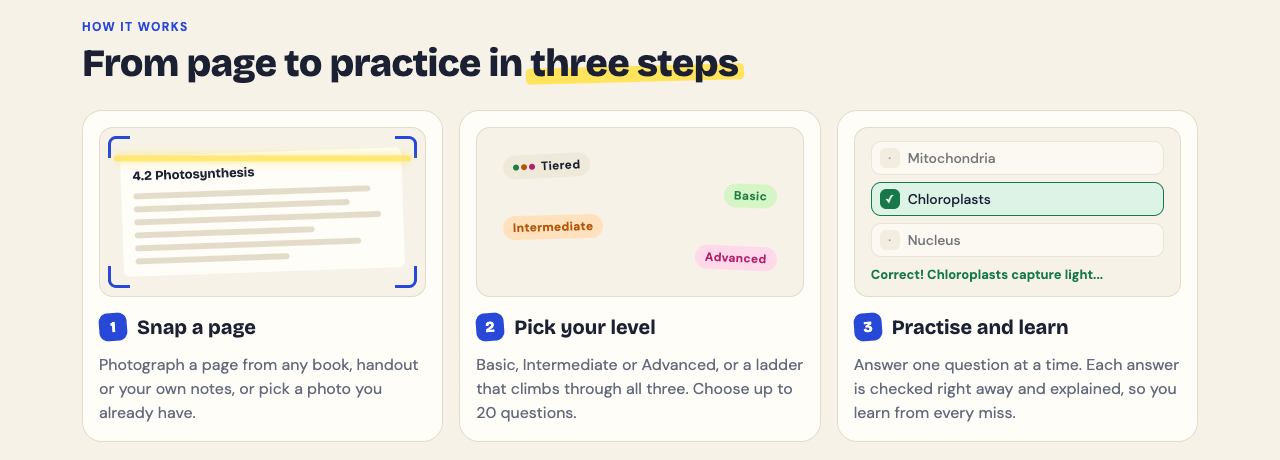
Writing your own questions is worth doing for the hardest ideas. For everything else, you need a lot of practice questions fast, and that is where Study Shot fits. It runs in the browser on your phone or computer.
Here is the workflow:
- Tap Take photo or Choose photo and snap a page from your textbook, notes or a whiteboard. Hold the page flat and fill the frame.
- Pick 5, 10, 15 or 20 questions. Ten is the default.
- Pick a level. Tiered is a ladder that climbs from basic to intermediate to advanced, much like the Aristotle example above. You can also go straight to Advanced ("Apply and predict in new situations") before an exam.
- Choose the quiz language. Questions, answers and explanations come in 50 languages.
- Press Create questions. It can take up to a minute.
Each question has four choices. After you press Check answer, you see whether you were right, the correct answer, and a short explanation. At the end, the results screen shows your score for each level and a Look at these again list of the questions you missed, with your answer next to the right one. That is your miss list, built for you. Quizzes are saved to your library so you can retake them for spaced review.
One honest note: the questions are written by an AI model and can contain mistakes. Read the explanation to check the reasoning against your page. If a question looks wrong, use Report a problem with this question. Spotting a bad question is good practice too.
Then do the part only you can do: take the two or three questions you missed and write your own harder versions of them.
Try Study Shot: it is free to start. Photograph the page you are studying tonight and get 10 practice questions on it, from basic to advanced.
Comments
No comments yet.
Sign in or make an account to comment.