Effective accelerationism (e/acc): what it means
Effective accelerationism, often written e/acc, is a 21st-century movement that wants technology, and above all AI, to move as fast as possible. Its supporters believe unrestricted progress is the answer to problems such as poverty, war and climate change. It sits at the far end of the debate about AI speed, opposite the people who want to slow down. This post explains what it believes, where its name and ideas come from, how it differs from nearby movements, and what its critics say, with no verdict. Every claim comes from Wikipedia's Effective accelerationism article.
What effective accelerationism believes
The movement takes an explicitly pro-technology stance. Its supporters believe that unrestricted technological progress, driven above all by artificial intelligence, can solve universal human problems. They see themselves as a counterweight to more cautious views, and often call their opponents "doomers" or "decels", short for decelerationists.
In practice, that means:
- Unrestricted AI. It calls for unrestricted development and deployment of AI, with a strong focus on artificial general intelligence (AGI).
- No regulation. It opposes regulation of AI, and government intervention in markets more generally.
- Competition as safety. Many supporters hold libertarian views and think AGI will be most aligned if many AGIs compete against each other in the marketplace.
- Risk as small. Supporters generally consider existential risks from AGI to be negligible, and claim that even if they were not, decentralized free markets would handle the risk better than central government rules.
The movement has been described as fringe and as cult-like, but it gained mainstream visibility in 2023.
Where the name and the goal come from
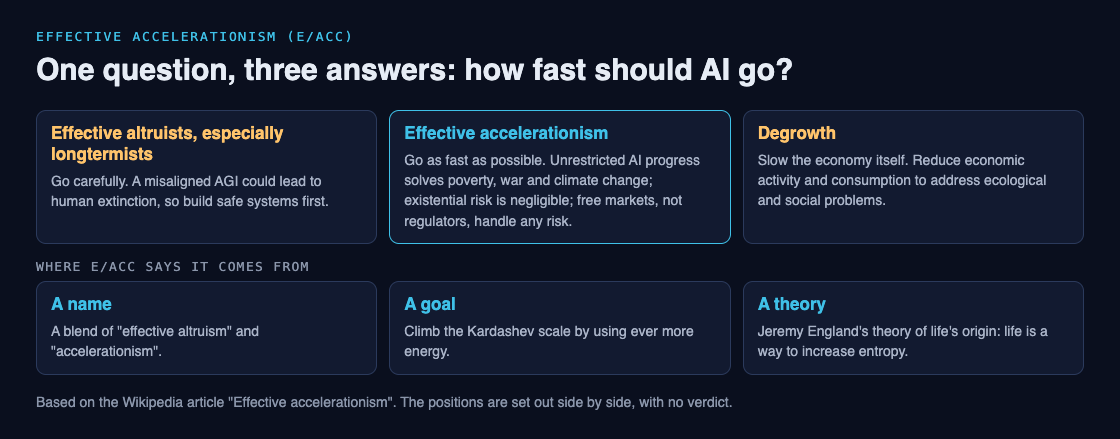
The name blends "effective altruism" and "accelerationism". According to Guillaume Verdon, one of the movement's founders, its aim is for human civilization to "clim[b] the Kardashev gradient", meaning to rise to higher levels on the Kardashev scale by using ever more energy.
AGI matters to the movement because it sees AGI as the key to that climb. Its founders also root it in Jeremy England's theory of the origin of life, which is about entropy and thermodynamics. In their reading, the universe tends to increase entropy, life is one way of doing that, and spreading life that uses ever more energy across the universe would fulfil the universe's purpose.
Where it started
Its exact origins are unclear. The earliest known reference is a May 2022 newsletter by four authors writing under pseudonyms. Émile Torres, one of the two people who coined the term TESCREAL, sees it as an extension of that bundle of ideologies, rooted in older Silicon Valley subcultures such as transhumanism and extropianism.
How it differs from nearby movements
Traditional accelerationism
The British philosopher Nick Land is seen as the intellectual originator of accelerationism in general. His version sees speeding up technological change, through capitalism, as a way to transform culture, society and the economy. Effective accelerationism instead focuses on using AGI for the greatest ethical good for conscious life, human or machine, and on expanding civilization and its energy use. Land has expressed support for e/acc.
Effective altruism
Despite the shared word, the two split over AI. Effective altruists, and longtermists in particular, argue that AI developers should be cautious and build safe systems, because any misaligned AGI could lead to human extinction. Effective accelerationists consider that risk negligible. For the cautious side's reasoning, see our posts on longtermism and AI and existential risk from AI.
Degrowth
Effective accelerationism stands in stark contrast with the degrowth movement, which calls for less economic activity and consumption to address ecological and social problems. E/acc embraces technological progress, energy use and the dynamics of capitalism instead.
What critics say
- Guardrails are needed. David Swan of The Sydney Morning Herald criticized its opposition to regulation, arguing that "innovations like AI needs thoughtful regulations and guardrails ... to avoid the myriad mistakes Silicon Valley has already made."
- Too dangerous to break things. The US Secretary of Commerce at the time warned against the "move fast and break things" mindset, saying of AI: "You can't break things when you are talking about AI."
- Unsettling ideas. Ellen Huet argued on Bloomberg News that some of the movement's ideas were "deeply unsettling", especially the view that "natural selection could lead AI to replace us as the dominant species."
Supporters answer, in the article's account, that faster AI progress is needed to ensure human survival and to spread consciousness through the universe.
A worked example: place yourself on the speed line
Most AI debates are really about speed. This exercise takes about 15 minutes.
- Draw a line. Put "slow down the economy" (degrowth) at the left end and "as fast as possible" (e/acc) at the right. Put "build safe systems first" (the cautious effective altruist view) somewhere in between.
- Write three claims e/acc makes: progress solves big problems; existential risk from AGI is negligible; markets handle risk better than regulators.
- Mark each claim agree, disagree or unsure.
- Add one critic's point to each claim you marked agree. For example, next to "markets handle risk", write David Swan's call for guardrails.
- Place your dot on the line. Then ask what evidence would move it left or right.
The point is not to land in the "right" place. It is to see which single claim decides where you stand.
Exploring the idea in Contain ASI
Contain ASI asks the opposite of e/acc: what if your job is to hold a race back? It is a story strategy game for 1 to 4 players that runs in your browser and needs WebGL 2. Chapter 1, Before ASI, starts in January 2024 with four fictional AI labs in one race. As a researcher, research manager, CEO or government, you try for three years to keep every lab from crossing into recursive self-improvement before 2027.
The game says it is inspired by the AI 2027 scenario, and that all its labs, people and events are fictional. It is a story to think with, not a forecast of what real labs will do, and playing it does not commit you to either side of this debate.
Frequently asked questions
What does e/acc mean?
It is short for effective accelerationism, a movement that wants unrestricted technological progress, especially in AI, as the answer to problems such as poverty, war and climate change.
Who started effective accelerationism?
Its exact origins are unclear. The earliest known reference is a May 2022 newsletter by four pseudonymous authors, and Guillaume Verdon is described as one of its founders.
How is e/acc different from effective altruism?
They split mainly over AI risk. Effective altruists, especially longtermists, urge caution because a misaligned AGI could lead to extinction, while effective accelerationists consider that risk negligible.
Why do critics oppose effective accelerationism?
Critics argue AI needs regulation and guardrails, warn that "move fast and break things" is too dangerous for AI, and find unsettling the view that AI could replace humans as the dominant species.
Get started
Want to feel the pull between speed and safety for yourself? Open Contain ASI in your browser and start a campaign as a researcher, research manager, CEO or government.
Comments
No comments yet.
Sign in or make an account to comment.