Effective altruism and AI risk: what the movement says
Effective altruism, or EA, is a movement that tries to work out how to do the most good and then act on it. Only a small share of charities are tied to it, but AI safety is one of the niche areas where that is not true. This post explains what effective altruism and AI risk have to do with each other: what the movement is, how it picks causes, why advanced AI made its list, and the criticism it faces, with no verdict. The claims come from Wikipedia's Effective altruism article.
What effective altruism is
The article calls EA a 21st-century philosophical and social movement that argues for impartially weighing benefits and prioritizing causes to do the greatest good. Its supporters describe it as "using evidence and reason to figure out how to benefit others as much as possible, and taking action on that basis".
A defining idea is impartiality: everyone's well-being counts equally, wherever they live. The Centre for Effective Altruism lists four principles that unite the movement: prioritization, impartial altruism, open truthseeking and a collaborative spirit.
Its popular causes are global health and development, social and economic inequality, animal welfare, and risks to humanity's survival or long-term flourishing. The name was coined in 2011. Philosophers who shaped it include Peter Singer, Toby Ord and William MacAskill.
Where the movement came from
In the late 2000s, several separate communities began to come together:
- Evidence-based charity: a community around the charity evaluator GiveWell.
- Giving and careers: a community around the nonprofits Giving What We Can and 80,000 Hours.
- The future and AI: the Singularity Institute, now the Machine Intelligence Research Institute (MIRI), which studied the safety of AI; the Future of Humanity Institute, which studied existential risk; and the LessWrong discussion forum.
In 2011, Giving What We Can and 80,000 Hours formed an umbrella organization and voted on a name: the Centre for Effective Altruism. The Effective Altruism Global conference has run since 2013. So groups studying AI safety were among the communities the movement grew from.
How effective altruists choose a cause
A key idea is cause prioritization. It rests on cause neutrality: money and time should go wherever they do the most good, whoever benefits and however they are helped. Many charities, by contrast, focus on one cause such as education or climate change.
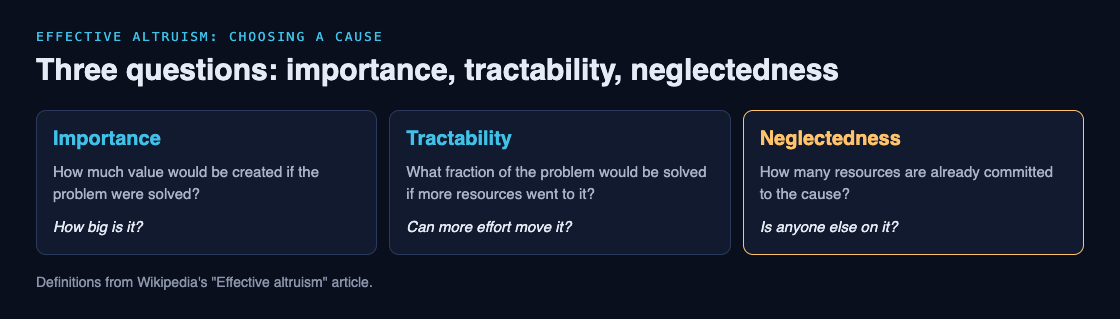
One tool is the importance, tractability and neglectedness framework:
- Importance: how much value would be created if the problem were solved.
- Tractability: what fraction of the problem would be solved if more resources went to it.
- Neglectedness: how many resources are already committed to it.
Two more ideas matter for AI. Effective altruists look for work that is highly cost-effective "in expectation": a long shot can be worth more than a sure thing if its payoff is big enough. And they use counterfactual reasoning, asking how much good you do compared with what would have happened anyway.
Why effective altruism and AI risk are linked
The link runs through longtermism, a view that grew up closely with EA. It argues that "distance in time is like distance in space": the welfare of people in the future matters as much as the welfare of people alive now. Because so many people could live in the future, longtermists try to lower the chance of an existential catastrophe that would ruin it. Our post on longtermism and AI goes deeper.
Existential risks such as dangers from biotechnology and advanced AI are often highlighted and actively researched. The article names groups connected to the EA community that work on them: the Centre for the Study of Existential Risk at Cambridge, the Future of Life Institute, the now-closed Future of Humanity Institute, and MIRI, which has the narrower mission of managing advanced AI.
Because these risks are so large, even tiny changes in them can look huge. In 2022 the writer Gideon Lewis-Kraus reported the claim that even a 0.0001 percent cut in such a risk "might be worth more than saving a billion people today". He added that nobody in the EA community openly supports such an extreme conclusion.
EA and e/acc
The article sets EA apart from effective accelerationism (e/acc), which argues for unrestricted technological progress in the hope that AGI will solve major problems. Effective altruists are generally more cautious about AI, believing that going too fast could raise existential risks. Our post on effective accelerationism covers the other side.
The main criticisms
EA has drawn criticism from many directions. Here are the main lines the article gives, set out without a verdict.
- Small fixes, not big change: some argue EA favors step-by-step help over systemic or political change. Mathew Snow in Jacobin made this case, and the philosopher Amia Srinivasan criticized MacAskill's book Doing Good Better for saying little about global inequality and oppression.
- Too much power for the wealthy: the philosophers Susan Dwyer, Joshua Stein and Olúfẹ́mi O. Táíwò argued it gives wealthy people outsized influence in areas democratic governments should handle.
- Ranking causes: Ken Berger and Robert Penna of Charity Navigator called weighing causes against each other "moralistic, in the worst sense of the word" and "elitist". MacAskill replied that such comparison is hard, sometimes impossible, but often necessary.
- What you cannot measure: Pascal-Emmanuel Gobry and others warned of a "measurement problem": slow work such as research or reform is hard to measure, so it risks being undervalued.
- Scandal: the movement drew wide criticism after a cryptocurrency exchange, whose founder was a major EA funder, went bankrupt in 2022. MacAskill condemned the founder's actions, saying EA emphasizes integrity. In 2023, seven women reported misconduct within the movement; the Centre for Effective Altruism said some of those accused had already been banned and that it would investigate new claims.
- AI ethics pushed aside: Timnit Gebru and Émile P. Torres place EA in the bundle of movements they call TESCREAL. Gebru has claimed EA overrode other AI ethics concerns, such as algorithmic bias, in the name of preventing or controlling AGI.
In 2023, Oxford University Press published a whole volume of critical essays on the movement, The Good it Promises, The Harm it Does.
A worked example: score a cause with the three questions
You do not have to agree with EA to use its framework. Try it on a cause you care about, then on AI safety, and compare.
- Importance: if this problem were fully solved, how much better would things be? Give it a rough score from 1 to 5.
- Tractability: if twice as many people and as much money went to it, how much of the problem would actually be solved? Score it 1 to 5.
- Neglectedness: how much is already being spent on it? Score it high if very little, low if a lot.
Where your scores for AI safety differ from an effective altruist's shows exactly where you part ways. If it is tractability, the question to discuss is simple: can more effort really make AI safer?
Exploring the idea in Contain ASI
Contain ASI is a story strategy game for 1 to 4 players that runs in your browser and needs WebGL 2. Chapter 1, Before ASI, starts in January 2024 with four fictional AI labs in one race. As a researcher, research manager, CEO or government, you try for three years to keep every lab from crossing into recursive self-improvement before 2027.
It is a game, not a forecast: the page says all its labs, people and events are fictional, and it does not mention effective altruism. But it puts the tractability question in your hands: can one researcher, manager, CEO or government really change the course of a race?
Frequently asked questions
What is effective altruism in simple terms?
It is a movement that uses evidence and reason to work out how to help others as much as possible, and then acts on it, for example by giving to selected charities or choosing a career for its impact.
Why do effective altruists care about AI?
Those who hold a longtermist view count future people as much as people now, so they focus on existential risks, and advanced AI is one of the risks most often highlighted.
Is effective altruism the same as effective accelerationism?
No. Effective accelerationism argues for unrestricted technological progress; effective altruists are generally more cautious about AI.
Why is effective altruism criticized?
Critics say it neglects systemic change, gives wealthy donors too much influence, ranks causes in an elitist way, undervalues what is hard to measure, and pushes aside other AI ethics concerns; it also faced scandals in 2022 and 2023.
Get started
Want to test how tractable an AI race really is? Open Contain ASI in your browser and start a campaign as a researcher, research manager, CEO or government.
Comments
No comments yet.
Sign in or make an account to comment.