Einstein vs Bohr: the quantum debate explained
Einstein vs Bohr is one of the great arguments in the history of science. Both men helped build quantum physics, and both won the Nobel Prize for it. Then they spent years disagreeing about what the theory actually tells us about the world. This guide explains who they were, walks through the debate in four steps, and sets out where it stands, using the Stanford Encyclopedia of Philosophy and the Nobel Prize's own pages, with no verdict of our own.
Einstein vs Bohr: who they were
According to the Nobel facts page on Albert Einstein, he was born in Ulm, Germany, on 14 March 1879. He worked at the patent office in Bern, where he produced several pioneering works, and from 1914 he was in Berlin. After the Nazis seized power he moved to the US and worked at the Institute for Advanced Study in Princeton, where he died in 1955. His Nobel Prize in Physics for 1921, received a year later, was "especially for his discovery of the law of the photoelectric effect". In that work he explained that light consists of quanta, packets with fixed energies.
The Nobel facts page on Niels Bohr says he was born in Copenhagen on 7 October 1885. He worked abroad, including in Manchester and Cambridge, then returned to head Copenhagen University's Institute for Theoretical Physics, which "became a legendary research environment and a center for the development of quantum physics". In 1913 he proposed a theory of the hydrogen atom in which electrons move only in prescribed orbits, and a jump to a lower orbit sends out radiation. He won the 1922 Nobel Prize in Physics for his work on the structure of atoms.
What they agreed on
Start here, because it is easy to forget. Both men built the early quantum theory. Einstein's light quanta and Bohr's atom both rest on the idea that some physical quantities only come in fixed amounts, and the Nobel page says Bohr's model "later incorporated the theories on light quanta".
Their quarrel was not over whether quantum mechanics works. The Stanford entry on the Einstein-Podolsky-Rosen argument says that by 1935 Einstein recognised "the theory's significant achievements". The fight was about what the theory means.
Bohr's side: complementarity
The Stanford entry on the Copenhagen interpretation says that "At Como in 1927" Bohr first presented his idea that certain different descriptions are "complementary". Roughly: some pictures of a quantum system cannot be used at the same time, yet you need each of them, depending on the experiment.
By 1935, the EPR entry says, understanding of quantum theory "was dominated by Niels Bohr's ideas concerning complementarity", and Bohr had emerged as the "philosopher" of the new theory. Be careful with any one-line summary of his view, though. The Copenhagen entry notes that "Bohr never gave a precise definition of complementarity", and scholars still argue over how to read him.
Einstein's side: the theory is incomplete
Einstein's enthusiasm for the theory, the EPR entry says, "had given way to disappointment" by 1935. It gives two reasons. "Firstly, he felt the theory had abdicated the historical task of natural science to provide knowledge of significant aspects of nature that are independent of observers or their observations." And "Secondly, the quantum theory was essentially statistical."
In other words, Einstein wanted a physics that describes how things are, not only the odds of what you will see when you look. He suspected quantum mechanics was a true but partial account, and that a more complete one was possible.
He even pointed to where such an account might come from. The EPR entry says that at the 1927 Solvay conference Einstein acknowledged "Louis de Broglie's pilot wave investigations as a possible direction to pursue for a more complete account of individual processes". So his complaint was not a refusal to accept new physics. It was a demand for more of it.
The debate in four steps
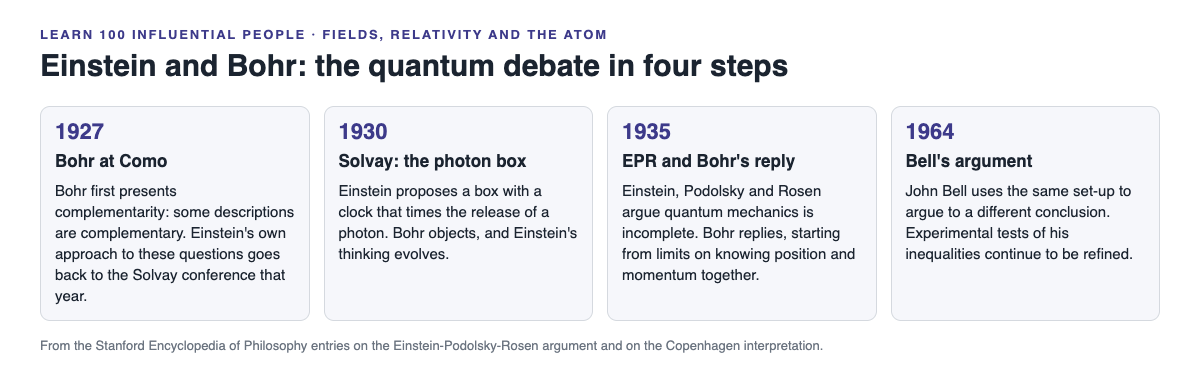
The Einstein and Bohr debate in four steps, from the Stanford Encyclopedia of Philosophy.
- 1927. Bohr presents complementarity at Como. The EPR entry says Einstein's own approach to these questions goes back to the Solvay conference the same year.
- 1930. At the next Solvay conference Einstein proposes a thought experiment: a box with a clock "set to time precisely the release (in the box) of a photon". Bohr objects, and the entry says Einstein's thinking about the experiment, and Bohr's objections, evolved into a different photon-in-a-box experiment.
- 1935. Einstein and his two assistants, Podolsky and Rosen, publish the EPR paper, which argues that quantum mechanics is incomplete. A detail students like: Podolsky wrote it, and "Apparently Einstein never checked Podolsky's draft before submission." Bohr's reply begins with "limitations on the simultaneous determination of position and momentum".
- 1964. John Bell uses the same set-up to build "a stunning argument, at least as challenging as EPR, but to a different conclusion".
Where the debate stands, and how to compare them
Who won? The honest answer is that it depends on which question you ask. The EPR entry says Bell's theorem "is often characterized simply as showing that quantum theory is nonlocal", but it also says that reading skips over real differences, and that "Experimental tests of the Bell inequalities continue to be refined." Fairly put: Bell changed the terms of the argument, and physicists and philosophers still disagree about what follows.
Here is a worked method for writing about any two scientists who disagreed:
- Name what they shared. Both built quantum theory and both won the Nobel Prize for it.
- State each position in one sentence, from a source. Bohr: some descriptions are complementary. Einstein: the theory is incomplete.
- Find the moment they met head on. The 1930 photon box and the 1935 EPR paper.
- Say what came after. Bell's 1964 argument and the experiments that followed.
- Leave the verdict open where experts disagree.
The same steps work in an essay; how to compare two historical figures in an essay turns them into a structure. For another scientist from the same course, read why Marie Curie was important.
Frequently asked questions
What did Einstein and Bohr disagree about?
Not whether quantum mechanics works, but what it means. Bohr held that some descriptions are complementary; Einstein argued the theory was incomplete and essentially statistical.
What is the EPR paper?
A 1935 paper by Einstein, Podolsky and Rosen arguing that quantum mechanics is incomplete. Bohr replied, starting from the limits on knowing position and momentum at the same time.
Did Einstein win a Nobel Prize for relativity?
No. His 1921 prize was for services to theoretical physics, "especially for his discovery of the law of the photoelectric effect".
Who won the Einstein and Bohr debate?
There is no simple answer. John Bell's 1964 argument changed the debate, and experts still disagree about what it shows.
Get started
Einstein and Bohr are both in Fields, Relativity and the Atom, an Advanced course on Learn 100 Influential People, with Faraday, Maxwell and Marie Curie. Advanced means "Modern power, modern physics and the debates still running today." Lessons take about 9 minutes, 38 cards set out where researchers disagree, and every lesson lists its sources, as the about page says. Sign in with your email and an emailed code, and questions from finished lessons come back for review, up to 5 a day.
Comments
No comments yet.
Sign in or make an account to comment.