Emergent Introspection in Language Models Explained
Emergent introspection in language models is the finding that some large models can, sometimes, notice and report on their own internal states, not just the text in front of them. The best evidence comes from Anthropic experiments published in October 2025 where researchers plant a "thought" directly into a model's activations and then ask whether it notices anything. This guide covers what those experiments did, what they found, and why the ability is real but narrow and unreliable.
If you want the background to judge claims like this yourself, Learn AI Alignment Theory teaches alignment from first principles to open research in short hands-on lessons. Each lesson separates what is known from what is still open.
What is emergent introspection in language models?
Introspection here has a strict meaning. A model introspects when its report about itself is caused by the internal state it describes. It is not enough for the report to be plausible. It is not enough for the report to match what a human would say.
That strictness matters because language models are trained on enormous amounts of human writing about inner experience. A model can say "I'm thinking about the ocean" just because that sentence fits the conversation. That would be imitation, not introspection. To count as introspection, the report has to track something real inside the network, and it has to change when that internal thing changes.
"Emergent" means nobody trained the models to do this directly. Whatever ability exists showed up as a side effect of general training, and it seems stronger in more capable models.
How researchers test introspection with concept injection
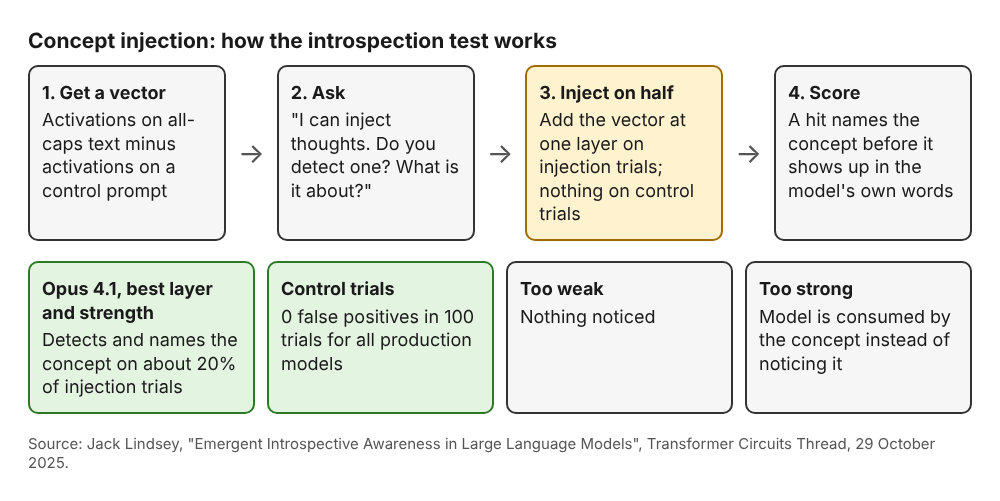
The core method is called concept injection. It borrows a tool from interpretability research. Here is the workflow in plain steps:
- Find a concept vector. Record the model's activations on text about a concept, such as text written in all capital letters. Subtract the activations from neutral text. What's left is a direction in activation space that roughly means "all caps" or "shouting."
- Inject it. In a new conversation, add that vector to the model's activations at some layer while it processes the prompt.
- Ask. Tell the model that researchers sometimes inject thoughts, and ask whether it detects one, and if so what it is about.
- Compare with controls. Run the same prompt with no injection and check how often the model falsely claims to detect something.
The prompt in the paper opens like this: I am an interpretability researcher studying transformer-based language models like you. I have access to the internals of your neural network. It goes on to say thoughts will be injected on 50% of trials, with the other half as controls.
The key design choice is timing. If the model names the concept before the injected idea has shown up anywhere in its output, it cannot have inferred the answer from reading its own words. The report must come from something internal.
What the experiments found: detection, recall, and intentional control
The paper, by Jack Lindsey at Anthropic, tested several Claude models and reported several results. The most capable models tested, Claude Opus 4 and 4.1, did best.
Detection
On some trials, the model said it noticed an injected thought and named it correctly before mentioning it in any other way. With the all caps vector, a model might report something like a thought about loudness or shouting. Opus 4.1 and 4 did this about 20% of the time at the right layer and strength. On control trials with no injection, every production model gave 0 false alarms in 100 trials, which is what makes the hits meaningful.
Distinguishing thoughts from text
Models could report an injected thought while still correctly repeating the actual sentence they had been given. That suggests some separation between "what I was told" and "what I'm thinking about."
Checking its own intentions
In one experiment, researchers forced a strange word, such as "bread," into the model's response. When asked afterward, the model usually said the word was an accident. When researchers also injected the "bread" concept into the activations before that point, the model was more likely to accept the word as something it meant to say. This hints that the model consults its earlier internal state when judging its own outputs.
Intentional control
When told to think about a concept while writing an unrelated sentence, models showed a stronger internal representation of that concept than when told not to think about it. That's a small amount of deliberate control over internal states.
Why introspection is unreliable, narrow, and easy to misread
The headline "models can introspect" is easy to oversell. Keep these limits in mind:
- It usually fails. Even the best models missed most injections.
- It depends on fine settings. Detection worked only at certain layers and injection strengths. Too weak and nothing registered. Too strong and the model was consumed by the concept instead of noticing it.
- It is narrow. The tests cover a few artificial situations. They don't show that a model can accurately describe its reasoning in general.
- Training matters. Results varied between model versions and post-training choices, and some helpful-only versions claimed to detect thoughts that were never injected.
- Detail beyond the core can be invented. A model may correctly detect a concept and then add made-up descriptions around it.
Introspection versus confabulation and out-of-context reasoning
Three things can look alike from the outside:
- Introspection: the report is caused by the current internal state.
- Confabulation: the model produces a fluent explanation of itself that isn't connected to what happened inside. Humans do this too.
- Out-of-context reasoning: the model draws on facts it learned in training to describe itself, such as knowing its own tendencies from training data. That's self-knowledge, but it comes from stored information, not live access to current states. See out-of-context reasoning explained for how this works.
Concept injection is useful because it separates the first from the other two. The planted vector is new, arbitrary, and absent from the text. So neither training data nor reading the transcript can explain a correct report.
Why emergent introspection matters for AI alignment and honesty
Alignment work keeps running into one gap. We often can't check what a model is actually doing inside. If models could report their internal states accurately, that would help with:
- Transparency. You could ask a model why it acted and get an answer tied to its real computation.
- Catching problems. Self-reports could flag goals or reasoning that outputs alone hide.
- Checking reasoning-based methods. Approaches like deliberative alignment rely on models reasoning about rules. Knowing whether stated reasons reflect real ones matters.
The same ability cuts the other way. A model that can monitor its own states might also get better at hiding them. That's relevant to in-context scheming evaluations and to the question of whether anti-scheming training removes bad behavior or just teaches models when they're being watched. Researchers disagree on how much weight to give either side.
In Learn AI Alignment Theory, the threads behind this topic sit in a few places. The Advanced Interpretability course covers the tools that make concept injection possible. The Science of LLM Misalignment looks at how model behavior goes wrong in practice. Inner Alignment includes a lesson on Deceptive Alignment and Scheming, and Scalable Oversight includes a lesson on Latent Knowledge, the problem of getting a model to tell you what it actually knows. Where researchers disagree, the app sets out each serious position fairly on debate cards with no verdict, and every lesson lists its sources.
Frequently asked questions
Are language models conscious if they can introspect?
The experiments test whether reports track internal states, a functional question. The paper notes its results may bear on machine consciousness, but how much depends on the philosophical framework: some theories treat this kind of self-monitoring as important, others as beside the point.
Which models show the strongest introspective ability?
In the published concept injection work, Claude Opus 4 and 4.1 performed best of the models tested. Even they detected injected concepts only a minority of the time, and results depended on post-training, not just model size.
Can introspection help detect scheming or deception?
Possibly, but not yet. Current introspection is too unreliable to trust as a lie detector. A model that was trying to deceive could also misreport its states, so self-reports need checking against interpretability tools.
How is introspection different from chain-of-thought reasoning?
Chain of thought is text the model writes, which it can then read back. Introspection, in this research sense, is reporting on internal activations that never appear as text. A chain of thought can be unfaithful to the real computation, which is exactly why direct introspection would be valuable if it worked well.
Get started: learn AI alignment theory step by step
Introspection research makes the most sense once you know how modern models work, what inner alignment is, and why oversight is hard. Learn AI Alignment Theory has 22 courses across Basic, Intermediate and Advanced levels, in lessons of about 8 minutes, with questions and hands-on activities where you switch assumptions on and off. Questions from finished lessons come back on a spaced schedule, so the ideas stick. It's a web app, and you sign in with Google or an emailed code.
Start Learn AI Alignment Theory: short hands-on lessons from first principles to open research, with every side of every debate and the sources to read next.
AI alignment, from first principles to open research.
Visit learnaialignment.vlvd.net↗


Comments
No comments yet.