Euclid's Elements: why it shaped mathematics
Few books have lasted like Euclid's Elements. Written around 300 BCE, it was still being taught as a model of clear reasoning in the late 1800s. World History Encyclopedia calls it the most widely used mathematics and geometry textbook in history. This guide explains what Euclid's Elements is, how it is built, what Euclid himself added, and why so much later thinking, in mathematics and beyond, borrowed its shape. Everything here comes from World History Encyclopedia's article on Euclid.
Who Euclid was
Almost nothing is known of Euclid's life. Around 300 BCE he ran his own school in Alexandria, Egypt. We do not know when or where he was born or died. He seems to have written a dozen or so books, about half of which are lost. Older books sometimes mix him up with a different man, Euclid of Megara.
One story, preserved by the later scholar Stobaeus, gives a glimpse of him. A student who had begun geometry asked what he would gain by learning it. Euclid told his slave to give the student some money, "since he must make gain out of what he learns". World History Encyclopedia says the story has the ring of truth.
Geometry before Euclid
People used geometry long before Euclid, but mostly as rules of thumb. The ancient Egyptians found the area of a circle by drawing a square whose sides were eight-ninths of the circle's width. That works out to a value of pi of about 3.16, close enough for building. The Babylonians knew number triples that fit the Pythagorean theorem, such as 3, 4, 5 and 5, 12, 13, recorded on clay tablets.
What was mostly missing was the question of why these rules are true, and whether they always hold. A few Greeks before Euclid, such as Thales, Theaetetus and Eudoxus, had begun to ask it. Euclid gathered their work together.
What Euclid's Elements is
The Elements is a textbook in 13 parts, usually called books, in three main sections:
- Books 1 to 6: plane geometry, the geometry of flat shapes.
- Books 7 to 10: arithmetic and the theory of numbers.
- Books 11 to 13: solid geometry, the geometry of three-dimensional shapes.
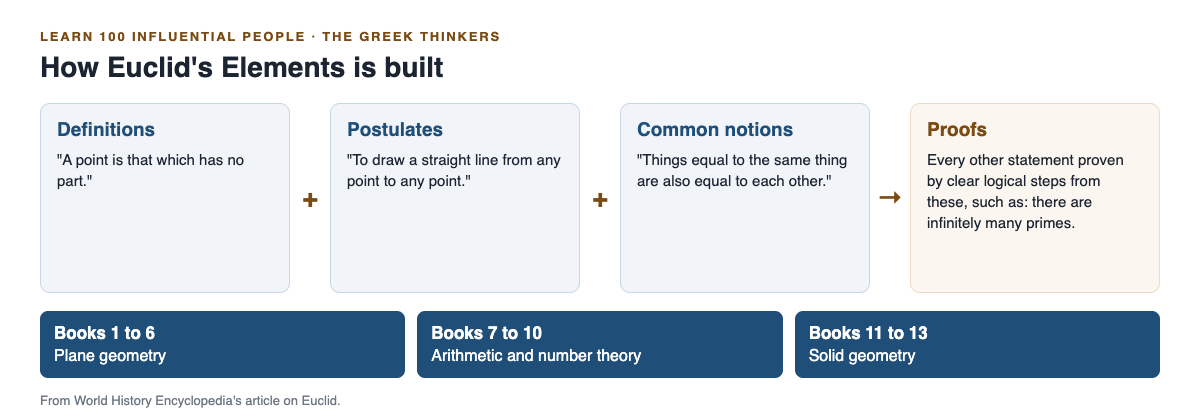
The building blocks of the Elements, and its three sections.
Every book opens with definitions. Book 1 also sets out postulates and what Euclid called common notions, which we now call axioms. Here is one of each, as World History Encyclopedia gives them:
- Definition: "A point is that which has no part."
- Postulate: "To draw a straight line from any point to any point." In other words, straight lines exist.
- Common notion: "Things equal to the same thing are also equal to each other."
If these look obvious, that is the point. Euclid wanted to start from ideas so plain that no one could reasonably doubt them, and then prove everything else from them.
What Euclid actually added
Euclid did not invent most of the ideas in the Elements. The philosopher Proclus, writing seven centuries later, said Euclid collected many of Eudoxus's theorems, perfected many of Theaetetus's, and gave firm proofs for things his predecessors had proved only loosely. World History Encyclopedia sums up his contribution in four parts:
- He collected the key mathematics of his day into one book, written as a textbook rather than a full reference.
- He defined his terms and stated his starting assumptions openly.
- He built an axiomatic system, where every statement is either a starting assumption or proved by clear logical steps from those assumptions.
- He added discoveries of his own, such as the first known proof that there are infinitely many prime numbers.
The third is the big one. The Elements did not just list true things about shapes and numbers. It showed how to know they were true.
Why the Elements shaped mathematics and beyond
From ancient times to the late 19th century, people treated the Elements as a perfect example of correct reasoning. It has gone through more than a thousand editions, which World History Encyclopedia says makes it one of the most popular books after the Bible. The article even suggests that much of Western mathematics has been a series of footnotes to Euclid, either developing his ideas or challenging them.
Its method spread outside mathematics too. In the 1600s the Dutch philosopher Baruch Spinoza wrote his Ethics in the same format of definitions, postulates, axioms and proofs. In the 20th century the Austrian economist Ludwig von Mises used Euclid's axiomatic method in his book Human Action.
Challenges came as well. Euclid's geometry describes the ordinary space around us. Modern non-Euclidean geometries describe space over astronomical distances, at speeds near that of light, or bent by gravity.
A worked example: think like Euclid
You can try his method in two minutes, using the common notion above.
- Start from what you accept. Things equal to the same thing are equal to each other.
- Set up a case. Line A is the same length as line C. Line B is also the same length as line C.
- Apply the rule. A and B are both equal to the same thing, C.
- Conclude. So A and B are equal to each other, and you did not need to measure them.
That is the whole idea, in miniature: a small number of plain starting points, and conclusions that follow by steps anyone can check. If you like seeing old ideas tested this way, the posts on Archimedes' inventions and Aristotle's contribution to science look at two more Greek thinkers.
Frequently asked questions
What is Euclid's Elements?
A geometry and mathematics textbook in 13 books, written around 300 BCE, that proves its results step by step from definitions, postulates and common notions.
Did Euclid invent geometry?
No. Egyptians, Babylonians and earlier Greeks already used geometry. Euclid collected it, organized it and proved it from first principles, adding some discoveries of his own.
What did Euclid prove about prime numbers?
The first known proof that there are infinitely many prime numbers is his.
Is Euclid's geometry still used?
Yes, for the ordinary space around us. Non-Euclidean geometries are used for space over huge distances, at near-light speeds or bent by gravity.
Get started
Euclid is one of six people in The Greek Thinkers, a Basic course on Learn 100 Influential People, alongside Socrates, Plato, Aristotle, Archimedes and Hippocrates. Basic courses cover the best-known names, with no background needed. Each lesson takes about 9 minutes and lists its sources, and its questions ask you to choose, put in order, match, sort and estimate a number. You sign in with your email and an emailed code.
Comments
No comments yet.
Sign in or make an account to comment.