Feature Visualization Explained for Beginners
Inside an image model, each neuron responds to something. But what? You cannot tell by staring at its numbers. Feature visualization answers that by making a picture of what a neuron is looking for. This post gives you feature visualization explained for beginners: how the pictures are made, why the first attempts look like static, how researchers fix that, what can mislead you, and why it matters for alignment.
Feature visualization explained: a plain definition
The clearest introduction is "Feature Visualization," a 2017 article by Chris Olah, Alexander Mordvintsev and Ludwig Schubert on Distill. It describes two threads of interpretability research. Attribution asks which parts of an input mattered for an output. Feature visualization "answers questions about what a network, or parts of a network, are looking for by generating examples."
In plain words: you pick a part of the network, and you make an input that part responds to strongly. The picture shows you what that part has learned to detect.
How it works: tweak an image until a neuron fires
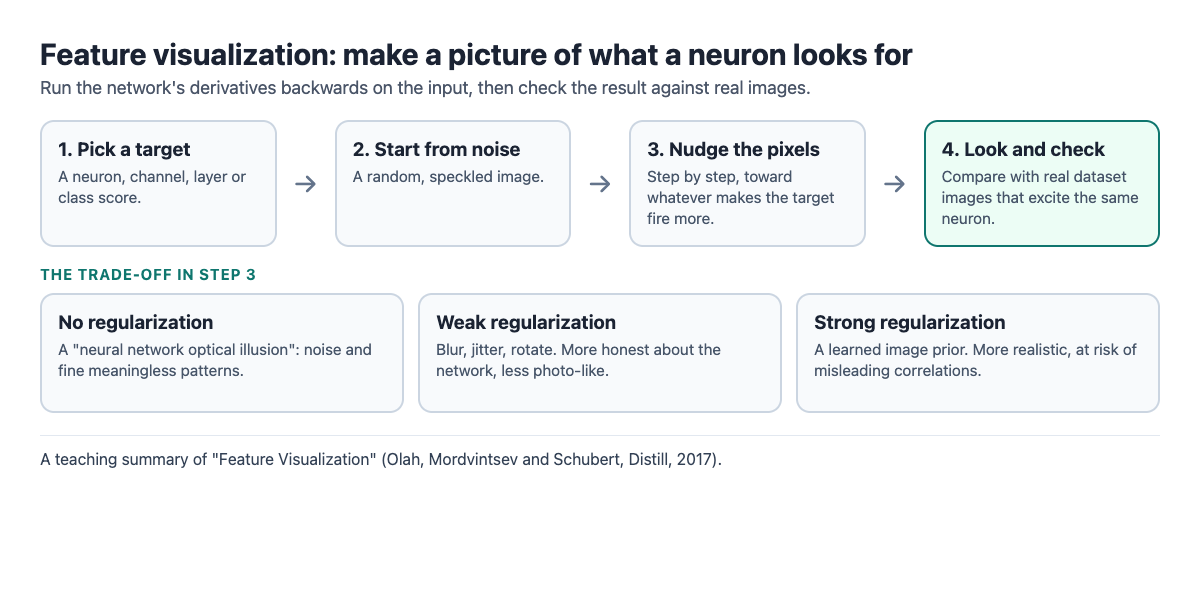
Neural networks can tell you, through derivatives, how a small change to the input changes any value inside them. So you can run the training process backwards:
- Pick a target. One neuron, a whole channel, a whole layer, or a class score such as "dog." The article walks through each choice.
- Start from random noise. A grey, speckled image.
- Nudge the image. Change each pixel slightly in the direction that makes the target fire more.
- Repeat many times, then look at the result.
The article's own example starts from noise and optimizes an image for one neuron in GoogLeNet, an image model, at layer mixed4a, unit 11. The core idea goes back to Erhan and colleagues in 2009.
Why raw results look like noise
Here is the catch. If you simply optimize an image to make a neuron fire, the article says, "this doesn't really work." You get "a kind of neural network optical illusion": an image full of noise and fine, meaningless patterns that the network responds to strongly. The authors describe it as the image "cheating," finding ways to excite the neuron that never occur in real photos.
Taming that noise has been "one of the primary challenges" of the field. The fixes are called regularization: rules that push the image toward something more natural.
How regularization fixes it, and its trade-off
The article sorts the fixes along a line from weak to strong:
- Frequency penalization. Penalize sharp pixel-to-pixel changes, or blur the image a little at each step.
- Transformation robustness. Randomly jitter, rotate or scale the image before each step, so only patterns that survive small shifts remain.
- Learned priors. Train a model of real images and keep the picture close to it.
Stronger regularization gives more realistic pictures, but there is a cost. In the article's words it comes "at risk of misleading correlations." With a learned prior, "it may be unclear what came from the model being visualized and what came from the prior." Weak regularization stays more honest about the network and looks less like real photos.
Dataset examples: the check that keeps you honest
There is a second way to see what a neuron likes: search a real dataset for the images that excite it most. Comparing the two is a useful check.
Dataset examples have one big advantage: diversity. Optimization usually gives one picture, which may show only one "facet" of a feature. Real examples show the whole range. In one of the article's cases, the top examples for a neuron included a spoon whose texture and color were close enough to dog fur to set it off. That is a hint the neuron responds to a texture, not only to dogs.
A worked example: read one neuron step by step
Here is a workflow you can follow with any published set of visualizations, such as the appendix of the Distill article:
- Look at the optimized picture. Write down a guess, for example "fur texture."
- Look at the top dataset examples. Do they match your guess? Note any odd ones, like the spoon.
- Look at weaker examples. Images that excite the neuron a little show its edges.
- Revise your label. "Fur-like texture, any object" beats "dog."
- Stay humble. Write down that your label is a guess about one neuron, not a proof.
Limits, and why it matters for alignment
The article is frank about limits. Neurons work in combinations, so single neurons may be the wrong unit; it suggests thinking about directions in "activation space." Its conclusion says that "by itself, feature visualization will never give a completely satisfactory understanding," and lists open problems: how neurons interact, which units matter most, and seeing every facet of a feature.
Later work built on it. Zoom In (2020) used these pictures to trace how curve detectors are built from simpler curve and line detectors, the start of circuits research. It also found a car feature spread over neurons that mostly detect dogs, which links to superposition.
For alignment, the appeal is seeing what a model has learned rather than only what it outputs. Opinions differ on how far that goes. Zoom In says the community is divided on whether neurons track meaningful things at all. Whether the pictures will help with the largest models is still an open question. For the wider field, see mechanistic interpretability for beginners.
Frequently asked questions
Is feature visualization the same as a saliency map?
No. A saliency map is a kind of attribution: it shows which parts of one input mattered. Feature visualization creates a new input to show what a part of the network looks for.
Why do feature visualizations look so strange?
Without regularization, optimization finds noisy patterns that excite neurons but never occur in real images. Regularization removes much of that, at some risk of adding patterns that come from the method.
Can feature visualization prove a model is safe?
No. Its own authors say it will never give a completely satisfactory understanding by itself. It is one tool among several.
Get started: learn interpretability step by step
On Learn AI Alignment Theory, Interpretability is one of the 7 Advanced courses. If you are new, the Basic course How Modern AI Works needs no background. Lessons run about 8 minutes, every lesson lists its sources, and debate cards set out each serious position with no verdict. You sign in with Google or an emailed code.
Start Learn AI Alignment Theory: short hands-on lessons from first principles to open research, with every side of every debate and the sources to read next.
Comments
No comments yet.
Sign in or make an account to comment.