Florence Nightingale's contributions to nursing, explained
Florence Nightingale's contributions to nursing are easy to name and hard to weigh. She is the woman with the lamp in the Crimean War, and she is also the person who made nursing a trained job with written standards. This post sets out what she did, in the order she did it, and where historians disagree about how much of it was hers. Every fact comes from Wikipedia's article on Florence Nightingale, which we opened for this post.
Who was Florence Nightingale?
She was born on 12 May 1820 in Florence, Italy, and died on 13 August 1910, aged 90. Wikipedia calls her an English social reformer, a statistician and the founder of modern nursing.
Her family did not want her to nurse. She rejected the role expected of a woman of her status and educated herself in "the art and science of nursing" against her family's opposition. In 1850 she visited a Lutheran community at Kaiserswerth in Germany, where deaconesses worked for the sick, and she had four months of medical training there. In 1851 she published her first work, anonymously, about that place. In August 1853 she became superintendent of the Institute for the Care of Sick Gentlewomen in Upper Harley Street, London.
What did she do in the Crimean War?
On 21 October 1854 she was sent to the Ottoman Empire with 38 women volunteer nurses and 15 Catholic nuns, with the backing of Sidney Herbert, the Secretary at War. She reached the barracks hospital at Scutari, now Üsküdar in Istanbul, in early November 1854.
The article describes poor care by overworked medical staff, medicines in short supply, hygiene neglected and mass infections, many of them fatal. Her team's job was to organise care in that place.
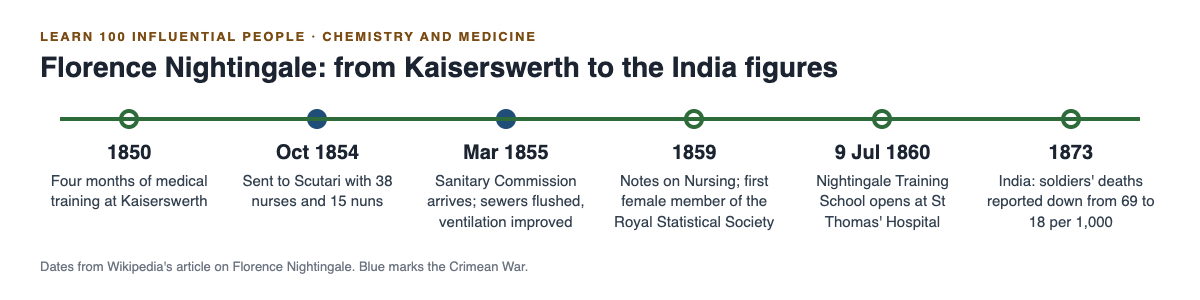
Nightingale's main dates, from Kaiserswerth to the India figures. Blue marks the Crimean War.
Who deserves the credit for the fall in deaths?
This is the part of the story with the most disagreement, so here are the numbers and the claims side by side.
- The numbers. In her first winter at Scutari, 4,077 British soldiers died there. Ten times more soldiers died of illness (typhus, typhoid, cholera and dysentery) than of battle wounds.
- The Sanitary Commission. The British government sent it in March 1855, almost six months after she arrived. It flushed the sewers and improved ventilation, and death rates fell sharply. The article says she never claimed credit for helping to reduce the death rate.
- The strong claim. Stephen Paget, in the Dictionary of National Biography, asserted that she cut the death rate from 42% to 2%, either by her own hygiene improvements or by calling for the Sanitary Commission.
- A comparison. After her plea to The Times, the government had Brunel design a prefabricated hospital, Renkioi, which had a death rate under one tenth of Scutari's.
- The doubts. BBC documentaries in 2001 and 2008 were critical of her performance. The scholar Lynn McDonald calls those criticisms "often preposterous" and says primary sources do not support them. The article also notes that recent commentators say the media of the day exaggerated her Crimean achievements, while critics agree her later work mattered.
The fair reading is that she was one of several causes, and that the commission is the better-documented one. Where you land on how much her pressure counted is your call.
The nickname "the Lady with the Lamp" comes from a report in The Times by William Russell, which pictured her alone at night "with a little lamp in her hand, making her solitary rounds". Longfellow's 1857 poem "Santa Filomena" spread it further. The article adds that troops had called her "the lady with the hammer", after she used a hammer to break into locked storage for medicine, and that Russell thought that unladylike and made up the lamp instead.
So the image is real but is partly a press creation. The same habit of asking who first told the story, and who gained from it, runs through our post on Jenner's smallpox vaccine.
Florence Nightingale's contributions to nursing as a job
The Nightingale Fund was set up on 29 November 1855 to train nurses. From it she had £45,000 to open the Nightingale Training School at St Thomas' Hospital in London on 9 July 1860. Wikipedia calls it the first secular nursing school in the world. The first trained Nightingale nurses began work on 16 May 1865 at the Liverpool Workhouse Infirmary.
Her book Notes on Nursing (1859) was written for people nursing at home, but it became the cornerstone of the school's curriculum. From the 1860s she also pushed trained nurses into the workhouse system, so that sick paupers stopped being cared for by other paupers.
For a sense of what she was changing, the article quotes the director of the Florence Nightingale Museum: before her, "there was no such thing as nursing", and Dickens's drunken nurse Sarah Gamp was "only a mild exaggeration". That is the museum director's view, and a fair one to check against other sources.
Her pupils carried the model outward. In the 1870s she mentored Linda Richards, "America's first trained nurse", and by 1882 several Nightingale nurses were matrons at leading hospitals in Britain and one in Sydney.
What was her work with statistics?
She used charts to argue with people who would not read tables. She is best known for the polar area diagram, which she called a "coxcomb", showing the seasonal sources of patient deaths in the military field hospital she managed. She presented the reports to Members of Parliament and civil servants. In 1859 she was elected the first female member of the Royal Statistical Society.
Credit is again shared. The article says she is frequently called the creator of the polar area diagram, but André-Michel Guerry used it in 1829 and Léon Louis Lalanne by 1830. Her contribution was using it to persuade.
What did she do after the war?
The war changed her view of what had killed the soldiers. After she collected evidence for the Royal Commission on the Health of the Army, she came to believe most had died of poor living conditions, so she moved to sanitary design of hospitals and homes.
- India. She reported in 1873 that soldiers' mortality there had fallen from 69 to 18 per 1,000 after 10 years of sanitary reform.
- Public health law. She lobbied for compulsory sanitation, and the Public Health Acts of 1874 and 1875 followed.
- Writing. She wrote some 200 books, pamphlets and articles, much of it from a sickbed: from 1857 she was intermittently bedridden.
- Honours. She received the Royal Red Cross in 1883 and in 1907 became the first woman to receive the Order of Merit.
It is sometimes said she denied infection all her life. The article says a 2008 biography disagrees: she opposed contagionism, the idea that disease passes only by touch. It adds that before the mid-1860s work of Pasteur and Lister hardly anyone took germ theory seriously, and that in the early 1880s she wrote for a textbook advocating strict precautions meant to kill germs. For the science behind that debate, read Pasteur's germ theory: what he showed and what came before.
A worked example: weigh one claim about her
Take the claim "Nightingale cut the death rate from 42% to 2%". You can test it in four steps.
- Find who said it. Stephen Paget, in a biographical dictionary, and he "asserted" it.
- Find the other causes. The Sanitary Commission arrived in March 1855 and flushed the sewers and improved ventilation.
- Find the doubts. Read the BBC criticism and McDonald's reply, and note that one is a documentary and the other a scholar citing primary sources.
- Write the narrower sentence. "Death rates fell sharply after the commission cleaned Scutari, and Paget credited her with the fall" holds up; "She alone cut deaths to 2%" does not.
The home page of Learn 100 Influential People, where the lessons start.
Frequently asked questions
Why is Florence Nightingale called the founder of modern nursing?
Because she opened the Nightingale Training School at St Thomas' Hospital in 1860, wrote Notes on Nursing and spent the rest of her life organising the profession. Wikipedia calls the school the first secular nursing school in the world.
Did Florence Nightingale really cut deaths at Scutari?
Death rates fell sharply after the Sanitary Commission arrived in March 1855. How much of the fall was hers is debated, and she never claimed credit for it.
What is the Nightingale rose diagram?
It is a polar area diagram, a circular chart showing the seasonal causes of patient deaths. She did not invent the form, since Guerry used it in 1829, but she used it to argue for reform.
Did Nightingale believe in germs?
She opposed contagionism, the idea that disease passes only by touch. A 2008 biography says that in the early 1880s she advocated strict precautions to kill germs.
Get started
Learn 100 Influential People has short hands-on lessons, about 9 minutes each, on the people who most shaped history, with questions that check what you learned. Its Chemistry and Medicine course pairs Nightingale and Fleming. You sign in with your email and an emailed code. Open Learn 100 Influential People and read about the project first if you want to see what is inside.
Comments
No comments yet.
Sign in or make an account to comment.