Friedman vs Keynes: money, spending and the state explained
Friedman vs Keynes is one of the great arguments in modern economics. John Maynard Keynes and Milton Friedman never traded blows in person, because Keynes died in 1946, the year Friedman earned his doctorate. But Friedman built his career by taking on the Keynesian view, and the two names still stand for two ways of answering the same question: when an economy goes wrong, should you steer spending, or steer the money supply? This guide explains who each man was, compares them on four questions, runs two real episodes through both lenses, and shows what is still debated.
Friedman vs Keynes: the short answer
- Keynes saw the economy as driven by total spending, which economists call aggregate demand. When spending collapses and people lose work, he argued, government should step in and spend, even on borrowed money.
- Friedman saw the money supply as the key. He saw inflation as fundamentally about money, and proposed that central banks follow a simple rule for how fast money grows.
Put simply, Keynes asks how to get spending back up. Friedman asks whether the money supply is growing at the right pace, and answers with a fixed rule.
Who was John Maynard Keynes?
Keynes (1883 to 1946) was born in Cambridge, England, and took a degree in mathematics at King's College, Cambridge, in 1905. The Concise Encyclopedia of Economics biography says that by 1919 he was the British Treasury's principal representative at the peace conference at Versailles, and that he resigned because he thought the treaty overly burdensome for the Germans.
His big change of mind came with the slump. Unemployment in interwar Britain dragged on, reaching levels as high as 20 percent, and Keynes went looking for causes beyond the ones he had learned. The result was The General Theory of Employment, Interest and Money. It treated aggregate demand as the sum of consumption, investment and government spending, and it argued that full employment could be maintained only with the help of government spending. In a downturn, it advocated deficit spending. The same entry stresses that Keynes was, in its words, "a relatively strong advocate of free markets", so he was no enemy of them.
Who was Milton Friedman?
Friedman (1912 to 2006) was born in New York City to Jewish immigrants and, as the Concise Encyclopedia of Economics biography records, won the Nobel Prize in economics in 1976. It calls him the twentieth century's most prominent advocate of free markets.
His 1957 book A Theory of the Consumption Function took on the Keynesian view that households adjust their spending to their current income. Friedman argued instead that people's consumption follows their "permanent income", the average they expect over a few years. His 1962 Capitalism and Freedom made the case for freer markets to a general audience, and Free to Choose, written with his wife Rose Friedman, was the best-selling nonfiction book of 1980. But he is popularly recognized for monetarism, a school that puts the money supply first.
Four questions, side by side
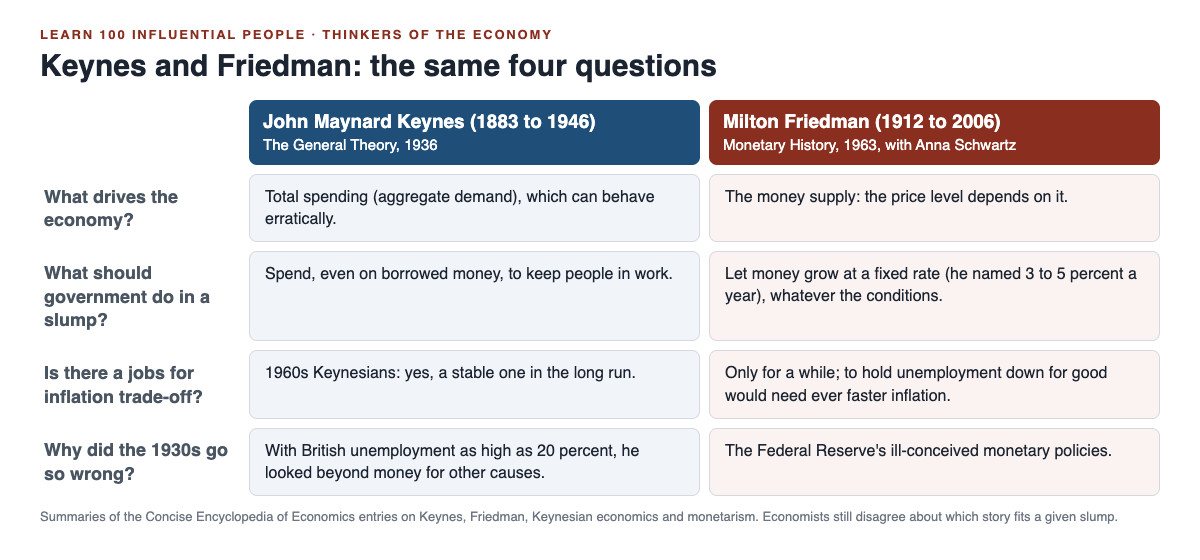
- What drives the economy? Keynes: total spending, which the entry on Keynesian economics says "sometimes behaves erratically". Friedman: the money supply. In Studies in the Quantity Theory of Money (1956) he argued that in the long run more money growth raises prices with little or no effect on output.
- What should government do in a slump? Keynes: spend, to keep people in work. Friedman: follow a rule. The entry on monetarism quotes his proposal that money grow "month by month, and indeed, so far as possible, day by day, at an annual rate of X per cent, where X is some number between 3 and 5".
- Is there a trade-off between jobs and inflation? In the 1960s, Keynesians and mainstream economists generally believed government could permanently lower unemployment by accepting higher inflation. Friedman, with Edmund Phelps, challenged that: once people adjusted, unemployment would creep back up, and holding it lower would need a permanently accelerating inflation rate.
- What went wrong in the 1930s? Keynes, facing British unemployment of up to 20 percent, looked beyond money for other causes. In A Monetary History of the United States (1963, with Anna Schwartz), Friedman contended that the Great Depression was the result of the Federal Reserve's ill-conceived monetary policies.
A slump, run through both lenses
Here is a worked example you can follow with a pencil. Imagine a country where households and firms suddenly spend less, factories cut shifts and unemployment rises.
- Keynes's first move. Ask what total spending is doing. If consumption and investment have fallen, someone has to fill the gap. The government hires the unemployed on public works, which was Keynes's idea of government taking the place of business for a while.
- The multiplier. Keynesian models say output rises by a multiple of the original spending. The Keynesian entry gives the example that ten billion dollars of extra government spending could raise output by fifteen billion (a multiplier of 1.5) or by five billion (0.5), and that the multiplier only has to be above zero for the argument to work.
- Friedman's first move. Ask what the money supply did. Friedman's own history of the Depression blamed the Federal Reserve's monetary policies, and his cure was his rule: money growing at a fixed rate, whatever the conditions.
- Compare the answers. Both sides want the slump to end. They differ on the tool: public spending for Keynes, steady money growth for Friedman.
Now try the 1970s. Through the 1960s, Keynesians had believed in a stable long-run trade-off between unemployment and inflation, so rising inflation looked like a price paid for jobs. The Concise Encyclopedia says the stagflation of the 1970s, rising inflation together with rising unemployment, gave strong evidence for the Friedman-Phelps view and swayed most economists, including many Keynesians.
Where they agree more than you think
The popular picture has them as opposites, but the sources describe a lot of common ground:
- The Keynesian entry quotes Friedman himself: "under any conceivable institutional arrangements, and certainly under those that now prevail in the United States, there is only a limited amount of flexibility in prices and wages." It adds that this "would certainly be called a Keynesian position".
- Economists once argued heatedly over which is stronger, monetary or fiscal policy. The same entry says nearly all Keynesians and monetarists now believe both affect aggregate demand.
- Most Keynesians no longer believe in fine-tuning. Almost all economists now agree that government cannot know enough soon enough to adjust spending, taxes and money every few months.
- Textbooks moved. The Friedman biography notes that Paul Samuelson's text said in 1948 that "few economists regard Federal Reserve monetary policy as a panacea", and by 1985 said "Money is the most powerful and useful tool that macroeconomic policymakers have".
What is still debated
Each side has taken real knocks. The monetarism entry says the school's reputation began to decline in the late 1970s for three main reasons: money demand looked unstable in practice, rational expectations economics split the critics of Keynesian activism into camps, and the Federal Reserve's monetarist experiment of 1979 to 1982. That began on 6 October 1979 under Paul Volcker, with monthly targets for the growth of M1, a measure of money. By 1981 and 1982 it had brought on the deepest recession since the Great Depression. Looking back, the entry says the period is widely seen as the crucial start of a necessary and successful attack on inflation.
Keynes's own work took knocks too. The Keynes biography says that little of his original work survives in modern economic theory, and that Keynesian economics today is chiefly the product of later economists. It even says that economists still argue about what Keynes thought caused high unemployment. So the real question is rarely "who won", but which tool fits which problem. For a related fight over the same period, read Keynes vs Hayek: the debate explained simply.
Frequently asked questions
What is the main difference between Friedman and Keynes?
Keynes focused on total spending and wanted government to fill the gap in a slump. Friedman focused on the money supply and wanted central banks to follow a steady rule for how fast it grows.
Did Friedman and Keynes ever meet or debate?
The sources do not describe a meeting. Keynes died on 21 April 1946, the same year Friedman earned his Ph.D., so their argument is one between Friedman and the Keynesian school that followed Keynes.
Was Friedman against Keynes completely?
No. The Concise Encyclopedia notes that Friedman accepted that prices and wages have only limited flexibility, which it calls a Keynesian position. His 1957 book still took on a Keynesian view of consumption.
Who was right, Keynes or Friedman?
Economists still disagree. Friedman's no-trade-off view won over most economists after the 1970s, while monetarism's own reputation declined from the late 1970s. Keynesian economics was heavily revised by later thinkers.
Get started
Keynes and Friedman are both in Thinkers of the Economy, an Intermediate course on Learn 100 Influential People, with Adam Smith, Ricardo, Malthus, Marx and Hayek. Intermediate courses cover "How ideas, faiths, inventions and markets spread and changed the world." Lessons take about 9 minutes. Like this guide, the site gives every side: cards set out where researchers disagree, and every lesson lists its sources. Sign in with your email and an emailed code; accounts are for people aged 13 or older.
Start Learn 100 Influential People: short hands-on lessons on the people who shaped history, with every side of the debate and the sources to read next.
Comments
No comments yet.
Sign in or make an account to comment.