Future of Life Institute: what it is and what it does
The Future of Life Institute, or FLI, is a nonprofit that campaigns against large-scale risks from technology, above all the risk that advanced AI could threaten humanity's survival. It is behind some of the best-known public letters on AI, from the Asilomar principles to the 2023 call for a pause and the 2025 Statement on Superintelligence. This post explains what FLI is, what it has done, and the criticism it has faced, with no verdict. The claims come from Wikipedia's Future of Life Institute article.
What the Future of Life Institute is
FLI's stated mission is to steer transformative technology towards benefiting life and away from large-scale risks. Its main focus is the potential risk to humanity from human-level or superintelligent artificial general intelligence (AGI). It also works on risks from biotechnology, nuclear weapons and global warming.
The article lists three kinds of work:
- Grantmaking: funding research.
- Educational outreach.
- Advocacy: with the United Nations, the United States government and European Union institutions.
How it started
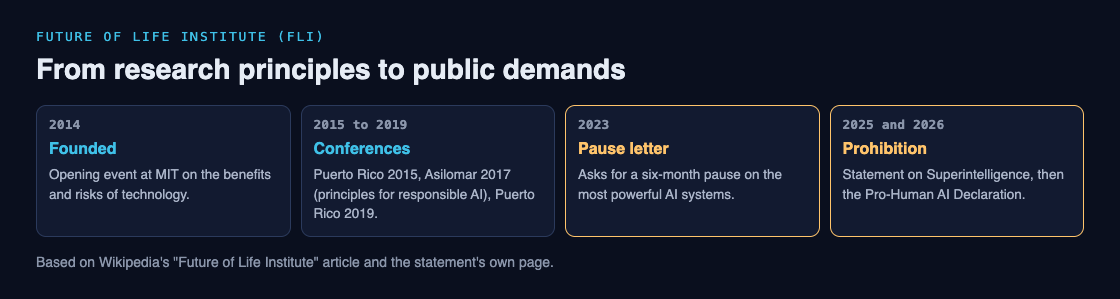
FLI was founded in March 2014. Its founders include the MIT cosmologist Max Tegmark, the Tufts University postdoctoral scholar Meia Chita-Tegmark and the UCSC physicist Anthony Aguirre, now its president. Tegmark's book on the future of AI is covered in our post on Life 3.0 by Max Tegmark.
Its opening event, at MIT in 2014, was a panel called "The Future of Technology: Benefits and Risks". The panelists included the physicist and Nobel laureate Frank Wilczek, the synthetic biologist George Church, the geneticist Ting Wu and the economist Andrew McAfee.
Conferences and the Asilomar principles
Since 2015, FLI has run conferences meant to bring together AI researchers from universities and industry:
- Puerto Rico, 2015: "The Future of AI: Opportunities and Challenges". FLI circulated an open letter on AI safety there, later signed by many AI researchers.
- Asilomar, California, 2017: the Beneficial AI conference. Afterwards, FLI released a set of principles for responsible AI development, signed by Yoshua Bengio and many other researchers. The article says they may have influenced AI regulation and later efforts such as the OECD Principles on Artificial Intelligence. See our post on the Asilomar AI principles.
- Puerto Rico, 2019: a conference on making sure artificial general intelligence benefits humanity.
- New Orleans, 2026: technologists, ethicists, policymakers and faith leaders on "what it means to keep the future human".
Open letters: from a pause to a prohibition
Its letters have asked for more over time: first a pause, then a prohibition.
The 2023 pause letter
In March 2023, FLI published "Pause Giant AI Experiments: An Open Letter". It asked major AI developers to agree on a verifiable six-month pause on the most powerful systems or, failing that, for governments to step in with a moratorium. Our post on calls to pause AI covers who backed and who opposed it. One critic, Margaret Mitchell, an author of a paper the letter cited, said: "Ignoring active harms right now is a privilege that some of us don't have."
The 2025 statement and the 2026 declaration
In October 2025, the Statement on Superintelligence called for a prohibition on developing superintelligence until there is "broad scientific consensus that it will be done safely and controllably" and "strong public buy-in". Our post on the Statement on Superintelligence explains it in full.
In March 2026, FLI organized the Pro-Human AI Declaration. Its five principles are keeping humans in charge, avoiding concentration of power, protecting the human experience, human agency and liberty, and responsibility and accountability for AI companies. By September 2026, more than 1 million people had signed it.
Policy, weapons and awards
FLI also works directly on policy. In October 2023, the US Senate majority leader invited it to share its view on AI regulation with selected senators. In Europe, it argued for including more general AI systems in the EU's Artificial Intelligence Act.
Its work on weapons goes beyond AI. It coordinated support from scientists for the Treaty on the Prohibition of Nuclear Weapons, and has argued at the UN and elsewhere for a treaty on autonomous weapons. In 2018 it drafted a letter calling for "laws against lethal autonomous weapons". In 2017 it released Slaughterbots, a short arms-control film, with sequels in 2021 and 2025. That same year it started the annual Future of Life Award; the first went to Vasili Arkhipov.
A grant controversy
In January 2023, the Swedish magazine Expo reported that FLI had offered a $100,000 grant to a foundation set up by a Swedish far-right online newspaper. Tegmark said the institute learned of the newspaper's positions only during due diligence a few months after the offer, and that the grant was immediately revoked.
A worked example: read any FLI letter with three checks
FLI publishes many letters, and they are easy to blur together. Three checks keep them apart. Here they are, applied to the three best known.
- What does it ask for? 2023: a six-month pause. 2025: a prohibition on superintelligence. 2026: five principles, including a prohibition until proven safe.
- Who has to act? 2023: major AI developers first, then governments if they do not. 2025: FLI's president says he is counting on "widespread realization among society at all its levels". 2026: the declaration calls for measures such as mandatory safety testing before consumer AI systems are released and criminal liability for executives responsible for prohibited or catastrophic AI harms.
- What would end it? 2023: six months, used to set up a safety framework. 2025: broad scientific consensus on safety and strong public buy-in. 2026: proof that it is safe.
Try the same three checks on the next AI letter you see, from FLI or anyone else. If you cannot answer the third one, you will know the letter's hardest question is still open.
Exploring the idea in Contain ASI
Contain ASI is a story strategy game for 1 to 4 players that runs in your browser and needs WebGL 2. Chapter 1, Before ASI, starts in January 2024 with four fictional AI labs in one race. As a researcher, research manager, CEO or government, you try for three years to keep every lab from crossing into recursive self-improvement before 2027.
It is a game, not a forecast: the page says all its labs, people and events are fictional, and it does not name FLI. Groups like FLI ask the real world to slow a race; the game lets you try it in fiction. For another group working on the same risks, see our post on MIRI.
Frequently asked questions
What does the Future of Life Institute do?
It campaigns against large-scale risks from technology, mainly from advanced AI, through grants, outreach such as letters, films and conferences, and advocacy with governments and the UN.
Who founded the Future of Life Institute?
It was founded in March 2014. Its founders include Max Tegmark, Meia Chita-Tegmark and Anthony Aguirre.
Did FLI write the AI pause letter?
Yes. In March 2023 it published "Pause Giant AI Experiments: An Open Letter", which asked for a six-month pause on the most powerful AI systems.
Is FLI the same as MIRI?
No. Both work on risks from advanced AI, but they are separate nonprofits. FLI works through grants, outreach and advocacy; MIRI is a research institute that has put policy and public communication first since 2023.
Get started
Want to see how hard it is to slow a race? Open Contain ASI in your browser and start a campaign as a researcher, research manager, CEO or government.
Comments
No comments yet.
Sign in or make an account to comment.