Galileo's discoveries: what he saw and why it mattered
Galileo Galilei (1564 to 1642) is one of the first names in any history of science. The Stanford Encyclopedia of Philosophy calls him a, if not the, central figure of the Scientific Revolution. But ask what exactly he found, and most people stop at "the telescope" and "the trial". This guide sets out Galileo's discoveries in two groups, what each one showed, why they got him into trouble, and where historians still disagree about his story.
Who Galileo was, in one paragraph
Galileo was the son of a court musician, and he left the University of Pisa without a degree. He still went on to teach mathematics, first at Pisa and then, from 1592, as holder of the chair of mathematics at the University of Padua in the Venetian Republic. At Padua he worked out much of the science of motion that he would publish late in life. In 1609 he heard of a new Dutch invention, the spyglass, built a better one, and turned it on the sky. The book that followed made him famous across Europe.
Galileo's discoveries about motion
The Stanford entry says his work on mechanics, done mostly at Padua, is his main lasting contribution to physical science. In plain words, he showed that:
- Falling bodies speed up at the same rate whatever their weight. Without air in the way, a heavy stone and a light one land together. He worked out the law of this fall.
- A thrown object follows a curve called a parabola. This is why a ball, a stone or a cannonball arcs the way it does.
- A moving body keeps moving unless something stops it. On a perfectly smooth surface, a ball would roll on at the same speed. This was an early form of the idea of inertia.
- Motion is relative. The Stanford entry also credits him with recognizing the relativity of motion.
These broke with the old physics of Aristotle. They also answered an old objection to the idea that the Earth goes around the Sun: what keeps it moving? Galileo's answer, says World History Encyclopedia, was that no continuous force was needed.
Galileo's discoveries with the telescope
World History Encyclopedia says his telescope reached a magnification of 33 diameters, far stronger than others had, which is partly why other astronomers struggled to see what he described. In March 1610 he published Sidereus nuncius, the Starry Messenger. The Stanford entry lists him as the first to report telescope observations of four things:
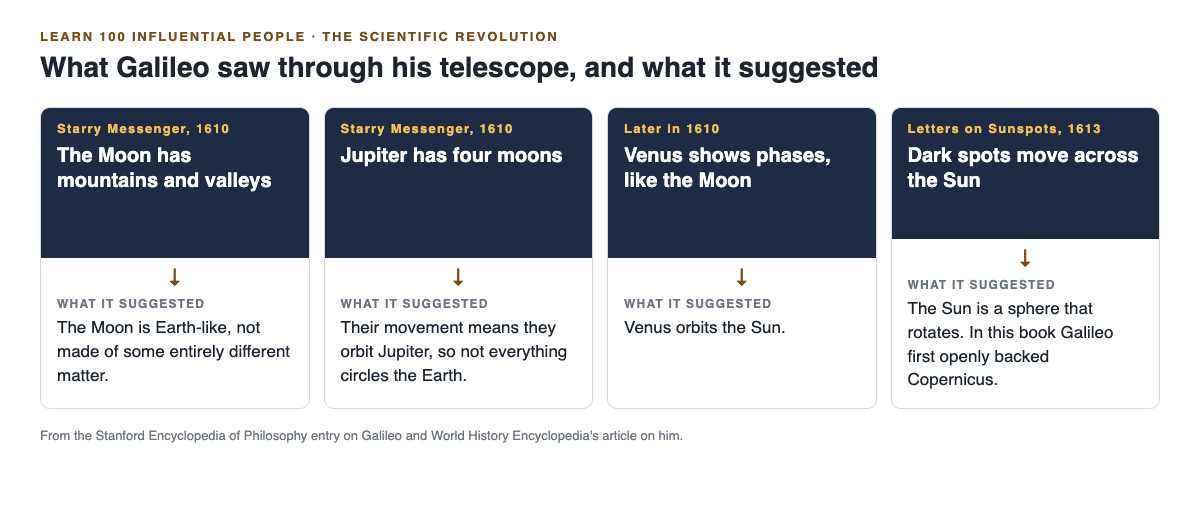
Four observations and what each one suggested.
- Mountains and valleys on the Moon. The Moon looked like the Earth, not like a perfect body made of some different stuff.
- Four moons circling Jupiter. Here were bodies that clearly went around something other than the Earth.
- The phases of Venus, seen later in 1610. Venus waxes and wanes like our Moon, which indicated that it orbits the Sun.
- A changing Saturn. He was seeing its rings, though he did not fully understand them.
He also studied sunspots. Watching them move across the face of the Sun, he argued that the Sun is a sphere and that it turns. He named Jupiter's moons the "Medicean stars" after the ruling Medici family of Tuscany, and the move worked: he became Chief Mathematician and Philosopher to the Grand Duke.
Why Galileo's discoveries mattered
Each observation on its own was a curiosity. Together, they pulled down the old wall between the heavens and the Earth. The Moon had mountains. Jupiter had its own moons. Venus went around the Sun. The heavens were made of the same kind of stuff as the ground, and obeyed the same rules.
That supported the idea Copernicus had put forward: that the Earth and planets go around the Sun, not the other way round. Galileo had said privately that he held this view as early as 1597, in a letter to Kepler. He first said so openly in his Letters on Sunspots of 1613.
World History Encyclopedia adds a point that matters as much as any single finding: Galileo combined mathematics, careful observation and repeated experiments to test ideas, and that way of working became the standard approach for the other serious thinkers of the Scientific Revolution. He also wrote in Italian, not only in Latin, so more people could read him.
He was not right about everything. Kepler showed that planets move in ellipses, not the perfect circles Galileo assumed, and Newton's gravity later explained things that had puzzled Galileo. That is how one discovery leads to the next, and it is why Newton's work is the natural next step after Galileo.
The trial: 1616 and 1633
In March 1616, the Church suspended Copernicus's book pending correction. Galileo was called before Cardinal Robert Bellarmine and told not to teach or defend the Copernican theory. The Stanford entry notes that the details of that meeting are still disputed.
In 1632 he published his Dialogue on the two chief systems of the world. It is written as a conversation, and the character who defends the old Earth-centred view is called Simplicio. The book clearly favoured Copernicus. The Inquisition banned its sale and called Galileo to Rome. In June 1633 he was convicted of "vehement suspicion of heresy", and his sentence was turned into house arrest for the rest of his life.
He kept working. His last book, Two New Sciences, set out his work on motion and the strength of materials. It had to be smuggled out of Italy and was published in Holland in 1638. He died early in 1642.
Where historians disagree
The Leaning Tower. Many people learn that Galileo dropped two balls from the Leaning Tower of Pisa. World History Encyclopedia calls that story apocryphal, meaning it is probably not true. The Stanford entry notes only that he is sometimes described as an experimenter who dropped stones from towers and ships' masts. What both agree on is the result: falling bodies speed up at the same rate.
Science against religion? Galileo's trial is often told as proof of a long war between science and religion, with Galileo as its martyr. The Stanford entry calls him a "purported" martyr in a "supposed" war. World History Encyclopedia quotes the historian John Henry: "The Galileo affair should not be taken as a general indicator of relations between science and religion in the early modern period". It also points to the personal enemies Galileo made. On the other side is the long tradition, which the Stanford entry describes, that made Galileo a martyr "to the cause of rationality and enlightened modernity" and his trial a clash between new evidence and old authority. Read both views and decide for yourself.
A worked way to study Galileo in a week
- Day 1: Learn the four telescope observations and what each showed. Say them aloud from memory.
- Day 2: Learn the motion findings. Explain to someone why a heavy and a light ball land together without air.
- Day 3: Put five dates in order: 1592 Padua, 1610 Starry Messenger, 1613 Letters on Sunspots, 1616 Bellarmine, 1633 trial.
- Day 5: Write three sentences on each side of the "science against religion" question.
- Day 7: Redo days 1 and 3 from a blank page, then check.
If you like this method, the post on how to make a history timeline that sticks shows how to turn those dates into a picture you will remember.
Frequently asked questions
What were Galileo's most important discoveries?
With the telescope: mountains on the Moon, four moons of Jupiter, the phases of Venus and the changing shape of Saturn. In physics: the law of falling bodies, the curved path of thrown objects, and an early idea of inertia.
Did Galileo invent the telescope?
No. He heard of the newly invented spyglass in 1609 and built a much better one. His contribution was what he saw with it and what he argued from it.
Why was Galileo put on trial?
His 1632 Dialogue clearly favoured Copernicus's Sun-centred view after he had been told in 1616 not to defend it. In 1633 he was convicted of "vehement suspicion of heresy" and placed under house arrest.
Did Galileo really drop balls from the Leaning Tower of Pisa?
Probably not. World History Encyclopedia calls the story apocryphal, though his finding about falling bodies is real.
Get started
Galileo is one of six people in The Scientific Revolution, a Basic course on Learn 100 Influential People, alongside Copernicus, Kepler, Newton, Darwin and Mendel. Basic courses cover the best-known names, with no background needed. Each lesson takes about 9 minutes, lists its sources, and ends with questions where you choose, put in order, match, sort and estimate a number, and the site's debate cards set out where researchers disagree. You sign in with your email and an emailed code.
Comments
No comments yet.
Sign in or make an account to comment.