Gandhi vs Martin Luther King: nonviolence compared
Gandhi vs Martin Luther King is less a contest than a family tree. King's civil rights organization took its working methods from Mohandas Gandhi. The Nobel Prize calls Gandhi "the strongest symbol of non-violence in the 20th century," and King won the Peace Prize for a non-violent struggle of his own. But they faced different opponents, drew on different faiths, and did not mean exactly the same thing by nonviolence. This guide sets out who each was, compares them on four questions, runs one protest through both, and shows where scholars still disagree.
Gandhi vs Martin Luther King: the short answer
- Gandhi (1869 to 1948) built a method he called satyagraha, "truth force," first against racist laws in South Africa and then against British authorities in India. You break an unjust law openly, accept the punishment, and calmly deny that the law is legitimate, until the other side sees it is wrong.
- King (1929 to 1968) was a leader of the struggle against racial segregation in the United States. His movement took its ideals from Christianity and, in the words of his Nobel biography, "its operational techniques from Gandhi."
Put simply, King learned the method from Gandhi and used it in a different country, against a different injustice, in his own Christian language.
Who was Mohandas Gandhi?
The Nobel Prize article "Mahatma Gandhi, the Missing Laureate" gives the outline. He was born in Porbandar, in what is now Gujarat in western India, where his father was chief minister. His mother was a deeply religious Hindu, and the family belonged to a branch of Hinduism in which non-violence and tolerance between religious groups mattered a great deal. He studied law in London in the late 1880s, and in 1893 went to Natal in South Africa to work for an Indian trading company.
There he fought increasingly racist laws against the Indian minority, and developed satyagraha. He came back to India in 1915, and within a few years was a leading figure in the Indian National Congress. Between the two world wars he led a series of non-violent campaigns against the British authorities, while working to unite Hindus, Muslims and Christians and to free the "untouchables" in Hindu society. The Stanford entry on civil disobedience names his Salt March, alongside the Boston Tea Party, as an example of civil disobedience. He was nominated five times for the Nobel Peace Prize but never received it, and was murdered on 30 January 1948.
Who was Martin Luther King Jr.?
King was born in Atlanta on 15 January 1929, the son and grandson of pastors. In 1954 he became pastor of the Dexter Avenue Baptist Church in Montgomery, Alabama. In December 1955 he led the Montgomery bus boycott, which lasted 382 days and ended after the Supreme Court declared bus segregation laws unconstitutional. During it he was arrested and his home was bombed.
In 1957 he became president of the Southern Christian Leadership Conference. He led the Birmingham protests that produced his "Letter from a Birmingham Jail," and spoke to 250,000 people at the march on Washington. He was arrested upwards of twenty times. In 1964, at 35, he became the youngest man to have received the Nobel Peace Prize, which the Nobel Prize page says was "for his non-violent struggle for civil rights for the Afro-American population." He was murdered in Memphis on 4 April 1968, where he had gone to support striking garbage workers.
Four questions, side by side
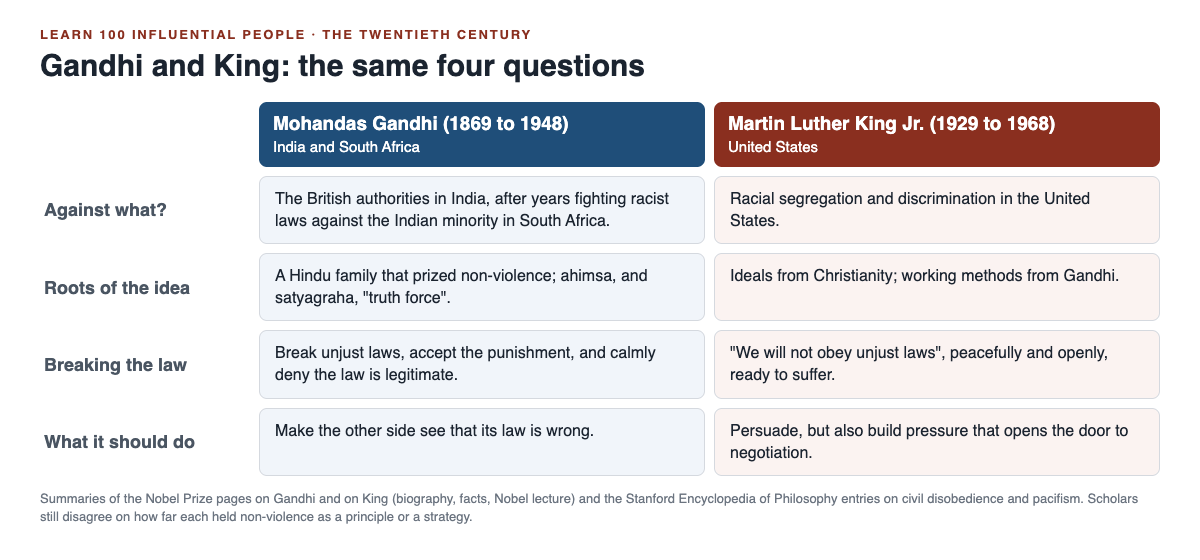
- What were they against? Gandhi: racist laws in South Africa, then the British authorities in India. King: racial segregation and discrimination in the United States.
- Where did the idea come from? Gandhi: a Hindu tradition of ahimsa, or nonviolence, tied to a wider religious path. King: Christianity for the ideals, Gandhi for the method. King added that nonviolence also meant overcoming the "internal violence" of hatred and anger.
- How do you break an unjust law? Both said: openly, and accept the cost. Gandhi asked people to accept punishment while rejecting the law's legitimacy. King, in his Nobel lecture: "We will not obey unjust laws or submit to unjust practices. We will do this peacefully, openly, cheerfully because our aim is to persuade."
- Persuasion or pressure? Gandhi aimed to make opponents recognize that their laws were unjust. King came to think appeals to conscience were not enough without disruption and "some form of constructive coercive power," as the Stanford Encyclopedia of Philosophy entry on civil disobedience explains.
Worked example: one protest, two lenses
Take the Montgomery bus boycott, and test it against each man's rules. You can use the same three steps for any protest you study.
- Is the law unjust, and is it broken openly? The bus laws required segregation. The boycott was open, not hidden, and King himself was arrested and abused but kept going. Gandhi's test and King's test both pass.
- Does it aim to persuade or to pressure? A boycott does both. It asks the public to see the injustice, and it costs the bus company money. The encyclopedia notes that boycotts are often seen as coercive because they impose costs on businesses, while King himself wrote that "Nonviolent coercion always brings tension to the surface."
- What happens to those who suffer? King held that "unearned suffering is redemptive." Gandhi made accepting punishment a core part of satyagraha. Both treated suffering without striking back as part of the message.
Write your answers in two columns, one per thinker. Where the columns differ, you have the core of an essay; our guide to how to compare two historical figures in an essay turns that into a plan.
Where scholars still disagree
- Principle or strategy? The Nobel article says many Indian nationalists used non-violence for tactical reasons, but that for Gandhi it was "a matter of principle." King called violence "both impractical and immoral," giving both kinds of reason. Karuna Mantena, as summarised by the Stanford entry, challenges the common view of Gandhi and King as committed to non-violence absolutely and in principle, and argues that their support for it reflected concerns about political effectiveness: they saw violence as "futile."
- How absolute was Gandhi? The Stanford entry on pacifism says Gandhi is often seen as the model of absolute nonviolence, but that how "absolute" he was is an open question. In September 1947, a newspaper report of a prayer meeting had him saying India might have to go to war with Pakistan; Gandhi said the report was correct but incomplete, and that he had not changed his mind.
- Who was the struggle for? Some critics outside India said Gandhi was too much of an Indian nationalist. One Nobel adviser in 1937 noted that his struggle in South Africa was on behalf of the Indians only, not of the black population, whose conditions were even worse.
- Does nonviolence work? Critics of Gandhi pointed to campaigns that turned violent, such as the attack at Chauri Chaura during the Non-Cooperation Campaign of 1920 to 1921. The Stanford entry on civil disobedience reports that recent social science research has backed the effectiveness of non-violence in campaigns against dictatorships and colonial powers.
Frequently asked questions
Did Martin Luther King follow Gandhi?
Yes. His Nobel biography says his organization took its ideals from Christianity and its operational techniques from Gandhi, and the Nobel Prize page says he adhered to Gandhi's philosophy of nonviolence.
What is the main difference between Gandhi and King?
Gandhi grounded nonviolence in a Hindu tradition of ahimsa and used it against British rule in India. King grounded it in Christianity, used it against segregation in the United States, and stressed the pressure that nonviolent action puts on opponents as well as its power to persuade.
Did Gandhi win the Nobel Peace Prize?
No. He was nominated in 1937, 1938, 1939, 1947 and 1948 but never received it; in 1948, after his death, the committee gave no prize that year.
What does satyagraha mean?
It means "truth force." People break unjust laws openly, accept the punishment, and calmly reject the law's legitimacy, so that the other side comes to see the law is wrong.
Get started
Gandhi and King are both in The Twentieth Century, an Advanced course on Learn 100 Influential People, with Lenin, Stalin, Hitler, Churchill, Roosevelt, Mao, Deng and Mandela. Advanced courses cover "Modern power, modern physics and the debates still running today." Lessons take about 9 minutes, 38 cards set out where researchers disagree, and every lesson lists its sources. Sign in with your email and an emailed code; accounts are for people aged 13 or older.
Start Learn 100 Influential People: short hands-on lessons on the people who shaped history, with every side of the debate and the sources to read next.
Comments
No comments yet.
Sign in or make an account to comment.