How to compare two historical figures in an essay: 5 steps
If you have to write about how to compare two historical figures in an essay, the hard part is not finding facts. It is turning two life stories into one argument. This guide gives you five steps that do that: a question, three points of comparison, a thesis, a structure, and fair evidence. Then it walks through a full essay plan on two economists who argued with each other, John Maynard Keynes and Friedrich Hayek.
How to compare two historical figures: the short answer
- Pick a pair and a question. Two people who answered the same problem, and one question about how they differ.
- Choose three points of comparison. The same three headings for both people.
- Write a thesis about the comparison. One sentence that says how they are alike, how they differ, and why it matters.
- Pick a structure. Point by point, or one person then the other.
- Back every point with evidence from both sides. A source for each claim, and the strongest case for each person.
The rest of this guide explains each step.
Steps 1 and 2: a pair, a question and three points
A good pair shares a problem. Two thinkers who answered the same question, two leaders in the same war, two scientists working on the same puzzle. Without a shared problem, you end up with two separate biographies.
Then turn the essay title into a question you can answer. "Compare Keynes and Hayek" is a topic. "Why did Keynes and Hayek give opposite advice about the same slumps?" is a question.
Now choose three points of comparison, and use the same three for both people. Good points are about ideas or actions, not dates. For two thinkers, try: the problem they saw, the cause they blamed, and the cure they proposed. For two leaders, try: their goals, their methods, and what they left behind.
Step 3: a thesis about the comparison
The most common weak thesis is two summaries joined by "and": "Keynes believed in government spending and Hayek believed in free markets." It describes. It does not argue.
A stronger thesis names a link and a difference, and says why the difference matters:
Keynes and Hayek both tried to explain the slumps of their time, but they disagreed about where the trouble starts: Keynes in too little spending during the slump, Hayek in the boom before it. That one difference led them to opposite advice.
Notice that this thesis does not say who was right. On a subject that is still debated, an essay can argue about the comparison itself and still treat each side fairly. If your teacher asks you to judge, judge one clear point, and show the best case for the other side first.
Step 4: point by point or one at a time
There are two common structures, and both work.
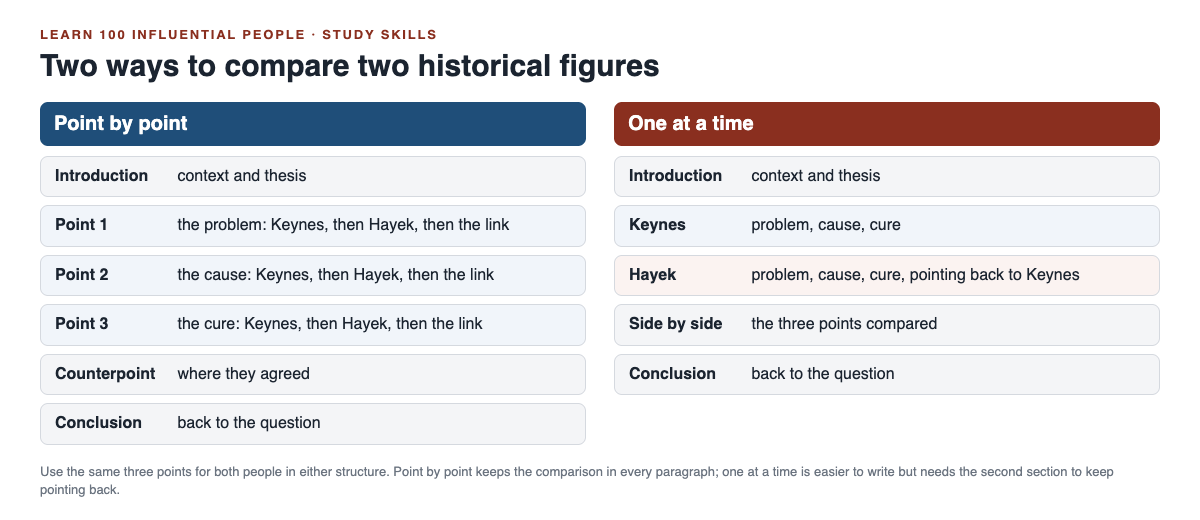
- Point by point. Each body paragraph takes one point of comparison and covers both people. It keeps the comparison in front of the reader, so it suits longer essays and exam answers that ask you to "compare."
- One at a time. First a section on one person, then a section on the other, then a section that sets them side by side. It is easier to write, but the comparison can get lost unless the second section keeps pointing back to the first.
If you are unsure, use point by point. It forces you to compare in every paragraph.
Worked example: Keynes and Hayek in one plan
Here is a full point-by-point plan, with a source for each claim. Every fact below comes from the Concise Encyclopedia of Economics biography of Keynes or its biography of Hayek.
- Introduction. Context: they built their ideas in the same years, knew each other's views and argued over their differences. Then the thesis above.
- Point 1: the problem they saw. Keynes: unemployment in interwar Britain that reached levels as high as 20 percent. Hayek: booms that turn into busts. Link: both wanted to explain the same kind of crisis.
- Point 2: the cause they blamed. Keynes: too little aggregate demand, the sum of consumption, investment and government spending. Hayek: credit made artificially cheap by the central bank, leading to "malinvestment." Link: this is the heart of the difference.
- Point 3: the cure they proposed. Keynes: government spending in downturns, even if it means borrowing, and stable wages, since a general wage cut would lower income and demand. Hayek: avoid the booms, and treat the bust as a "healthy and necessary readjustment." Link: opposite advice from opposite diagnoses.
- Counterpoint. They were not opposites on everything. Keynes praised Hayek's The Road to Serfdom: "Morally and philosophically I find myself in agreement with virtually the whole of it." One way to read this: their quarrel was mainly about slumps, not about freedom itself.
- Conclusion. Return to the question. Then show the debate is still live: the Hayek biography says most economists believe Keynes's General Theory "won the war," while Hayek never believed it.
For the full story of both men, read our guide to Keynes vs Hayek. For two more pairs already set out side by side, see Locke vs Rousseau and Adam Smith vs Karl Marx.
Common mistakes to avoid
- Two biographies in a row. If you could swap your paragraphs between two essays, you are describing, not comparing. Start every body paragraph with a sentence that names both people.
- Uneven evidence. Three quotes for one person and none for the other makes the essay look one-sided. Give each the same kind of support.
- A straw man. Describe each person as their own supporters would. If your summary of Hayek would make a Hayek scholar wince, fix it before you criticise him.
- A verdict with no reasons. "Keynes was more influential" needs a measure. Influential on what, for whom, and by what evidence?
- Dates instead of ideas. Years help, but a paragraph built on dates rarely makes an argument.
To keep both people straight while you plan, try the one-card method in our guide on how to remember historical figures.
Frequently asked questions
How many points of comparison should a history essay have?
Three is a good number for most essays: enough to show a pattern, few enough to cover each one properly. Use the same three for both people.
Should I say which historical figure was better?
Only if the question asks you to judge. Even then, set out the strongest case for each person first, and judge one clear point with reasons.
What is the difference between compare and contrast?
Comparing looks at how two people are alike and different; contrasting looks only at the differences. Many essay questions that say "compare" expect both, so check the wording of yours.
Where can I find sources on both sides?
Start with a reference work that sets out several positions, then go to the original writing. On Learn 100 Influential People, every lesson lists its sources and debate cards show where researchers disagree.
Get started
The courses on Learn 100 Influential People group people who make natural pairs: Keynes and Hayek in Thinkers of the Economy, Locke and Rousseau in Power, Reason and Rights, and Gandhi and King in The Twentieth Century. Lessons take about 9 minutes, 38 cards set out where researchers disagree, and every lesson lists its sources, so you can read the original work. Questions from lessons you finish come back, up to 5 a day, to keep both people fresh before your essay. Sign in with your email and an emailed code; accounts are for people aged 13 or older.
Start Learn 100 Influential People: short hands-on lessons on the people who shaped history, with every side of the debate and the sources to read next.
Comments
No comments yet.
Sign in or make an account to comment.