Geoffrey Hinton: what he argues about AI risk
Geoffrey Hinton is a Nobel Prize laureate known for his work on artificial neural networks. Then, in 2023, he left his industry job so he could warn people about it. This post explains who he is, what his research did, and what he argues about AI risk, using Wikipedia's Geoffrey Hinton article as its only source.
Who is Geoffrey Hinton?
The article calls Geoffrey Hinton a British-Canadian computer scientist, cognitive scientist, cognitive psychologist and Nobel Prize laureate. He is known for his work on artificial neural networks. That work earned him the title "the Godfather of AI".
He was born in 1947. He earned a degree in experimental psychology at King's College, Cambridge, in 1970, and a PhD in artificial intelligence from the University of Edinburgh in 1978. He is now University Professor Emeritus at the University of Toronto, where he has been affiliated since 1987.
He also has roles outside the university. In 2017 he co-founded the Vector Institute in Toronto and became its chief scientific advisor. He is a strategic advisor to the Schwartz Reisman Institute for Technology and Society.
Awards
His list of honours is long. A few stand out:
- In 2001 he was the first winner of the Rumelhart Prize.
- In 2018 he received the Turing Award with Yoshua Bengio and a third researcher, for their work on deep learning.
- In 2024 he shared the Nobel Prize in Physics with John Hopfield, "for foundational discoveries and inventions that enable machine learning with artificial neural networks".
His research in plain words
Hinton's research is about using neural networks for machine learning, memory, perception and symbol processing. He took what is called the connectionist approach: the idea that abilities like logic and grammar can be encoded into the parameters of neural networks, and that the networks can learn them from data. In the 1980s he was part of a group that favoured this approach during the AI winter. The other side, the symbolists, wanted to program knowledge and rules into AI directly.
In 1986 he co-authored a highly cited paper with David Rumelhart and Ronald J. Williams. It popularised backpropagation, a method for training networks with many layers. Their experiments showed such networks can learn useful internal representations of data. The article notes they were not the first to propose the approach.
In 2012, a network he designed with his students won a major image-recognition challenge. The article calls it a breakthrough in computer vision.
Not everyone thinks the credit has been shared fairly. The researcher Jurgen Schmidhuber contended that Hinton and others did not properly credit earlier work, including work by Paul Werbos and Shun-Ichi Amari in the 1970s.
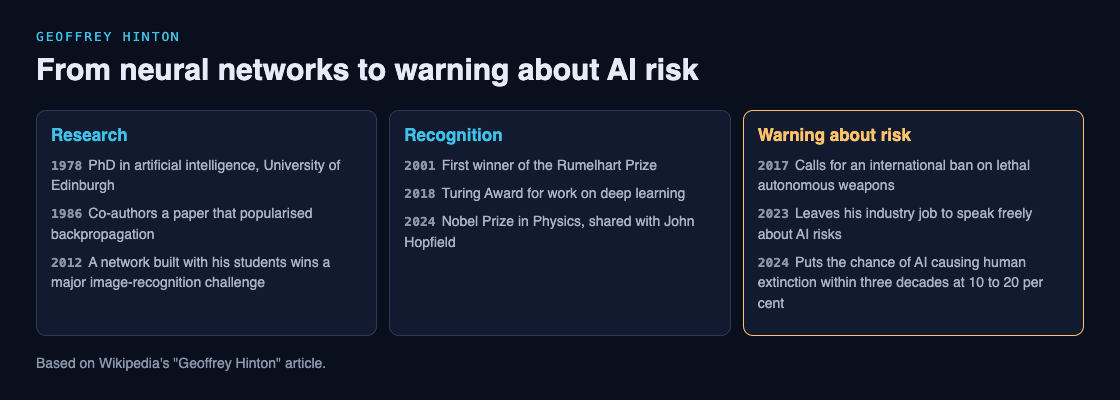
Hinton's path, as Wikipedia's article on him sets it out.
Why he left his industry job
From 2013 to 2023, Hinton split his time between the University of Toronto and a large technology company. That company had bought a company he co-founded with two of his graduate students.
In May 2023 he announced he was leaving. He said he wanted to "freely speak out about the risks of AI". In one interview he said he could now "talk about the dangers of AI" without thinking about how it would affect the company. He also said that part of him now regrets his life's work.
His sense of timing had changed too. He once believed general AI was "30 to 50 years or even longer away". In March 2023 he said it might be fewer than 20 years away, with changes "comparable in scale with the industrial revolution or electricity".
The risks Geoffrey Hinton names
The article sorts his concerns into three groups.
Losing control
Hinton has said "it's not inconceivable" that AI could "wipe out humanity". He worries that a generally intelligent AI system could "create sub-goals" that do not match what its builders want. It might seek power or stop itself from being shut off, not because its builders intended it, but because those sub-goals help it reach later goals. He says "we have to think hard about how to control" AI systems that can improve themselves. For more on this idea, see our post on AI takeover.
He also points to how AI learns. In 2023 he explained that when one copy of a chatbot learns something new, it is passed to the entire group, so they can gather knowledge far beyond what any one person could. In 2025 he put it bluntly: "If you want to know how it's like not to be the apex intelligence, ask a chicken."
Misuse by bad actors
He has said "it is hard to see how you can prevent the bad actors from using [AI] for bad things." In 2017 he called for an international ban on lethal autonomous weapons. In 2025 he named people using AI to create lethal viruses as one of the greatest short-term threats.
Jobs and inequality
In 2018 he was optimistic about AI and work. By 2023 he worried AI would upend the job market and take away more than "drudge work". In 2024 he said the British government would have to set up a universal basic income. In his view, AI will create more wealth, but without government action it will make the rich richer and hurt people who lose their jobs.
His estimate of the danger
In December 2024, Hinton said there was a "10 to 20 per cent chance" that AI would cause human extinction within the next three decades. He had earlier suggested a 10% chance, with no timescale. He said he was surprised at how fast AI was advancing.
For how such numbers are used and who gives which, our post on p(doom) explains what the number means.
What he proposes, and who disagrees
Hinton's proposals follow from his worries:
- Safety research. After the Nobel Prize, he called for urgent research into how to control AI systems smarter than humans.
- Regulation. He said leaving AI to "the profit motive of large companies" is not enough, and that "the only thing that can force those big companies to do more research on safety is government regulation."
- Cooperation. He said safety guidelines will need cooperation among those competing in AI, to avoid the worst outcomes.
In August 2024 he co-wrote a letter with Yoshua Bengio, Stuart Russell and Lawrence Lessig backing a California AI safety bill. They called it the "bare minimum for effective regulation of this technology".
Not every leading researcher agrees. Another researcher who shared the Turing Award with him, also called a "godfather of AI", said AI "could actually save humanity from extinction". Both men helped build the field. They read its future very differently. For the wider debate, see the main arguments for and against existential risk from AI.
A worked example: sort Hinton's concerns
Hinton names several risks at once. It helps to pull them apart. Take a sheet of paper and try this.
- Make three columns. Label them "control", "misuse" and "jobs".
- Place each concern. Sub-goals and power-seeking go under control. Lethal viruses and autonomous weapons go under misuse. Lost jobs and inequality go under jobs.
- Match each fix. Under each column, write the proposal that fits it. Control research fits the first. A weapons ban fits the second. A universal basic income fits the third.
- Find the gaps. Look for a concern with no matching fix. Ask what would be needed to fill it.
Now read the other Turing Award winner's view again. Ask which column he is pushing back on. This shows you where the two really split.
Exploring the idea in Contain ASI
Contain ASI is a story strategy game for 1 to 4 players that runs in your browser and needs WebGL 2. Chapter 1, Before ASI, starts in January 2024 with four fictional AI labs in one race. As a researcher, research manager, CEO or government, you try for three years to keep every lab from crossing into recursive self-improvement before 2027.
It is a game, not a forecast. The page says it is inspired by the AI 2027 scenario and that all its labs, people and events are fictional. It does not mention Hinton. His point about cooperation among competitors is still worth keeping in mind as you play.
Frequently asked questions
Who is Geoffrey Hinton?
He is a British-Canadian computer scientist and Nobel Prize laureate known for his work on artificial neural networks. He is University Professor Emeritus at the University of Toronto.
Why did Geoffrey Hinton leave his job in 2023?
He said he wanted to "freely speak out about the risks of AI" without thinking about how it affected his employer.
What chance does Hinton give AI causing human extinction?
In December 2024 he said a "10 to 20 per cent chance" within the next three decades.
Does everyone agree with him?
No. Another researcher who shared the 2018 Turing Award with him said AI "could actually save humanity from extinction".
Get started
Want to see how hard cooperation is when four labs are racing? Open Contain ASI in your browser and start a campaign as a researcher, research manager, CEO or government.
Comments
No comments yet.
Sign in or make an account to comment.