George Washington's Presidency: What He Set Up and Left
George Washington's presidency set the pattern for the American executive. He was the first president of the United States, elected unanimously in 1789 and serving two terms until 1797, and he spent those years defining an office that the Constitution had only sketched. He left behind a working government, a set of precedents, and several problems that he could not solve.
If you want to learn how the people behind such turning points fit together, Learn 100 Influential People covers Washington in its Age of Revolutions course, in short lessons with questions that check what you remember.
Taking office in 1789: a government built from nothing
Washington had spent the years after the Revolutionary War at Mount Vernon. He resigned as commander-in-chief in December 1783, intending to retire to a life of gentleman farming. Concern grew over the weakness of the Articles of Confederation, under which Congress could not raise taxes or put down armed insurrections such as Shays' Rebellion. Washington decided the Articles would have to be replaced, and he hesitantly agreed to preside over the Constitutional Convention in Philadelphia in May 1787.
The new Constitution was ratified by nine states by 1788 and called for the election of a president. World History Encyclopedia says there was never any question who it would be. In the election of 1789 the electors voted for Washington unanimously, with John Adams as vice president. He was inaugurated on 30 April 1789 at Federal Hall in New York City, "burdened with defining the office of the presidency and guiding the fragile young republic".
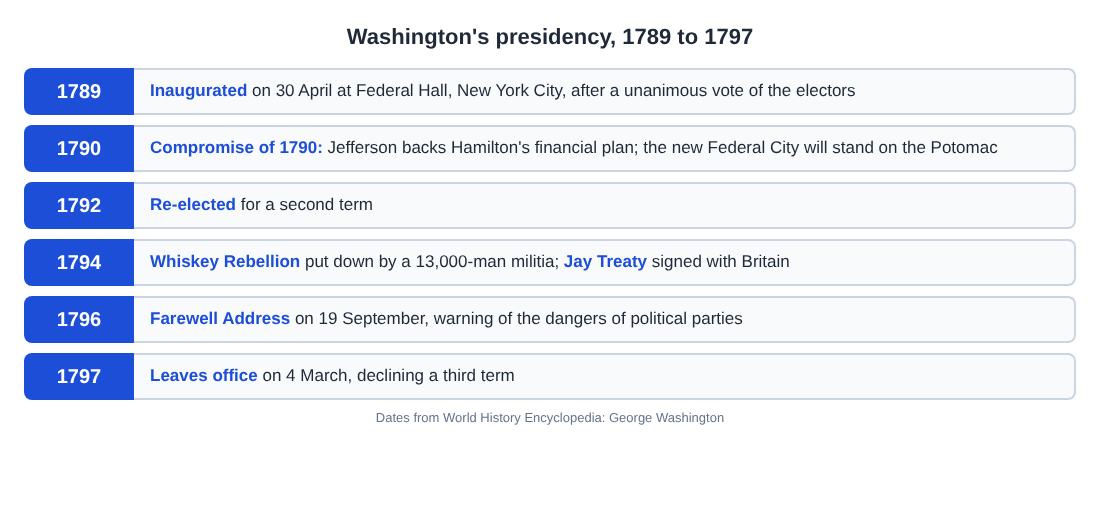
Key dates of Washington's two terms, from World History Encyclopedia.
George Washington's presidency: the precedents he set
The first president had no model to follow, so how he behaved mattered as much as what he decided. World History Encyclopedia says he brought to the presidency the same caution that had served him on the battlefield. Three habits stand out:
- No royal style. He refused any title or official procedure that smacked of monarchy and preferred the humble title "Mr. President".
- Above the quarrel. He held himself aloof from the partisanship that was bubbling in his cabinet.
- Two terms and out. At the end of his second term he declined to stand again. His refusal to seek a third term set a precedent that every later president followed except Franklin D. Roosevelt.
These were choices, not rules. Nothing in the Constitution told him to take a plain title or to leave after eight years. That is why historians often call his presidency a foundation: later presidents inherited habits as well as powers.
Hamilton, Jefferson and the cabinet fight
In the first years of the administration, Treasury Secretary Alexander Hamilton proposed a controversial financial program. It called for the federal government to assume state debts and for a national bank. Secretary of State Thomas Jefferson and his southern supporters hotly opposed the plan. The two clashed often in cabinet meetings until the Compromise of 1790. Jefferson agreed to support Hamilton's plan in return for the new Federal City, named in Washington's honor, to be built on the Potomac River.
The compromise shows how Washington worked: he let strong people with opposed views argue, and the government kept going. It also shows the limit of that method. World History Encyclopedia says the partisan struggles "were only beginning" and would escalate through the rest of his presidency and beyond.
Two tests of federal authority: the Whiskey Rebellion and the Northwest
A young federal government had to show it could enforce its own laws. Two events tested it.
In 1794 the Whiskey Rebellion broke out in western Pennsylvania, where farmers revolted against a liquor excise tax imposed by Hamilton. Washington was reluctant at first to use force. He then raised a federalized militia of 13,000 men, and it suppressed the rebellion without a single battle. The incident strengthened the authority of the federal government.
The administration also fought the Northwest Indian War (1790 to 1795), against a coalition of Native American nations for control of the Northwest Territory. General "Mad" Anthony Wayne won the Battle of Fallen Timbers, and the nations had to cede their claims in the territory in the resulting Treaty of Greenville. The British, who had given the Native nations clandestine support, were also compelled to leave their forts in the region. Seen from the Native nations' side, this was the loss of their land, a point any fair account has to hold alongside the US view of it as a victory.
Neutrality, the Jay Treaty and the first parties
Much of Washington's second term was shaped by the French Revolution, which was engulfing Europe in a total war. Jefferson and the emerging Democratic-Republican Party urged him to support Revolutionary France. Washington pursued a policy of neutrality and refused to get involved in the French Revolutionary Wars.
The controversy over that decision grew with the Jay Treaty of 1794, which strengthened the United States' economic ties to Britain. Both issues gave fuel to the rivalry between the Democratic-Republicans and Hamilton's Federalist Party. This is the origin of the warning in his Farewell Address, which he gave on 19 September 1796. In it he famously warned of the dangers of political parties. He left office when his term expired on 4 March 1797 and went home to Mount Vernon.
What he left unresolved: slavery and faction
Any account of the presidency has to include what Washington did not fix. World History Encyclopedia reports that 577 enslaved people lived and worked at Mount Vernon over the course of his lifetime. It says his views on slavery evolved, and that by the time of the Revolution he found the practice abhorrent. It also says he did little to work toward abolition and continued to rent and purchase enslaved people until his death. Historians weigh that gap between what he said and what he did, and a fair reading holds both facts.
The second unresolved problem was faction. His warning against parties did not stop them, and the two-party rivalry that began under him, between Hamilton's Federalists and the Democratic-Republicans, continued after he left. He ended his time in office, as the source puts it, mourned across the Western world as a champion of freedom and liberty, even as the questions he left behind remained open.
A worked example: study his presidency in three steps
Here is a short plan to learn this period so it stays in memory.
- Make a list of precedents. Write down the title "Mr. President", the cabinet, the neutrality policy and the two-term limit by habit. Next to each, note whether it was a law or a choice.
- Pair the disputes. Write Hamilton against Jefferson on the bank and debts, then the Compromise of 1790 beside it. In one line, say what each side gave up.
- Add the cost. For each success on your list, write one thing it left out: the Northwest nations' land, the enslaved people at Mount Vernon, the parties that his warning could not prevent.
In ten minutes you will have a one-page map of the presidency that shows both what he built and what he left, which is the pattern behind most good history essays.
Frequently asked questions
When was Washington elected president?
He was elected in 1789, by a unanimous vote of the electors, and re-elected in 1792. He declined to stand for a third term.
What precedents did Washington set?
He preferred the title "Mr. President" over anything royal, stayed above the partisanship in his cabinet, followed a policy of neutrality in the French Revolutionary Wars, and left office after two terms. Every later president followed the two-term pattern until Franklin D. Roosevelt.
What was the Whiskey Rebellion?
It was a revolt in western Pennsylvania in 1794 by farmers against a liquor excise tax. Washington raised a 13,000-man militia, which ended it without a battle, and the episode strengthened the federal government.
What did the Farewell Address warn about?
Washington gave it on 19 September 1796 and famously warned of the dangers of political parties.
Get started
If you want Washington in a short, structured form, Learn 100 Influential People puts him in the Age of Revolutions course, alongside Napoleon, Bolivar, Toussaint Louverture, Jefferson and Lincoln. The lessons last about 9 minutes, and the site sets out where researchers disagree and lists the sources for every lesson. You sign in with your email and an emailed sign-in code to keep your progress. You can see how it handles your data on the privacy page, or read more on the about page.
Start Learn 100 Influential People: short hands-on lessons on the people who shaped history, with every side of the debate and the sources to read next.
100 people who shaped history, from Moses to the web.
Visit influentialpeople.vlvd.net↗
Comments
No comments yet.
Sign in or make an account to comment.