Half turn metric vs quarter turn: how cube moves are counted
The half turn metric is the most common way to count moves on a cube: any turn of one outer face, a quarter or a half, counts as one move. The quarter turn metric counts a half turn as two. That one difference is why the same solution can be quoted at two different lengths. This guide explains both counts and a third, the slice turn count, gives you sequences to count yourself, and shows how a 2048 puzzle on a cube keeps its own Moves counter.
What a move count is
Cube notation names each turn. R turns the right face a quarter clockwise, R' a quarter the other way, and R2 a half turn. The notation tells you what to do. The metric tells you what to count. Our notation guide for beginners covers the letters.
The question that splits the counts is simple: is R2 one move or two? And what about a turn of a middle layer, such as M? Wikipedia's Superflip article sets out three answers, and they are the three counts below.
The half turn metric: any face turn is one move
In the half turn metric, often shortened to HTM, turning a face 90 or 180 degrees counts as one move. R, R' and R2 each cost one. Wikipedia calls it the most commonly used count, so a move count given with no metric named is usually this one.
A middle-layer turn is not a face turn. In this count it costs two, the same as turning the two outer layers on either side of it the opposite way.
The quarter turn metric: a half turn costs two
In the quarter turn metric, or QTM, only a 90 degree face turn counts as one move. A half turn like R2 is two quarter turns, so it costs two. A middle-layer turn costs two or four, depending on whether it is a quarter or a half.
Every move in this count is the same size, one quarter of a face. That makes it the stricter count, and the numbers it gives are never smaller than the half turn count.
The slice turn metric: middle layers count as one
The slice turn metric, or STM, is the loosest of the three. A 90 degree face turn, a 180 degree face turn and a turn of a middle layer, quarter or half, each count as one move. R, R2, M and M2 each cost one.
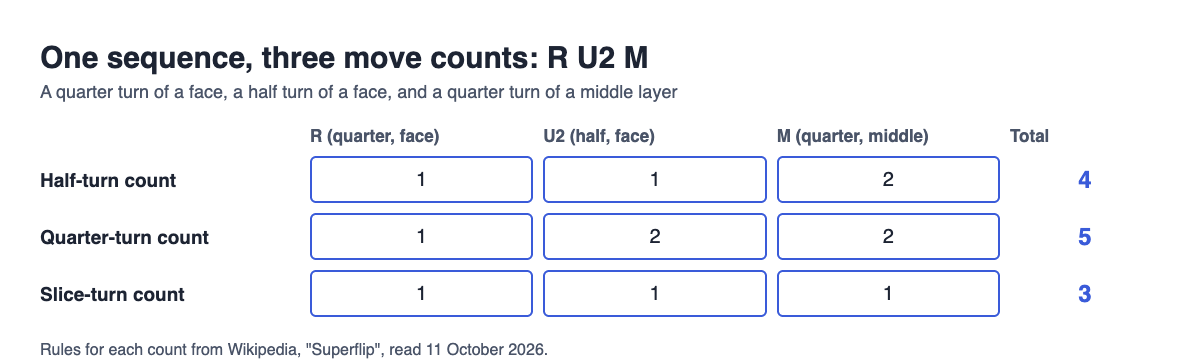
One sequence, three totals, using the rules in Wikipedia's Superflip article.
Worked examples: count these yourself
The fastest way to learn the counts is to count real sequences. Here is a rule of thumb for sequences with no middle-layer turns: count every symbol for the half turn total, then add one for each half turn to get the quarter turn total.
R U R' U': 4 symbols and no half turns, so 4 in both counts.R U R' U R U2 R': 7 symbols and one half turn (U2), so 7 half-turn moves and 8 quarter-turn moves.R U2 M: here a middle layer joins in. Half turn count: 1 + 1 + 2 = 4. Quarter turn count: 1 + 2 + 2 = 5. Slice turn count: 1 + 1 + 1 = 3.M2 U M U2 M' U M2: slice turn count 7, one per symbol. Half turn count: each middle turn costs 2 and eachUorU2costs 1, so 2 + 1 + 2 + 1 + 2 + 1 + 2 = 11. Quarter turn count:M2costs 4,MandM'cost 2,Ucosts 1 andU2costs 2, so 4 + 1 + 2 + 2 + 2 + 1 + 4 = 16.
One sequence, three answers: 7, 11 and 16. That spread is why a move count without its metric tells you little. For more on middle-layer turns, see M, E and S moves.
The superflip: one position, three distances
The superflip, a cube with all twelve edges flipped in place, shows how much the count matters. According to Wikipedia's Superflip article:
- In the half turn count it needs 20 moves, and no position needs more. That limit is God's number, which we explain in God's number explained.
- In the quarter turn count it needs at least 24, and it is not the farthest position. The superflip combined with the "four-spot" pattern needs 26 quarter turns, and the article cites work titled "God's Number is 26 in the Quarter-Turn Metric".
- In the slice turn count a 16-move sequence makes it.
The same position is 16, 20 or 24 moves from solved, depending only on what you count. We look at the position itself in superflip: the cube position with every edge flipped.
None of these counts charges for holding the cube differently. Wikipedia's Rubik's Cube article notes that the cube's 43 quintillion positions treat the centres as fixed; counting every way of holding the cube as different would multiply the total by 24.
How a 2048 cube counts its moves
Evolved 2048 is the 2048 puzzle on a cube you turn like a Rubik's cube: six faces of nine squares, 54 in all. It has a Moves counter in its top bar, and its rules make a count of their own. Each of these was checked in the live game.
- A slide of the front face counts one move. A slide that moves nothing is refused and does not count: in our test, six key presses gave Moves 4, with "Nothing moves that way. Try another way, or twist a row." on screen.
- A twist turns one layer a quarter and counts one move, middle layers included. Dragging the right face's middle row counted 1, the way the slice turn count would score it.
- A turn of the whole cube counts nothing. Four Shift and Left turns brought the cube back to where it started, with Moves unchanged.
Twists are quarter turns only. Key 1 twists the top row to the right and Shift and 1 twists it to the left, one move each. Two layers together took two twists in our test, for 2 moves. So the game counts like a slice count that has no half turns and charges nothing for turning the whole cube.
There is one cost the counter does not show. Every slide or twist also adds a new 2 or 4 tile, and a twist needs an empty square for it. Two twists cost two moves and two new tiles.
Frequently asked questions
Is a half turn one move or two?
One in the half turn count and in the slice turn count, two in the quarter turn count.
Which count is used most?
The half turn count. Wikipedia's Superflip article calls it the most commonly used, and God's number of 20 is given in it.
Does a middle-layer turn like M count as one move?
Only in the slice turn count. The half turn count charges two for it, and the quarter turn count two or four.
Does turning the whole cube count as a move in Evolved 2048?
No. Turning the whole cube is free: it adds no move and no points, so you can look at every face before you twist.
Get started
Try counting for yourself. Start a game and slide a few times so tiles reach the top row, then press 1 to twist it and watch Moves go up by one. A twist of a row with no tiles in its ring is refused and not counted. Press Shift and an arrow key to turn the whole cube and see Moves stay put. You can play without an account, and your game, best score and settings are saved on your device.
Play Evolved 2048: it is free and plays in your browser on a computer or a phone.
Comments
No comments yet.
Sign in or make an account to comment.