Hip-hop beats for a skateboarding edit: pick, cut and license
Finding hip-hop beats for a skateboarding edit sounds easy until you sit down with two hours of footage and a timeline that will not line up. The right beat gives your clips a pulse. The wrong one makes a clean trick feel late. This guide covers how to pick a beat by tempo and energy, how to cut clips so landings hit on the drum, and what a license needs to cover before you post to YouTube or Instagram.
Why hip-hop beats and skateboarding edits go together
Skating has its own rhythm. Push, push, pop, land, roll away. A hip-hop beat has a steady kick and snare with space between them, and that space is where a trick lives. The snare gives you a hard point to land on. The loop structure means you can cut a long line or a short clip and the music still feels whole.
Hip-hop instrumentals also leave room. Most of them do not have a melody fighting for attention, so the sound of wheels on concrete and a clean pop still come through. If you mix your clip audio under the music, the beat holds it all together.
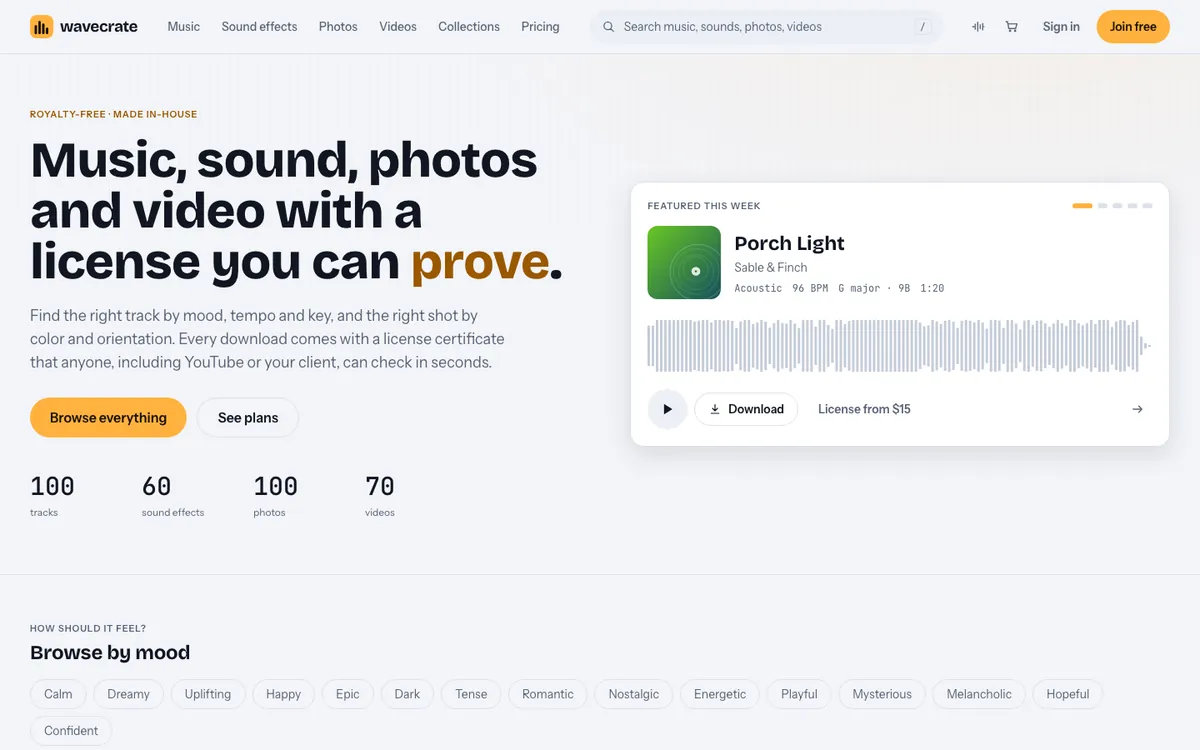
Wavecrate, the music library used as the example in this guide, lets you filter hip-hop beats by tempo, mood and energy, and every download comes with a license certificate and a code.
Match the beat to your footage: tempo, mood, and energy
Before you scroll through tracks, watch your footage once without sound and answer three questions:
- How fast is the skating? Slow cruising and manual lines need a slower beat. A hill bomb or a fast ledge session can take more speed.
- What is the feeling? A sunset session with friends is relaxed. A spot that took twenty tries to land is tense.
- How much is going on? A part with lots of quick clips needs a beat with steady drive. A part built on long lines can sit on something calmer.
Then turn those answers into numbers. On the Wavecrate music browse page you can filter by mood, by tempo, by length and by energy. The tempo filter offers Slow (under 90 BPM), Mid (90 to 120 BPM), Fast (over 120 BPM), or a custom range. Energy runs through levels like Calm, Relaxed, Steady and Driving.
Here is a worked example. Say you have a cruising part filmed at golden hour, mostly long lines and a few flatground tricks. Set the tempo to Slow, the mood to calm or nostalgic, and energy to Relaxed. You now have a short list instead of a whole catalog.
To audition fast, use the keyboard shortcuts that work on every page: Space plays or pauses, Left and Right skip 5 seconds, and Shift with Left or Right jumps to the previous or next item. Play your footage on a second screen and flip through beats until one feels right.
Boom bap or lo-fi: picking a style for each part
Different styles suit different parts of a video. These are general starting points, not rules.
Boom bap for classic street parts
Boom bap has a punchy kick and a hard snare. It suits street skating, ledge lines and raw filming, and every snare is a natural landing point. On Wavecrate, the Hip-hop genre listed ten tracks on 11 October 2026, all between 81 and 97 BPM. Corner Store Sunday, marked Free, is "boom-bap drums, deep sub bass and a looping piano phrase," an instrumental at 92 BPM with Steady energy; Bright Fork (Free, 95 BPM) is another.
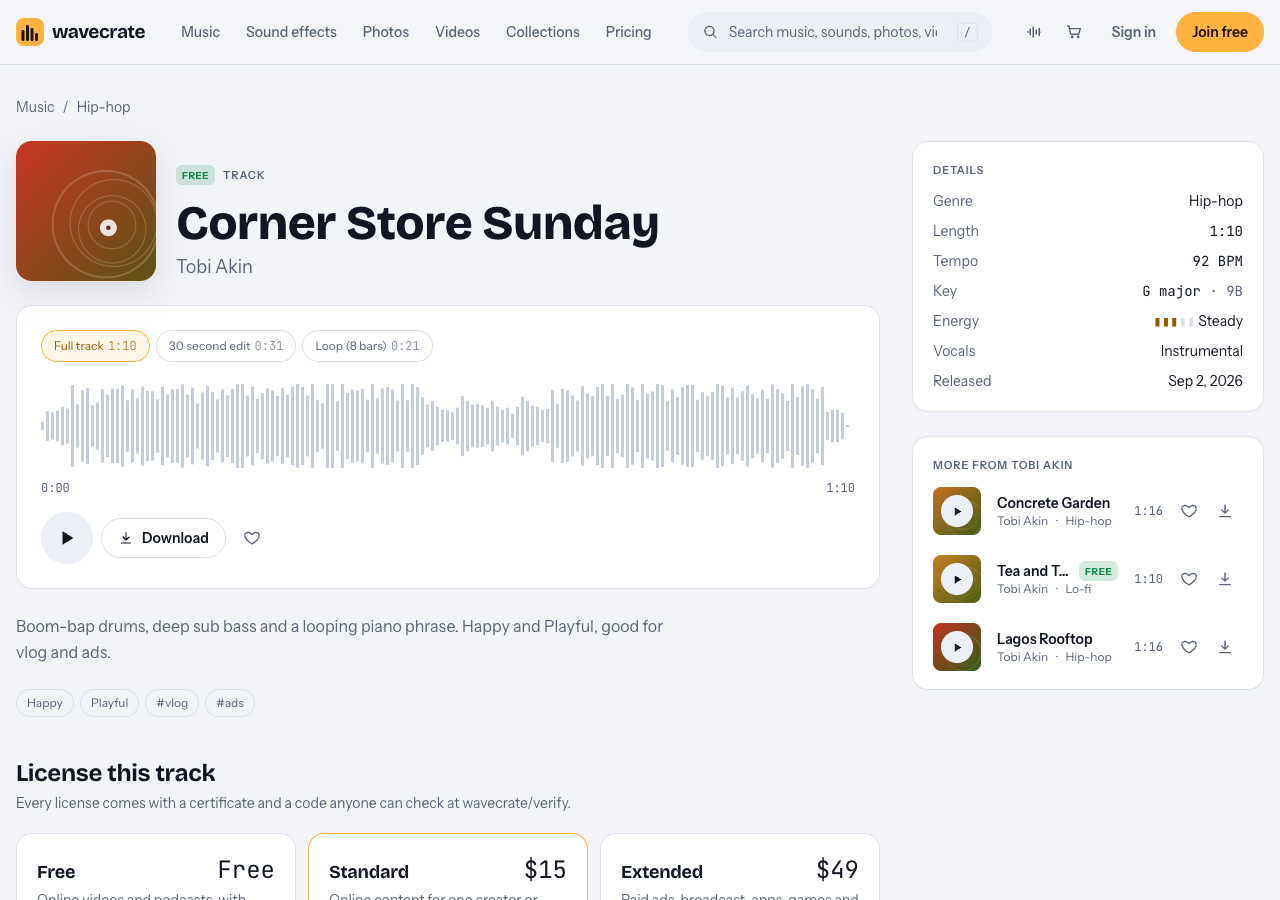
Corner Store Sunday, read on 11 October 2026.
Lo-fi for cruising and B-roll
Lo-fi is softer and slower, with swung drums and dusty textures. It works for warm-up footage, friends section intros, and slow motion. One example is Tea and Tape, marked Free, at 82 BPM, described on its page as "Dusty swung drums under soft electric piano chords and a little vinyl crackle." The Study and focus collection also groups several slow lo-fi tracks, including Night Bus Home (Free, 78 BPM) and Paper Lanterns (84 BPM). They were picked for studying, but a calm, nostalgic beat fits a cruising clip just as well.
How to cut skate clips to the beat
Start with the math. At 90 BPM, one beat lasts about 0.67 seconds and one bar of four beats lasts about 2.7 seconds. An 8-bar phrase is around 21 seconds. Knowing this tells you how much footage fits in each section before you start cutting.
A simple workflow:
- Drop the beat on the timeline first. Add markers on every snare in the first few bars. Most editors let you tap a key to place markers while the track plays.
- Put your best landing on a downbeat. The first beat of a bar is the strongest point. Line up the moment the wheels hit the ground with it.
- Cut on the kick, land on the snare. Switch clips on a kick, then let the trick land on the next snare. It makes each clip feel planned.
- Change sections every 4 or 8 bars. A new spot or a new skater at the start of a phrase feels natural to the viewer.
Track versions help here. Wavecrate track pages list a full track, a 30 second edit and an 8 bar loop. On Corner Store Sunday, the full track runs 1:10, the 30 second edit 0:31 and the loop 0:21. The 30 second edit fits an Instagram clip. The loop lets you stretch a section for a long line without a hard cut in the music. Pro includes all three versions.
Licensing hip-hop beats for a skateboarding edit
The fastest way to lose a good edit is a copyright problem after you post. A royalty-free beat is not the same as a beat you own. With Wavecrate, you get a license to use the track. Wavecrate keeps the copyright.
The trap is a track marked Free in a business video. Take Corner Store Sunday through three uses, using its page and the license table on the pricing page:
- Your own part on your own channel. The Free license covers YouTube, TikTok, Instagram, Twitch and podcasts, monetized channels included, with credit text required in your description. A free account gets 3 free downloads a month.
- Your own skate shop's or brand's channel. That is "your own business and brand content." The Free license does not tick that row, so it needs Standard (listed at $15 on this page), even though the track is marked Free. Standard needs no credit and prints your registered channels on the certificate.
- A shop or brand that hires you, or a paid ad. Filming and editing for a client is client work, and boosting the edit is paid advertising. Both need Extended (listed at $49 on this page).
Paid licenses are not on sale yet: Wavecrate says purchases open soon, so those are the listed prices for when sales open. Tracks marked Free can already be downloaded with a free account.
Every download comes with a license certificate and a code. Paste the code in your video description. If you ever get a claim, send the platform your code or certificate link. Anyone can check it on the verify page, which shows the licensee, the item, the license type and your registered channels. A reviewer can confirm it without contacting Wavecrate. It does not stop a claim from appearing, but it gives you proof to send.
Where to find royalty-free hip-hop beats for skate videos
Start on the music browse page and use the filters from the section above. To see only items you can download with a free account, use the free downloads filter. Those carry the Free license, so keep your credit line in the description.
If you post often, compare options on the pricing page. Pro is listed at $99 a year ($8.25 a month, billed yearly) or $12 month to month, and is not on sale yet. It covers Standard licenses on the whole catalog, so no credit line. Videos you publish while subscribed stay covered after Pro ends. Pro does not include Extended, so client work and paid ads still need an Extended license on each item.
Frequently asked questions
What BPM works best for a skateboarding edit?
For cruising and long lines, try under 90 BPM. For most street parts, 85 to 100 BPM feels natural. Wavecrate's Hip-hop tracks all sat between 81 and 97 BPM when read; for a faster part, set the Tempo filter to Fast and try other genres.
Is a track marked Free enough for my skate shop's video?
No. On Wavecrate the Free license does not cover your own business and brand content, so a shop's own video needs Standard, and a brand that pays you needs Extended.
Are free hip-hop beats safe to use in monetized edits?
On Wavecrate, items marked Free come with a Free license that covers monetized channels on YouTube, Instagram, TikTok and Twitch. You must add the credit text in your description. Client work and paid ads need an Extended license.
How long should the song be for a skate part?
Match the song to your best footage, not the other way around. For social posts, a 30 second edit of a track is often enough.
Get started
Pick your slowest and fastest clips, set the tempo and energy filters, and audition beats with the keyboard shortcuts until one locks in. Then cut to the snare and paste your license code in the description. You can join free with a name, email and password, and the name you enter is printed on your licenses.
Browse Wavecrate: you can join free and download items marked Free now, paid licenses are not on sale yet (purchases open soon), and every download comes with a license certificate and a code anyone can check on its verify page.
Comments
No comments yet.
Sign in or make an account to comment.