Hippocrates' contributions to medicine, explained
Hippocrates is called the father of medicine, and doctors still take an oath with his name on it. Yet almost everything about him comes with a question mark. This guide sets out Hippocrates' contributions to medicine, sorted by how sure we can be about each one, using World History Encyclopedia's article on Hippocrates. You will see what he most likely did, what was credited to him later, and why his name matters even where the details are uncertain.
Who Hippocrates was
Hippocrates was born on the Greek island of Kos in the 5th century BCE, perhaps around 460 BCE. He became the most famous physician of the ancient world. He set up and ran a school of medicine on Kos, travelled throughout his life, and died at Larissa in Thessaly around 370 BCE. He had three sons who carried on his work.
World History Encyclopedia warns that the information about him is patchy and unreliable. Even in ancient times people speculated about his life. One of the oldest accounts, a Life of Hippocrates credited to the physician Soranus of Ephesus, was written by a physician who lived in the 1st and 2nd centuries CE, long after his death. That is why the sorting below matters.
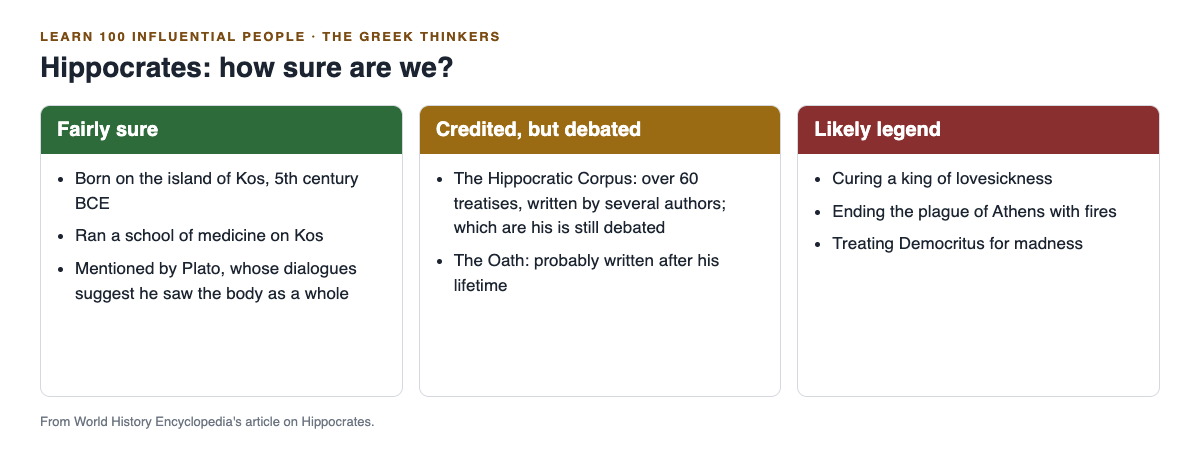
Hippocrates, sorted by how sure we can be.
Hippocrates' contributions to medicine: the big one
His largest contribution is a change of approach. Before him, Greek medicine was closely tied to religion and to Asclepius, the god of healing. According to World History Encyclopedia, historians credit Hippocrates with moving medicine away from that supernatural approach towards one based on observation, classification, and causes and effects.
In practice, this meant:
- Looking for natural causes. Explaining illness through causes and effects rather than through the gods.
- Watching closely. Systematic, hands-on study of diseases and remedies, which is why he is credited as the founder of modern medicine.
- Separating medicine from philosophy. The Roman medical writer Celsus claims Hippocrates was the first to do this.
- Caring for the whole body. Plato's dialogues suggest Hippocrates believed the body should be treated as a whole, and other ancient sources say he stressed diet and exercise for health.
World History Encyclopedia is careful to add that he was not alone. Others before him, such as Alkmaion of Kroton, had begun to approach medicine rationally too. Hippocrates became the name attached to the change.
What we can be fairly sure of
A few things rest on firmer ground. He came from Kos and set up and ran a medical school there. Plato mentions him in his dialogue Protagoras, in a way that suggests Hippocrates worked for fees, and in the Phaedrus, which suggests he saw the body as a whole. And by every account he was the most famous physician of the ancient world.
Credited to him, but debated: the Hippocratic Corpus
The Hippocratic Corpus is a collection of more than 60 medical treatises long credited to Hippocrates. It was gathered together in the Hellenistic period in Alexandria, Egypt. The texts cover diagnosis, biology, treatment and advice for doctors, on topics from joints and surgery to physiology, the course of diseases and gynaecology. Later physicians, Galen among them, wrote commentaries on them.
But did he write them? Modern scholars say that, judging by style alone, the texts must come from several authors. And no source from his own lifetime mentions him writing anything. The scholarly position, says World History Encyclopedia, is that some of the texts are his, but exactly which ones is still debated.
The Hippocratic Oath
The Oath is the most famous thing with his name on it, and it probably came after him. World History Encyclopedia describes it as a religious document, reserved for a select group of doctors. Those who took it swore by Apollo and the healing goddesses Hygieia and Panacea to respect their teacher, and not to give poison, abuse patients in any way, use a knife, or break the confidence between patient and doctor.
Modern versions of the oath, or similar statements, are still sworn by many medical students around the world. So even if Hippocrates did not write it, it shows how far his name came to stand for the ideal doctor.
Likely legend
Ancient writers told many stories of his skill, and World History Encyclopedia says most of them are likely pure invention. Among them:
- He found that King Perdiccas II of Macedon's illness was really lovesickness.
- He ended the plague that struck Athens in 430 BCE by lighting fires everywhere.
- He treated the philosopher Democritus, whom everyone thought mad.
Stories like these tell you how famous he became, not what he did. The same pattern appears with other ancient figures, as in the post on Archimedes' inventions.
A worked way to judge any "father of" title
"Father of medicine", "father of history", "father of mathematics": these titles are everywhere. Here is a quick test you can apply to any of them, using Hippocrates as the example.
- What change does the title point to? For Hippocrates, the move from supernatural to natural explanations of disease.
- Who gave the title, and when? He was known as the father of medicine in the ancient world as well as today.
- Was anyone doing it before him? Yes: Alkmaion of Kroton, for one.
- How much of the famous work is really his? Some of the Corpus; which parts is debated. The Oath, probably not.
Your answer can then be fair to both sides: he deserves the title as the best-known face of a real change, while the details of his own work are uncertain. For more on judging historians and their sources this way, see what historiography is.
Frequently asked questions
What are Hippocrates' main contributions to medicine?
He is credited with moving medicine from supernatural explanations towards observation, classification and natural causes, and with running a famous medical school on Kos. Later medical writing, the Hippocratic Corpus, was gathered under his name.
Did Hippocrates write the Hippocratic Oath?
Probably not. World History Encyclopedia says the Oath probably appeared after his lifetime, though modern versions are still taken by many medical students.
Why is Hippocrates called the father of medicine?
Because historians credit him with making medicine a matter of observation and natural causes rather than religion. He was called that in the ancient world too.
When did Hippocrates live?
In the 5th and 4th centuries BCE, perhaps from about 460 to about 370 BCE, though the dates are uncertain.
Get started
Hippocrates is one of six people in The Greek Thinkers, a Basic course on Learn 100 Influential People, alongside Socrates, Plato, Aristotle, Euclid and Archimedes; the site also has a Chemistry and Medicine course that runs from Lavoisier to Fleming. Basic courses cover the best-known names, with no background needed. Each lesson takes about 9 minutes and lists its sources, and the site's debate cards set out where researchers disagree. You sign in with your email and an emailed code.
Comments
No comments yet.
Sign in or make an account to comment.