History of AI: a short timeline, 1950 to today
The history of AI is a story of big promises, long waits and sudden jumps. This post walks through the history of artificial intelligence in order, from ancient myths to the alignment problem, using one source: Wikipedia's History of artificial intelligence. The main dates:
- 1950: Alan Turing proposes a test for whether a machine thinks.
- 1956: A workshop at Dartmouth College founds the field and names it.
- 1974 to 1980: Funding is cut after promises go unmet (the first "AI winter").
- 1980 to 1987: Expert systems turn AI into a billion-dollar business.
- Late 1980s to 1990s: The business collapses (the second winter).
- 1997: A computer beats the world chess champion.
- 2012: A deep learning model wins an image contest by a wide margin.
- 2014: A book on superintelligence helps turn "alignment" into a field of study.
- 2017: The transformer design arrives, and large language models follow.
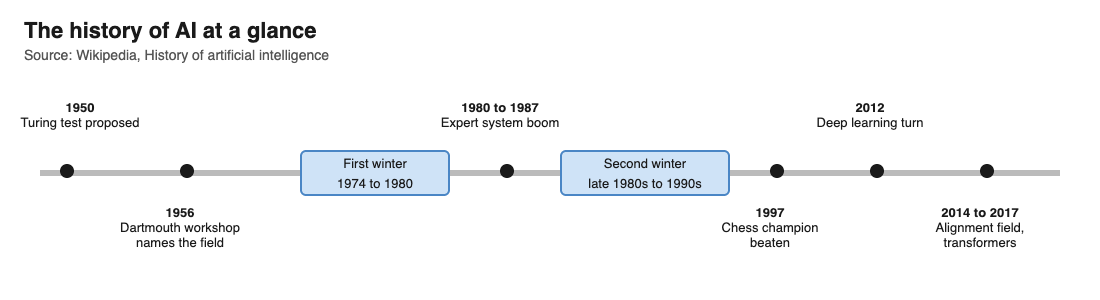
The shape of the timeline: two rises, two drops, then a long climb.
The history of AI starts before computers
The idea is old. The article says Greek myths already told of artificial beings such as Talos, the bronze man, and that by the 19th century thinking machines were a popular theme in fiction. The idea that thought can be mechanized came from philosophers. In the 17th century Thomas Hobbes wrote that reason "is nothing but reckoning, that is adding and subtracting". When Ada Lovelace wrote about Babbage's machine, she warned against "exaggerated ideas" of its powers. That warning still fits.
In 1943 Walter Pitts and Warren McCulloch analyzed networks of idealized artificial neurons, and in 1951 Marvin Minsky and Dean Edmonds built the first neural net machine, the SNARC.
In 1950 Turing published "Computing Machinery and Intelligence". Because "thinking" is hard to define, he proposed a test instead: if a machine can hold a conversation that is indistinguishable from a human's, it is reasonable to say it thinks. Our post on the Turing test covers the test and the arguments about it.
Then came the founding event. The Dartmouth workshop of 1956 was organized by Minsky and John McCarthy, with Claude Shannon and Nathan Rochester. The proposal said the group wanted to test the claim that "every aspect of learning or any other feature of intelligence can be so precisely described that a machine can be made to simulate it". McCarthy introduced the term "artificial intelligence" there. Allen Newell and Herbert A. Simon showed the Logic Theorist, a program that went on to prove 38 of the first 52 theorems in a famous maths book.
1956 to 1974: bold promises and early programs
The first years produced programs that looked remarkable. Some solved algebra word problems or worked in small "micro-worlds" such as a table of blocks. ELIZA, the first chatbot, sometimes made users think they were talking to a person, yet it only gave canned replies or repeated back what was said to it. In 1958 Frank Rosenblatt introduced the perceptron, a single-layer neural network.
The researchers also made forecasts, and the article lists them:
- 1958, Simon and Newell: within ten years a computer will be the world's chess champion.
- 1965, Simon: machines will be able to do any work a man can do within twenty years.
- 1967, Minsky: within a generation the problem of creating artificial intelligence will be substantially solved.
- 1970, Minsky: in three to eight years there will be a machine with the general intelligence of an average human being.
None of these came true on time.
1974 to the 1990s: two winters and an expert-system boom
By the early 1970s the programs were, in the article's words, "toys". It names the limits: too little memory and speed, a "combinatorial explosion" of possible paths, little commonsense knowledge, and tasks such as recognizing a face that proved harder than proving theorems. A 1969 book by Minsky and Papert showed limits of the perceptron and, per the article, almost halted neural network research. In 1973 the Lighthill report criticized the failure of AI to reach its "grandiose objectives" and led to the dismantling of AI research in the UK. Funding in the US shifted toward projects with clear aims.
The article adds a caution: historian Thomas Haigh argued in 2023 that there was no winter, and the cuts hit only a few large labs. So the "winter" story is itself debated.
Then came a boom. Expert systems, programs that answer questions in one field using rules from human experts, were adopted by companies worldwide. The article says the AI industry grew from a few million dollars in 1980 to billions in 1988. In 1981 Japan set aside 850 million dollars for a project meant to build machines that could converse and reason like humans.
The boom ended fast. In 1987 the market for specialized AI hardware collapsed. Expert systems proved expensive to maintain and "brittle", meaning they could make grotesque mistakes on unusual inputs. By 1991 many goals of Japan's project were unmet, and by the end of 1993 over 300 AI companies had shut down, gone bankrupt or been acquired. Our post on AI winters looks at what caused each one.
1990s to 2012: narrow wins, faster computers and deep learning
AI recovered by thinking smaller. In the 1990s researchers picked specific problems with checkable answers and borrowed tools from statistics and mathematics. Work on neural networks quietly continued: the AI community learned of backpropagation in the 1980s, and by 1990 Yann LeCun was using convolutional networks to read handwritten digits, the first genuinely useful use of neural networks.
On 11 May 1997 Deep Blue beat the reigning world chess champion, Garry Kasparov. The article says this was mostly engineering skill and faster computers: Deep Blue ran 10 million times faster than the machine that played chess in 1951. The same pattern showed up again in 2012, when a deep learning model called AlexNet won the ImageNet image contest with far fewer errors than the runner-up. The method had been known since the 1960s. What changed was powerful hardware and large amounts of training data.
2002 to today: general intelligence and the alignment problem
As narrow AI succeeded, some researchers worried that the field had dropped its first goal. In the early 2000s Ben Goertzel and others argued for direct research on artificial general intelligence, and in 2004 Minsky organized a symposium on human-level AI. Our posts on AGI and narrow versus general AI explain those terms.
At the same time, thinkers began to ask what happens if such a system is built carelessly. The article credits Nick Bostrom's 2014 book Superintelligence with the argument that badly defined goals could lead a machine to harm people while pursuing them. It also gives Stuart Russell's example of a robot that would stop anyone switching it off, since "you can't fetch the coffee if you're dead". The fix proposed was to align the machine's goals with those of its owner and humanity. That became known as the value alignment problem, or AI alignment. The article says risks from AI became an area of serious academic research after 2016.
The transformer design of 2017 led to large language models, and AI investment rose from 18 billion dollars in 2014 to 119 billion in 2021. The worry about machines improving themselves is the subject of our post on recursive self-improvement.
A worked example: check a forecast against the history
The timeline gives you a way to read any claim about when AI will do something. Take Minsky's 1970 line, "in from three to eight years we will have a machine with the general intelligence of an average human being", and ask four questions of it.
- Who said it, and how was the field behaving? The article quotes Hans Moravec blaming the 1970s crisis on a "web of increasing exaggeration" among researchers.
- Is there a date? Minsky gave one. A claim with no date cannot be wrong, which makes it weak.
- What is it measured by? "General intelligence of an average human" had no test. Chess champions and image contests do.
- What had to change first? In the 1970s it was memory, speed and knowledge. In 2012 it was hardware and data.
For Minsky's line the answers are a field later blamed for exaggeration, a date that passed, no test, and things that had not yet changed. Run the same four questions on a forecast you read this week.
Frequently asked questions
Who coined the term "artificial intelligence"?
According to the article, John McCarthy introduced the term at the 1956 Dartmouth workshop. The workshop is widely seen as the birth of AI as a field.
When was the first AI winter?
The article dates it from 1974 to 1980. It follows a 1973 UK report and cuts in US funding. One historian argued in 2023 that there was no winter.
Why did deep learning take off in 2012?
Per the article, the method was known from the 1960s, but it needs powerful hardware and large training sets. Those arrived, and AlexNet's win in 2012 turned the field toward deep learning.
Get started
Reading the history of AI is one way to think about the race to build smarter systems. Another is to play through a version of it as fiction. Contain ASI is a story strategy game for 1 to 4 players that runs in your browser and needs WebGL 2. It starts in January 2024 with four fictional AI labs in one race, and you try for three years to keep every lab from crossing into recursive self-improvement before 2027. Its home page has three buttons: New campaign, How to play and Settings. The page says it is inspired by the AI 2027 scenario, and that all its labs, people and events are fictional. It is a game, not a forecast.
Play Contain ASI: a story strategy game for 1 to 4 players that runs in your browser. Its labs, people and events are all fictional.
Comments
No comments yet.
Sign in or make an account to comment.