How Do Games Decide How Fast Enemies Appear? Spawn Rates
If you have ever wondered how do games decide how fast enemies appear, the answer is less mysterious than it looks. A designer picks a few numbers, tests them, and changes them until the game feels right. This post walks through those numbers using the two browser games on Tank City Reboot as worked examples.
How do games decide how fast enemies appear? The short answer
Spawn rate is a designed number. Nobody discovers it. A designer chooses how long to wait between enemies, how many can be on screen at once, and how those two values change as you play. Then they play the game, feel whether it is too slow or too frantic, and adjust.
The pace you feel comes from several settings working together, not one. A short timer with a low cap feels very different from a long timer with a high cap, even if the enemies per minute match.
What a spawn rate actually is
A spawn rate is how often the game creates a new enemy. It is usually not stored as "enemies per minute". It is stored as a wait: the number of seconds between one enemy entering and the next.
Three settings tend to sit behind it:
- The interval: how many seconds pass between entries.
- The cap: how many enemies may be alive at once.
- The total: how many enemies the level sends before it ends.
Change any one and the feel changes. That is why a game can get harder without a single enemy getting stronger.
Timers and intervals: the simplest way to spawn enemies
The simplest spawner is a countdown. It counts down from some interval. At zero, it creates an enemy at an entry point and starts the countdown again.
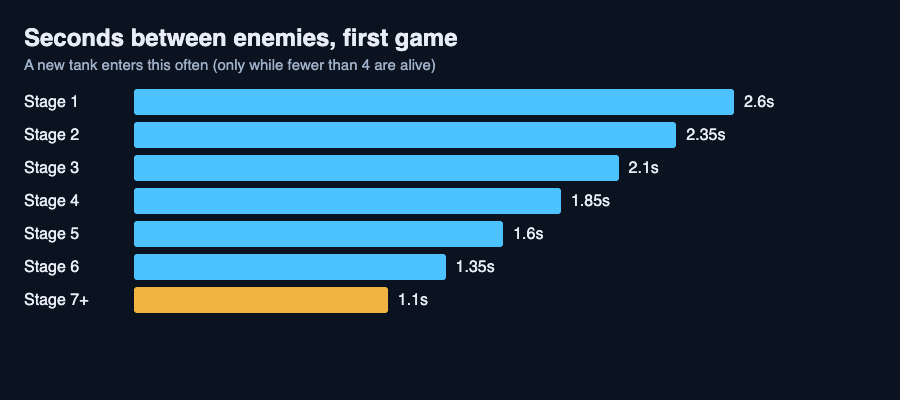
The first game, Tank City Reboot, works this way. Each stage sends 20 malware tanks, and they enter from three gates at the top: top left, top middle and top right. On stage 1, a new tank enters every 2.6 seconds. Each later stage cuts a quarter of a second off that wait, until it bottoms out at 1.1 seconds from stage 7 onward.
Here is that pacing laid out in your head: 2.6, 2.35, 2.1, 1.85, 1.6, 1.35 seconds across stages 1 to 6, then 1.1 from stage 7. The change per stage is small, so you never feel a sudden jump. You just notice, a few stages in, that you have less time to breathe.
A timer on its own can pile enemies up forever, though. That is where the cap comes in.
Waves: spawning enemies in groups
A wave is a batch of enemies that the game treats as one unit. You clear it, get a short break, and the next one starts. Waves give a game a rhythm: tension, release, tension.
Tank City Zero Day, the second game, is built entirely on waves. After each wave you pick one of three upgrades, then the next wave begins. The wave number feeds straight into the spawn settings:
- Threats per wave: at least 6 plus 2 for each wave number, up to 30 (drones come in threes, so a wave can run a little over).
- Seconds between entries: 2.0 minus 0.08 for each wave, never under 0.6.
- Most threats at once: 4 plus one for every 3 waves, capped at 8.
Work it through for wave 10. The game sends at least 26 threats. The wait between entries is 2.0 minus 0.8, so 1.2 seconds. Up to 7 threats can be on the field at once. Compare that with wave 1: at least 8 threats, a wait of about 1.9 seconds, and 4 at a time. Same game, very different pressure, and all of it comes from three simple formulas.
Zero Day also breaks the rhythm on purpose. Every fifth wave is a boss wave. Instead of the usual random mix, you get the boss plus groups of three botnet drones. The change in pattern tells you something big is coming.
Difficulty curves: why enemies speed up over time
Spawn rate is only one way to raise difficulty. Games also make enemies move faster. In Zero Day, threats move 3% faster per wave, and that growth stops at wave 15. In the first game, once you finish stage 6 the stages loop, every stage uses the hardest lineup, and enemy speed rises 8% each loop.
Notice the two design choices. One curve levels off, the other keeps climbing. A flat ceiling, like wave 15 in Zero Day, keeps the game fair at long runs. The first game instead keeps pushing until you lose.
Speed and spawn rate stack. Faster enemies arrive more often, so each one gives you less time to line up a shot. If you want to see how speed affects shooting, our plain guide to projectile speed covers the same idea from the bullet's side.
Caps, randomness, and spawn points that keep play fair
Without limits, a spawner can bury you. Good games add guardrails.
The cap on live enemies
In the first game, a new enemy enters only while fewer than 4 are on the field. So the timer might say "spawn now", but if four tanks are alive, the game waits. This is why the first game feels steady rather than overwhelming: the 20 tanks of a stage arrive four at a time, and killing one makes room for the next.
That also means your skill changes the pace. Clear tanks quickly and the field refills at the timer's speed. Clear them slowly and the field stays full, and the queue of waiting tanks grows.
Not spawning on top of someone
The first game also skips a gate if a tank is standing on it. The enemy does not appear inside another tank. It simply waits for a clean entry. Small rules like this prevent bugs that players would read as cheating.
Fair arenas
Zero Day generates a fresh arena every wave. It keeps the three enemy gates, your start position and the core's wall clear. Then it checks that every gate and your start can reach the core, going around silicon and coolant. Firewall counts as open, since any tank can shoot through it. If an arena fails the check, the game draws a new one. A spawn rate only feels fair if the map lets you respond to it.
Randomness
Zero Day picks the threats for a normal wave at random from what is unlocked. Ransomware joins from wave 3 and cryptominers from wave 4. Randomness keeps waves from feeling scripted, while the formulas around it keep the overall pressure predictable.
How enemy types change the pace (carrier enemies and more)
Not every spawn is equal. One tank that takes four hits slows your clearing down more than four tanks that take one. So designers mix types to control pace without touching the timer.
In the first game, Worms are slow and fall in one hit. Trojans move almost twice as fast as worms. Spyware fires fast shots. Rootkits are armored and take four hits. The stage lineups shift the mix as you go. Stage 1 sends 18 worms and 2 trojans. Stage 6, KERNEL, sends 4 trojans, 6 spyware and 10 rootkits. The spawn timer is much faster by then, and each enemy is also harder to remove. That combination is why late stages feel crushing.
Some spawns also carry a reward. In the first game, the 4th, 11th and 18th tank of each stage blink, and hitting one drops a power-up. These are carrier enemies, and they change the rhythm: you start to watch the queue and wait for the fourth tank.
Zero Day mixes in other behavior. Botnet drones come in threes and hunt you, not the core. Cryptominers are turrets that do not move, and each takes 5 hits, so they stay on the field far longer than a drone that dies in one.
Your own speed matters as well. How quickly you can shoot decides how fast you can clear spawns, which is the same balance covered in our guides to fire rate and cooldowns. A designer who raises the spawn rate often has to think about what the player's tools can handle.
A quick way to spot spawn design in any game
Next time you play, watch for these:
- Count the seconds between entries. Is the gap shrinking?
- Count how many enemies are alive at the peak. Is there a ceiling?
- Check whether the mix changes, with tougher types appearing later.
- Look for pauses between groups, which mean the game uses waves.
Once you can name these four things, almost any shooter's pacing starts to make sense.
Frequently asked questions
What is a spawn rate in a game?
It is how often the game creates a new enemy, usually stored as a number of seconds between entries. It works alongside a cap on how many enemies can be alive at once.
Why do enemies appear faster as a game goes on?
Designers shorten the wait between spawns as you progress, so the game gets harder without needing new content. In Tank City Reboot, the wait drops from 2.6 seconds on stage 1 to 1.1 seconds from stage 7.
What is the difference between a wave and a timer spawn?
A timer spawn creates enemies one at a time at a steady interval. A wave sends a batch, then pauses until you clear it, which gives the game a rhythm of pressure and rest.
Why do games cap how many enemies are on screen?
A cap keeps the game readable and fair. In the first Tank City Reboot game, only 4 enemies can be on the field at a time, so the rest of the stage's 20 tanks wait their turn.
Get started with Tank City Reboot
The best way to feel spawn design is to play with it. The first game shows a timer and a cap at work, and Zero Day shows formula-driven waves with boss breaks. Each page also explains the computing idea behind every enemy, in one sentence.
Play Tank City Reboot: it is free, plays in your browser on a computer or a phone, and needs no account.
Comments
No comments yet.
Sign in or make an account to comment.