How to analyze a political cartoon in history: 4 steps
If you want to know how to analyze a political cartoon in history, start with one idea: a cartoon is an argument with pictures. Someone drew it, at a certain time, to make readers think or feel something about the news of the day. The four steps below come from the National Archives document analysis worksheets, which teach the same careful reading for photos, maps, posters and cartoons. This post explains each step, then walks you through one of the best-known cartoons in American history.
Why a political cartoon is a special kind of source
A letter or a speech tells you what someone thought in words. A cartoon squeezes an opinion into one picture and a few words. That makes it fast to read, and easy to misread.
Cartoons lean on symbols. An animal can stand for a country, a figure can stand for a party, an object can stand for an idea. Readers at the time knew what the symbols meant. You may not, so part of the work is decoding them.
A cartoon is also one-sided by design. It does not weigh both sides; it takes one. That is not a flaw for a historian. It is the point. A cartoon shows you what one person wanted readers to believe, and how they tried to persuade them. Like any document, it is read with the questions our guide to how to analyze a primary source sets out: who made it, when, for whom and why?
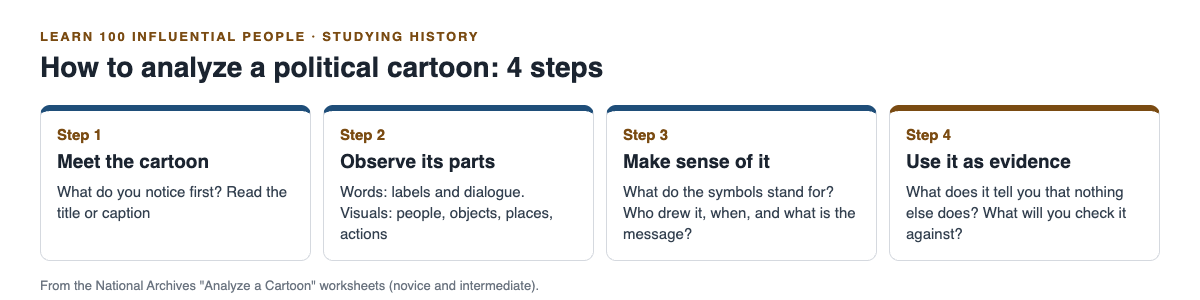
The four steps, in the order the worksheets use them.
Step 1: Meet the cartoon
Start with a quick look. The National Archives' intermediate cartoon worksheet asks you to scan the cartoon and note what you notice first. That first glance matters: the cartoonist chose what would catch your eye.
Then find the title or caption. The novice worksheet adds two simple checks: is the cartoon black and white or in colour, and if there is a caption, what does it tell you? A caption is often the cartoonist's own key to the picture.
Step 2: Observe its parts
Now slow down and list what is there, before you decide what it means. The intermediate worksheet splits this into two lists.
- Words. Are there labels, descriptions, thoughts or dialogue? Copy them down exactly.
- Visuals. List the people, the objects and the places in the cartoon, and then the actions or activities going on.
The novice worksheet asks the same thing more simply: are there people, symbols or objects, what are the people doing, and what are the objects used for? It ends with a small task that works at any level: write two words that describe the cartoon.
Keep describing and explaining apart. "A snake cut into pieces" is a description. "The colonies are divided" is already an interpretation, and it belongs in the next step.
Step 3: Try to make sense of it
This is where you think, not just look. The intermediate worksheet asks four kinds of question.
- The words. Which words or phrases are the most significant? What adjectives describe the emotions the cartoon shows?
- The symbols. Which of the visuals are symbols, and what do they stand for?
- The source. Who drew this cartoon? When is it from? What was happening at the time it was made?
- The message. What is the cartoon's message? List the evidence, from the cartoon or from what you know about the cartoonist, that led you to that answer.
The novice worksheet puts the last part plainly: what is the main idea of the cartoon, and which two parts of it support that idea? Naming the parts keeps your answer tied to the evidence, not to a guess.
The source question often takes outside reading. A cartoon makes sense only against its moment, so you need to know what was in the news when it was printed. Our guide to cause and consequence in history can help you place it.
Step 4: Use it as historical evidence
The last step turns the cartoon into evidence for an argument. The worksheet's key question is this: "What did you find out from this cartoon that you might not learn anywhere else?"
A cartoon rarely tells you what happened. It tells you how someone wanted people to feel about what happened. That is real evidence about opinion, persuasion and the arguments of the time.
Then ask what other documents or historical evidence you will use to check it. A cartoon on its own proves little. Next to a letter, a newspaper report or the record of a meeting, it can show you what was at stake and how people argued about it. The National Archives page makes the same point: "Analysis is just the foundation."
Worked example: how to analyze a political cartoon in history
Take a cartoon from 1754. Open "Join or Die" on World History Encyclopedia and work through the four steps. Give it about 20 minutes, and write your answers down.
- Meet the cartoon. Note what you see first. Then read the words printed under the picture: "Join, or Die". Those words are the cartoon's caption and its whole argument in three words.
- Observe its parts. List what is there: a snake, cut into separate pieces, and the words under it. The page explains that the pieces are the colonies, and that the New England colonies are lumped together into one piece. Write two words that describe it, such as "broken" and "urgent".
- Make sense of it. The symbol is the snake: the colonies are its pieces, and a snake in pieces cannot live. Now the source. The page says the cartoon was published in the Pennsylvania Gazette in 1754, during the French and Indian War, and that it is attributed to Benjamin Franklin or James Turner. So even "who drew it?" has two possible answers. Write that down rather than picking one.
- Read the moment. World History Encyclopedia's Benjamin Franklin article fills in what was happening. In June 1754, delegates from seven colonies met at the Albany Congress to plan their defence against the French and their Indigenous allies. Franklin, for Pennsylvania, proposed his Albany Plan of Union: one government for the colonies, with a grand council and a president appointed by the British Crown. The article says Franklin lobbied for the plan in the Pennsylvania Gazette, where the cartoon appeared.
- Use it as evidence. Write the message in one sentence, such as: "The cartoon argues that the colonies must unite against the French or be destroyed one by one." Then ask what it shows that a list of facts does not: how its supporters tried to make readers feel the danger. Last, check it against the outcome. The same article says the other delegates rejected the plan, fearing it would take away the colonies' own control. The cartoon shows the argument; it does not show that the argument won.
That last point is the habit to keep. A cartoon is evidence of what someone wanted, not proof of what happened. When you write it up, our guide on building a history argument from evidence shows how to put it next to your other sources.
Frequently asked questions
What are the four steps to analyze a political cartoon?
The National Archives worksheets use four: meet the cartoon, observe its parts, try to make sense of it, and use it as historical evidence.
Is a political cartoon a primary source?
Yes, when you study the time it was made. A cartoon printed in 1754 is a primary source for what people argued in 1754.
How do I work out what the symbols in a cartoon mean?
Read the labels and caption first, then learn what was in the news when it was printed. Readers at the time knew the symbols; the context tells you what they knew.
Can a political cartoon be biased and still be useful?
Yes. A cartoon takes one side on purpose, so it is strong evidence of that side's opinion and how it tried to persuade, even though it is weak evidence of what actually happened.
Get started
Cartoons, letters and speeches are how you hear the arguments around the people who shaped history. Learn 100 Influential People teaches the 100 people who most shaped human history, from Moses to the web, in 46 lessons of about 9 minutes, where you read, study the diagrams and try hands-on activities. Its 272 questions check what you learned, 38 cards set out where researchers disagree, and every lesson lists its sources. Sign in with your email and an emailed code, and read what the site is for.
Comments
No comments yet.
Sign in or make an account to comment.