How to analyze a sound recording in history: 4 steps
If you want to know how to analyze a sound recording, start with one idea: a recording is not the past speaking to you, it is something someone chose to make. Someone decided to switch the microphone on, what to keep and what to release. The four steps below come from the National Archives document analysis worksheets, which teach the same careful reading for photographs, written documents, artifacts and more. This post explains each step, then works through one real example, a famous lecture from 1964.
How to analyze a sound recording: why a listen is not enough
A voice feels like proof. You hear the pace, the pauses and the tone, and it seems nothing stands between you and the moment. That feeling is the reason to slow down.
A recording is a source like any other. Someone made it, for some audience, for some reason, and the copy you hold may have come to you through other hands. A recording can tell you things a printed text cannot, such as how a speaker paced a line. It cannot tell you everything, and it can mislead if you take it at face value.
That is the same question you ask of a written document or a historical photograph: who made it, when, and why? Our guide to how to analyze a primary source covers the general method.
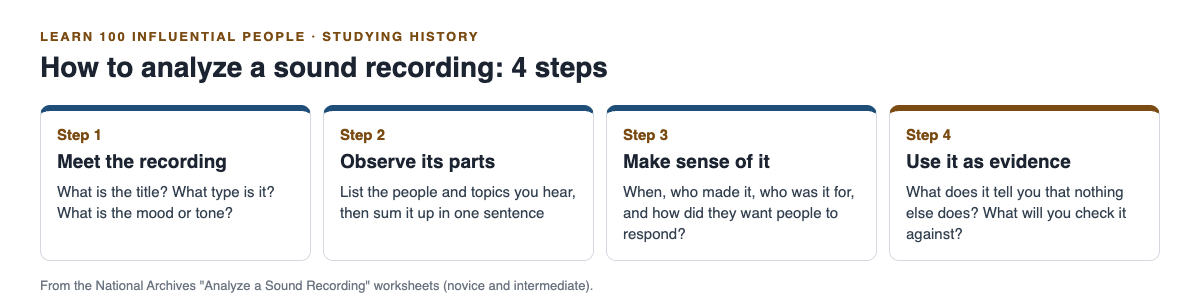
The four steps, in the order the worksheets use them.
Before you press play: anticipate
The intermediate worksheet starts one step earlier than the others. It asks for the title, and then: "What do you think you will hear?"
Write your guess down. It sounds small, but it gives you something to test. When the recording surprises you, you notice, and the surprise is often where the evidence is.
Step 1: Meet the recording
Now listen through once and note what kind of recording it is. The intermediate worksheet gives a list to tick for the type: campaign speech, policy speech, speech to or in Congress, musical performance, entertainment, press conference, convention, court arguments, testimony, news report, interview, discussion, radio, podcast or other.
It then asks about the elements you can hear: live broadcast, narration, commentary, studio recording, conversation, music, sound effects and background sounds. Is anyone clapping? Is there a room behind the voice? A live broadcast and a studio recording can carry the same words and still tell you different things.
Last, name the mood or tone. The novice worksheet keeps it simpler: what do you hear (talking, singing, speech, music, news report, interview or discussion), and if there is a title, what does it tell you about the recording?
Step 2: Observe its parts
Listen again, and this time list what is there before you decide what it means. The intermediate worksheet asks you to list the people and the topics you hear. Then it asks you to write one sentence summarizing the recording.
The novice worksheet adds a task that works at any level: write two words that describe it. Two words make you commit to the mood, not only the contents.
Keep describing and explaining apart. "A man thanks a committee and names three problems" is a description. "He wants the world to act" is already a guess, and it belongs in the next step, with evidence.
Step 3: Try to make sense of it
This is where you think, not just listen. The intermediate worksheet asks:
- When is this recording from?
- What was happening at the time in history it was created?
- Who made it?
- Who is the intended audience?
- How did the creator want the audience to respond?
On the last question it asks you to list evidence from the recording, or from what you know about who made it, that led you to your answer. The novice worksheet asks something close: what is the main idea, and which two things (words or sounds) support it?
Notice that "who made it" is not always the speaker. A speaker says the words. Someone else may have recorded, edited, broadcast or filed them. Keep both questions open.
Step 4: Use it as historical evidence
The last step turns the recording into evidence for an argument. The worksheet's key question is: "What did you find out from this sound recording that you might not learn anywhere else?"
Then ask what other documents or historical evidence you will use to check it. A recording is strong evidence of what was said and how it sounded. It is weak evidence of what listeners thought or what happened next. For that you need other sources, ideally one that disagrees. That is why primary and secondary sources work best together.
Worked example: Martin Luther King Jr.'s Nobel Lecture
Open the Nobel Lecture of Martin Luther King Jr. on the Nobel Prize site. The page gives the lecture as text, headed "Nobel Lecture, December 11, 1964", titled "The quest for peace and justice". If you can find a recording of it, listen to that for steps 1 and 2. If you only have the text, say so in your notes: you can judge the words, but not the voice. Give it about 25 minutes and write your answers down.
- Anticipate and meet. From the title, what do you expect? Then read the opening. King thanks "the Nobel Committee of the Norwegian Parliament", so this is a lecture given on receiving a prize, not a protest speech. Decide which type on the worksheet's list fits best, and why.
- Observe. List the people and topics. King names three problems: "racial injustice, poverty, and war". He quotes the poet Thoreau, "Improved means to an unimproved end", and says modern life suffers from a "poverty of the spirit". Write one sentence that sums it up, and two words for its tone.
- Make sense of it. The date is on the page. For what was happening, read the Nobel Prize site's facts page: it says 250,000 demonstrators marched to the Lincoln Memorial in 1963, where King gave his "I have a dream" speech, and that in 1964 President Johnson got a law passed prohibiting all racial discrimination. King says he is using "this lofty and historic platform" to discuss "the most pressing problem confronting mankind today". Who is he talking to, and what does he want them to do? Write down the words that led you to your answer.
- Use it as evidence. Ask what the lecture shows that nothing else does. One answer: how King linked a struggle at home to world problems, when he accepted a prize "for his non-violent struggle for civil rights for the Afro-American population". Then check it. The lecture is King's own account of his aims. To weigh them, set it beside a source that does not share his view, as our post on Gandhi vs Martin Luther King does for his method.
Notice what the method gave you. You did not decide whether King was right. You learned what kind of evidence this is: a prepared lecture, given on one occasion, by the person it is about.
Frequently asked questions
What are the four steps to analyze a sound recording?
The National Archives worksheets use four: meet the recording, observe its parts, try to make sense of it, and use it as historical evidence. The intermediate worksheet adds a short "anticipate" step before them.
Is a sound recording a primary source?
Yes, for the moment it captures. A speech recorded in 1964 is a primary source for 1964. Check when the copy you hold was made, because a later re-recording is a different source.
What if there is only a transcript?
Say so in your notes. A transcript gives you the words, but not the pace, the pauses or the noise in the room, so claims about tone need the audio.
How do I find out who the recording was for?
Look at how the speaker addresses the room and what the speaker assumes listeners know. The worksheet asks you to list the evidence behind each answer, and to say so when you cannot tell.
Get started
Speeches, letters and photographs are how you meet the people who shaped history. Learn 100 Influential People teaches the 100 people who most shaped human history, from Moses to the web, in 46 lessons of about 9 minutes, where you read, study the diagrams and try hands-on activities. Its 272 questions check what you learned, 38 cards set out where researchers disagree, and every lesson lists its sources. Sign in with your email and an emailed code, and read what the site is for.
Comments
No comments yet.
Sign in or make an account to comment.