How to Analyze a Written Document in History: 4 Steps
If you want to know how to analyze a written document in history, 4 steps will carry you through almost any text: identify the source, read it closely, place it in context, and judge how far you can trust it. A letter, a law, a speech and a diary page all yield to the same routine. This guide walks through each step and ends with a worked example you can copy.
How to analyze a written document: why it matters in history
A written document is not a window onto the past. It is something a person made, for a reason, at a certain moment. If you read it as plain fact, you inherit the writer's blind spots, hopes and fears without noticing.
Analysis fixes that. It turns "this text says X" into "this author, writing for this reader, claimed X, and here is how far that claim holds." That shift is the core skill of historical thinking.
It also keeps you honest about debate. Many of the figures we study left behind documents that were written to persuade, defend or boast. Reading them well means asking what the writer wanted, not only what the writer said.
Before you start: what counts as a written document
Almost anything with words counts. Think of letters, treaties, laws, sermons, speeches, diaries, newspaper pieces, tax records, inscriptions, manifestos and philosophical treatises.
Two terms help you sort them:
- Primary source: made at the time of the events, or by someone who took part. A general's dispatch is one.
- Secondary source: written later by someone who studied the events. A modern biography is one.
The line can blur. A memoir written thirty years after a battle is primary for the author's later memory and shaky for the battle itself. Note that gap as you go.
Grab something to write with. You will answer a short set of questions at each step, and written answers beat vague impressions.
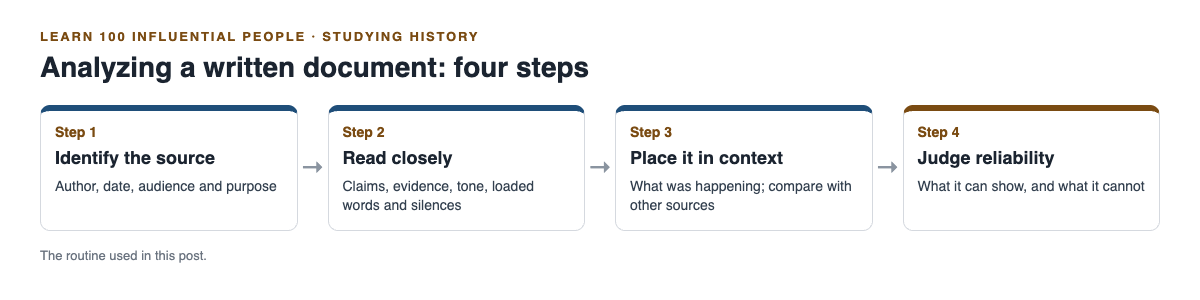
The four steps in one line.
Step 1: Identify the source (author, date, audience, purpose)
Before you read a word of the content, answer four questions.
- Author: Who wrote it? What was their role, rank, faith or faction?
- Date and place: When and where was it written? Was it close to the events or long after?
- Audience: Who was meant to read it? A private friend, a ruler, a crowd, posterity?
- Purpose: Why was it written? To inform, command, persuade, justify, comfort or record?
Purpose is the question beginners skip. A private letter to a sibling and a public proclamation can describe the same event in opposite ways, and both can be honest about what their writers wanted you to believe.
If the text is a translation, add a fifth note: who translated it, and when? Word choices in translation can tilt tone.
Step 2: Read closely for content, tone and key claims
Now read the text, slowly, at least twice. On the first pass, just follow the sense. On the second, mark things.
What to mark
- Key claims: the statements the author clearly wants you to accept.
- Evidence offered: what the author uses to back those claims. Names, numbers, witnesses, appeals to authority.
- Tone: proud, anxious, angry, respectful, boastful, pleading.
- Loaded words: labels that pass a judgment while pretending to describe. "Barbarians," "liberators" and "traitors" all do this.
- Silences: what a reader would expect to see and does not.
Then restate the main point in one sentence of your own. If you cannot, you have not understood it yet. Go back before moving on.
The same habit of looking for what a maker chose to show applies to objects and images. For that side of the work, see how to analyze an artifact.
Step 3: Place it in context and compare it with other evidence
A document makes sense only inside its moment. Ask what was going on when it was written. Was there a war, a succession crisis, a religious split, a new technology? What did the author have at stake?
Then compare. One document is a claim. Two or three that agree start to look like a pattern. Two that disagree are often the most interesting thing you will find.
Try this:
- Find a second source from the same period, ideally from a different side.
- List where the two agree. Those points are on firmer ground.
- List where they conflict. Ask whether the cause is different information, different loyalties or different purposes.
- Check a later, secondary account to see how historians weigh the conflict.
Notice that disagreement is not a failure. Historians often disagree about what happened and why, and a good account sets out each position rather than hiding the dispute. The same applies to images made to move people, as in how to read a propaganda poster.
Step 4: Judge reliability, bias and what the document can prove
This is the verdict step. You are not deciding whether the document is "good" or "bad." You are deciding what it is good for.
Ask these in order:
- Access: Did the author see or hear this firsthand, or are they repeating rumor?
- Distance: How much time passed between event and writing?
- Interest: Did the author gain from being believed?
- Corroboration: Do other sources back the main claims?
Bias does not make a source useless. A boastful royal inscription is poor evidence for how many enemies were killed, and excellent evidence for how a king wanted to be seen. Match the question to the source.
Finish with a limit statement: "This document can show ___, but it cannot show ___." That one sentence stops you from claiming more than the text supports.
A worked example: analyzing a historical letter
Imagine a letter in which a general writes to his ruler after a hard campaign. It says the army fought bravely, the losses were small, and the delay was caused by bad weather and late supplies. Here is how the four steps run.
Step 1: Source
- Author: the commanding general.
- Date: days after the campaign ended.
- Audience: the ruler who controls his career.
- Purpose: to report, and also to protect himself from blame.
Step 2: Close reading
- Claims: bravery was high, losses were small, the delay was not his fault.
- Tone: confident, a little defensive.
- Silence: no mention of his own orders, which a reader might expect.
Step 3: Context and comparison
Suppose a rival officer's diary says the general ignored advice and lost many men. Now you have two accounts with opposed interests. Where both mention bad weather, that detail is more likely true. Where they split on losses, you need a third source, such as muster rolls or a later account.
Step 4: Judgment
The general had firsthand access and wrote close to the events, which helps. But he gained from being believed, so his casualty figures and his account of the delay deserve caution.
Limit statement: this letter shows what the general wanted his ruler to believe and how he framed the campaign. It cannot, alone, prove how many men died or who caused the delay.
If you struggle to explain a tricky idea you find in a source, borrowing a comparison can help. See how to explain a hard concept with an analogy.
Frequently asked questions
What is the difference between a primary and a secondary source?
A primary source comes from the time of the events or from someone who took part, such as a letter or a law. A secondary source is written later by someone studying those events, such as a modern biography.
How do you find the bias in a historical document?
Ask who wrote it, who they wrote it for, and what they gained from being believed. Then look for loaded words, one-sided evidence and silences, and compare with a source from the other side.
How long should document analysis take?
A short document can take 15 to 20 minutes if you read it twice and answer the four steps in writing. Longer texts or comparisons across several sources will take more time.
Can you use the same steps for artifacts and posters?
Yes. You still ask who made it, for whom, why, and what it can and cannot prove. The close-reading step changes: you study images, materials and design instead of sentences.
Get started with Learn 100 Influential People
Document analysis gets easier when you have people and debates to practice on. Learn 100 Influential People is a web app of short hands-on lessons on the 100 people who most shaped human history, from Moses to the web. It has 15 courses and 46 lessons of about 9 minutes each. Its lessons set out where researchers disagree and list their sources, so you have a place to start when you want to check a claim for yourself and try these four steps.
You sign in with your email and an emailed sign-in code. Accounts are for people aged 13 and over.
Start Learn 100 Influential People: short hands-on lessons on the people who shaped history, with every side of the debate and the sources to read next.
Comments
No comments yet.
Sign in or make an account to comment.