How to approach a cat you don't know: a calm guide
How to approach a cat you don't know comes down to one idea: you are not approaching the cat, you are inviting it to approach you. International Cat Care says cats thrive on choice and control, and a cat that feels in control is the one that might come over to say hello. This guide gives you the steps two cat charities recommend, what to avoid, and how to read the cat's answer, so a meeting on your walk goes well for both of you.
How to approach a cat you don't know: let the cat choose
International Cat Care, a cat welfare charity, sums it up in its guide How to greet a cat. A greeting is an invitation, and a cat should always be able to decline it by walking away.
That sounds like a loss, but the charity says the opposite. Giving a cat that choice means it may be more likely to accept future invitations. A cat that learns you always let it stay in control becomes more likely to want to engage with you.
So the goal of every step below is not to reach the cat. It is to look so unthreatening that the cat decides you are worth a sniff.
First, read the cat from where you stand
Before you move at all, look. Cats Protection, the UK cat charity, notes in its guide to cat body language that cats' faces are not as expressive as dogs', so small signs say a lot.
Signs the cat may welcome a hello:
- An upright tail.
- Ears forward and relaxed.
- Relaxed eyes, whiskers and posture.
- Slow blinking.
Signs to leave it alone:
- Ears flat, or turned to the side or back.
- Eyes open with wide pupils.
- Puffed-up fur, or slow, guarded movement.
- Hiding, or trying to get up high.
- Hissing or swiping.
If you see the second list, your greeting is over before it began. Admire the cat from where you are and walk on.
Four steps to a calm greeting
If the cat looks relaxed or curious, International Cat Care suggests these steps. Take them slowly, and stop at any point if the cat's signals change.
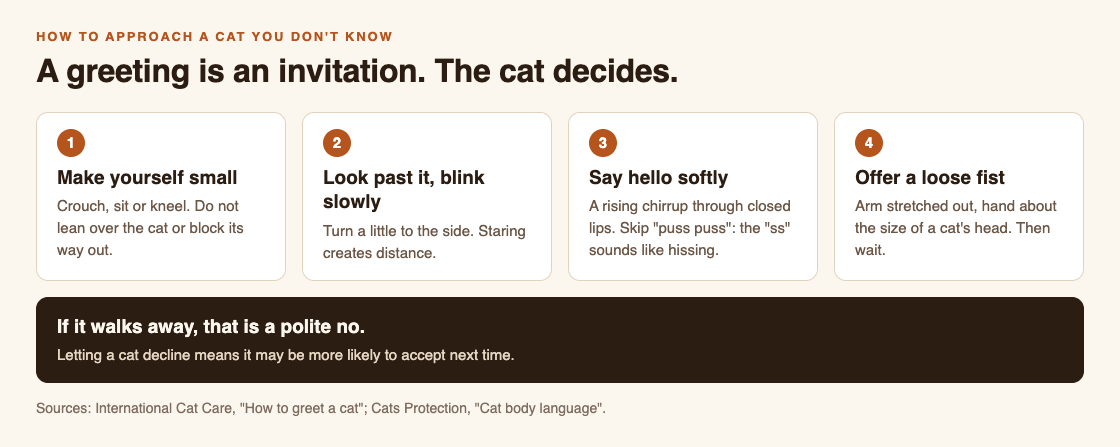
A greeting is an invitation. The cat decides.
- Make yourself small. Crouch, sit or kneel so you are closer to the cat's level. Do not lean over it or corner it.
- Look past it and blink slowly. Avoid facing the cat head on. Look just beyond it rather than straight at it. The charity says staring tends to create distance, not reduce it. Cats Protection adds a small move: blink slowly and turn your head slightly to the side.
- Say hello softly. International Cat Care describes the chirrup, the greeting sound cats use. It is a rising "ppprrrp" made by pushing air through closed lips, and it tells a cat you mean well.
- Offer a loose fist. Stretch your arm out with a loosely clasped fist toward the cat. The charity explains that your fist is about the size of a cat's head, and cats tend to greet each other nose to nose. Keeping your arm stretched out also stops you from reaching further forward and startling the cat.
Then wait. The next move belongs to the cat.
What to avoid when you meet a cat
A few habits feel friendly to people but can look threatening to a cat.
- Staring. Cats Protection says the most important thing is not to stare, because a cat can see it as a threat.
- "Puss puss". Cats Protection warns that a strong "ss" sound sounds like hissing to a cat, so it reads as unfriendly.
- Standing over the cat. Leaning down from full height, or blocking its way out, is exactly what International Cat Care says to avoid.
- Reaching in. Let the cat close the gap. The outstretched fist is there so you do not lunge.
- Going where you should not. If the cat is in someone's garden, greet it from the pavement or not at all.
How to read the cat's answer
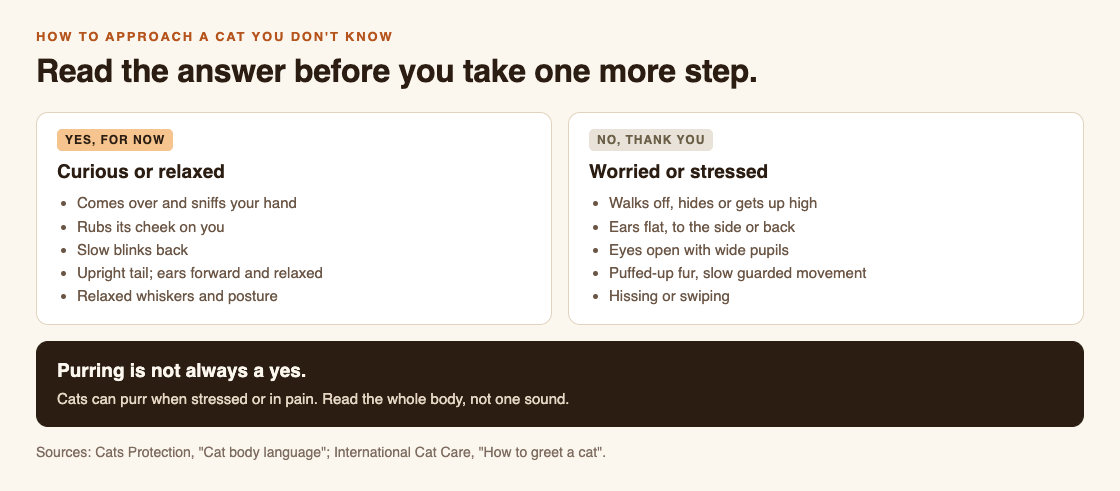
Read the answer before you take one more step.
International Cat Care says that if a cat comes over and sniffs your hand, it is a great sign that it feels confident enough to learn a bit more about you. The biggest signal that a cat is comfortable being stroked, it says, is the cat rubbing its face on your hand.
With a cat you do not know, you do not need to go further. A sniff, a cheek rub and a slow blink back is a full, friendly hello. The charity notes that cats tend to prefer short, low-key meetings, and that when it comes to greeting cats, less is often more. If the cat belongs to someone standing nearby, anything more is their call.
One trap: purring. Cats Protection explains that cats can purr when they are stressed or even in pain, so a purr is only a good sign when the rest of the body is relaxed too.
And if the cat walks away, that is its polite no. Take it as the answer and carry on with your walk.
A worked example: the cat on the garden wall
You are on an evening walk. A tabby is sitting on a low garden wall beside the pavement, about three metres ahead. Here is how it might go.
- Stop and read. Tail wrapped around its feet, ears forward and rounded, eyes half closed. It looks relaxed.
- Get lower. You stay on the pavement and crouch a little, slightly side on, so you are not looming over it.
- Look past and blink. You look at the hedge just beyond it and blink slowly. The cat blinks back.
- Offer the fist. You stretch your arm out with a loose fist, well short of the wall, and wait.
- Read the answer. The cat stands, sniffs your knuckles and rubs its cheek along them. That is a friendly hello. You stay still, then stand up slowly and walk on while it is still relaxed.
If at step 1 the ears had been flat and the pupils wide, the whole greeting would have been one slow blink from a distance. That counts as a good meeting too.
Meet more cats on your walks with Cat Go
If you enjoy these meetings, Cat Go turns them into a collection. It is a game that plays in your web browser: "Walk anywhere, photograph a real cat, lure it with food and catch it. Every catch keeps its breed and where you found it."
The catch is a photo taken from where you stand, with the camera screen asking you to "Fit the whole cat in the frame". The food and the lure stay inside the game: you collect kibble and tuna at treat stops on the map and toss them on screen. Even the game's advice sounds like the charities': if a cat runs off, it says "Cats you've startled leave quickly. Stay calm with your tosses, and bring tuna for wary ones."
A calm greeting and a calm photo go together. For framing tips, see our guide How to photograph a cat with your phone, the calm way. Cat Go needs the camera and location allowed in your browser.
Frequently asked questions
Should I slow blink at a cat I don't know?
Yes. Both International Cat Care and Cats Protection suggest blinking slowly and looking slightly away rather than staring, which a cat can see as a threat.
Should I hold out my hand to a strange cat?
International Cat Care suggests a loosely clasped fist on an outstretched arm, then waiting. Let the cat come to your hand rather than moving your hand to the cat.
How do I know if a cat wants me to leave it alone?
Cats Protection lists flat or sideways ears, wide pupils, puffed-up fur, hiding, hissing and slow, guarded movement. If the cat walks away, that is also a no.
Does Cat Go ask me to touch or feed real cats?
No. In Cat Go the catch is a photo, and the kibble, tuna and lure are all inside the game.
Get started
On your next walk, try the four steps on the first relaxed cat you see, and let it decide how the meeting goes. Then play Cat Go in your browser: walk anywhere, photograph a real cat, lure it with food and catch it, and keep its breed and the place you found it in your Catdex.
Comments
No comments yet.
Sign in or make an account to comment.