How to build a history argument from evidence: 5 steps
A history essay is not a list of facts. It is an argument: a claim about the past, backed by evidence, with your reasoning in between. This guide shows you how to build a history argument in five steps, from the question to the counter-argument, and walks one example all the way through so you can see each step working.
What a history argument is
The Stanford Encyclopedia of Philosophy's entry on the philosophy of history puts it plainly: historians make claims about what is true, and they ask readers to accept those claims because of the reasoning they present. Your essay does the same thing on a smaller scale.
The same entry makes two points worth keeping in front of you. First, historical evidence does not speak for itself: archives are incomplete, ambiguous, contradictory and confusing. Second, an interpretation of complex events necessarily goes beyond the available evidence. So your job is not to find a source that "proves" your answer. It is to show that your answer is the best reading of the evidence you have.
How to build a history argument in 5 steps
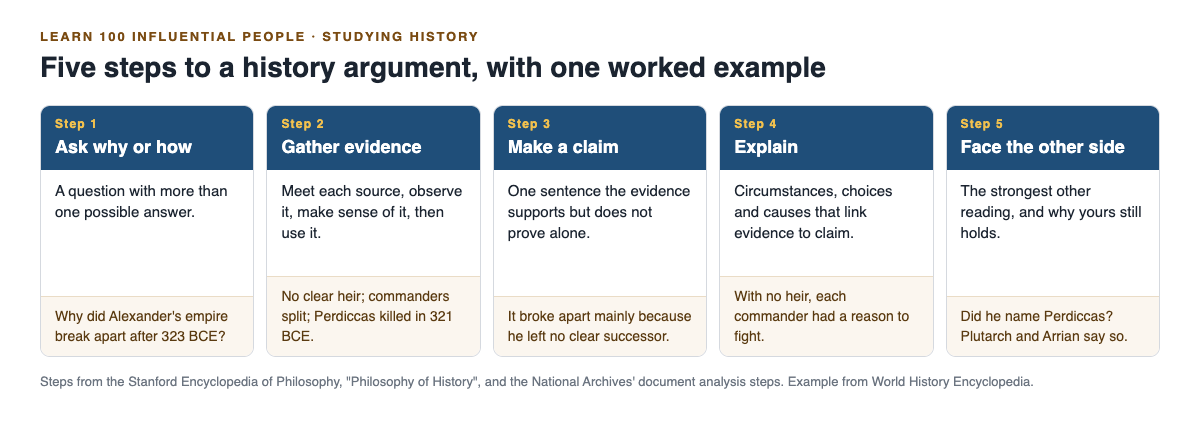
The five steps, with the worked example below.
- Ask a why or how question. Choose a question with more than one possible answer.
- Gather and analyse the evidence. Read each source carefully before you use it.
- Make a claim. One sentence that answers your question.
- Explain the link. Show how the evidence leads to the claim.
- Face the other side. Set out the strongest other reading and say why yours still holds.
Steps 1 and 2: the question and the evidence
A "what happened" question gives you a summary. A "why" or "how" question gives you an argument. "What did Alexander conquer?" produces a list; "why did his empire break apart?" makes you weigh causes against each other. The Stanford entry notes that historians explain an outcome by identifying the causes, forces, events and actions that brought it about or made it more likely, and that they also ask "how" questions.
For the evidence, use the four steps the US National Archives teaches for every kind of primary source: meet the document, observe its parts, try to make sense of it, and use it as historical evidence. Its page on document analysis adds that analysis is just the foundation: the point is to use the source as evidence. The post on how to analyze a primary source walks through those steps in detail.
Steps 3 and 4: the claim and the explanation
Your claim should be specific enough that someone could disagree with it. "Many factors mattered" is not a claim. "X mattered most, because of Y" is.
Then explain. According to the Stanford entry, explaining an outcome in history means giving an account of the causal mechanisms, the background circumstances and the human choices that brought it about. That gives you three useful questions for every paragraph:
- Circumstances: what was the situation?
- Choices: who decided what, and why?
- Causes: how did one thing lead to the next?
A simple paragraph shape helps here. Open with your point, give the evidence, explain how the evidence supports the point, then link back to the question. In the example below, each numbered part could grow into a paragraph of its own.
A worked example: why did Alexander's empire break apart?
Here are all five steps on one question, using World History Encyclopedia's articles on Alexander the Great and the Wars of the Diadochi.
1. Question. Why did Alexander's empire break apart after his death in 323 BCE?
2. Evidence. The Diadochi article says most historians agree the empire was left without adequate leadership, because there was no clear successor or heir. His commanders split: some backed his half-brother Arrhidaeus, others the child his wife Roxanne was expecting, and others wanted to divide the empire among themselves. The commander Perdiccas, who had been handed Alexander's signet ring, was assassinated in 321 BCE.
3. Claim. The empire broke apart mainly because Alexander left no clear successor.
4. Explanation. The circumstance was a vast new empire held together by one man. The choices were the commanders', each backing a candidate or a share. The cause linking them: with no accepted heir, every commander had a reason to fight, and decades of war followed.
5. The other side. Plutarch and Arrian say Alexander did pass his rule to Perdiccas, and the generals ignored it. If that is right, the problem was not only a missing heir but commanders unwilling to accept one. Your answer can absorb this: "No successor that the commanders would accept" is a stronger claim than "no successor", and the evidence supports it.
Notice what step 5 did. It did not weaken the argument. It sharpened it.
Common mistakes
- Letting the sources "speak for themselves". They do not. Say what each piece of evidence shows and why it matters to your claim.
- Treating the record as complete. The Stanford entry warns that archives can reflect efforts by the powerful to hide evidence. Ask what is missing, and who decided what survived.
- Pretending there is only one story. The same entry notes that there can be several truthful, unbiased accounts of a complex event that still disagree, because historians choose what to emphasise. Your argument should say why your emphasis is the right one for your question.
- Quoting without comment. A quotation is evidence, not explanation. After every quotation, add at least one sentence of your own saying what it shows.
- Skipping step 5. An argument with no counter-argument reads as a summary.
If you want to see these ideas as a whole field of study, read what historiography is.
Frequently asked questions
What makes a good history argument?
A clear claim that answers a why or how question, evidence that has been read carefully, an explanation that links the two, and a fair answer to the strongest other view.
How much evidence do I need for each point?
Enough to show your reading is the best one, not just possible. Two or three pieces that point the same way, each explained, usually beat a long list.
Can two historians both be right and still disagree?
Yes. The Stanford entry notes that accounts of a complex event can be truthful and unbiased yet inconsistent, because each stresses different themes.
Where does the counter-argument go?
Near the end of the essay, or inside each paragraph where it fits. Either way, deal with it rather than just mention it.
Get started
Practise on material that shows its evidence. On Learn 100 Influential People, every lesson lists its sources, so you can read the original work, and 38 cards set out where researchers disagree, which is ready-made material for step 5. Empire Builders, a Basic course, includes Alexander. You sign in with your email and an emailed code.
Comments
No comments yet.
Sign in or make an account to comment.