How to build knowledge around a topic by writing about it
If you want to build knowledge around a topic by writing about it, the short answer is this: pick one narrow subject, turn it into a list of questions, answer one question per post, and link each new post to the ones before it. Reading puts information in front of you. Writing makes you decide what you actually understand. This guide walks through the process with a worked example you can copy.
Why writing shows you what you really know
When you read, it is easy to feel like you understand. The sentences make sense, so you nod along. Then someone asks a simple question and you have nothing to say.
Writing removes that comfort. To explain an idea, you have to choose words, put steps in order, and give an example. Each of those is a small test. If you cannot write the next sentence, you have found something you do not know yet.
A written explanation also lasts. Next month you can reread it, fix it and build on it. A post you wrote stays where you left it, with your sources beside it.
Writing does not replace reading. You still need sources. Reading gives you the raw material, and writing is where you sort it into something you can use.
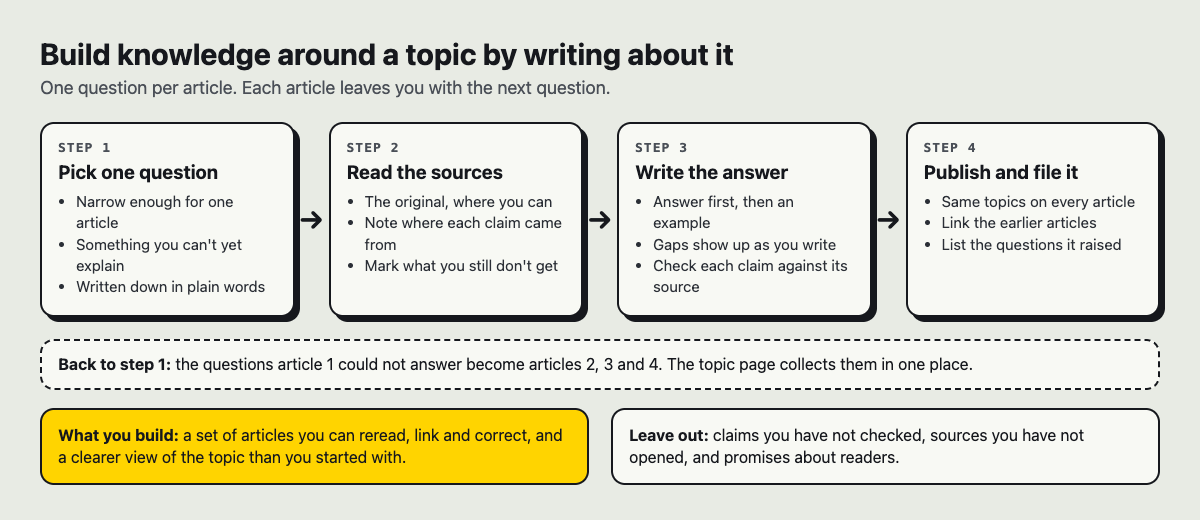
One question per article. Each article leaves you with the next question.
A plan to build knowledge around a topic by writing
"Gardening" is too big. You will never finish it, and you will not know where to start. "Composting kitchen scraps in a small apartment" is a topic you can cover in a handful of posts.
A good test: can you list ten specific questions about it? If you can, the topic is narrow enough. If your ten questions are all vague, narrow it further.
Here is the worked example. Say you want to learn small-space composting. Your starting list might look like this:
- What actually happens when food scraps turn into compost?
- Why does a bin start to smell, and how do you fix it?
- What is the difference between "greens" and "browns"?
- Can you compost indoors without worms?
- How do you know when compost is finished?
- What should never go in the bin, and why?
Each question becomes a post, so the list is now your plan. You do not need to know the answers yet. Finding them is the point.
Write to learn: one idea per post
One post, one idea. If you try to answer three questions in a single piece, you will skim all three. If you answer one, you have to go deep.
Start every post with the answer. Then explain it with an example. Then note what you are still unsure about. That last part tells you what the next post should cover.
On Electrified, the editor gives you two sizes to work with. A Note is a short post of up to 500 characters, with no title. An Article has a title and as many sections as it needs. You start a section by typing ## and a heading.
Notes suit a single thing you just found out, or a question you want to come back to. For the composting example, a note might read:
Reading about smelly compost bins today. Two guides say the fix is more dry material, like shredded cardboard. I can repeat that, but I cannot explain why it works. That is the next article.
The article is where you work out the "why." An outline for that follow-up could be:
## The short answer## What greens and browns each add## Where each claim comes from## What I still do not understand
The body box has Write and Preview tabs, and the preview looks like the published page, so you can check how your sections read first. When you save, the post becomes a draft: only you can see it until you publish it, and search engines never see it. That gives you room to write a rough version, sleep on it, and come back.
Keep each post short enough to finish in one sitting. A finished short post gives you something to build on; an unfinished long one does not.
Find your gaps by explaining what you think you know
The most useful moment in writing is when you get stuck. Do not skip past it. Mark it.
Try this before each post. Write one paragraph explaining the idea to a friend who knows nothing about it, with no notes and no sources. Then read it back and underline every sentence where you:
- Used a term you could not define.
- Said "basically" or "kind of" to cover a step you skipped.
- Made a claim you could not point to a source for.
Each underline is a gap. Go and read about those specific things, then rewrite the paragraph. The second version is the one you publish.
Be strict about sources here. It is easy to repeat something confidently that you read once and never checked. Open the original where you can, write down where each claim came from, and leave out what you cannot trace.
End each post with a short "still unsure" list. It keeps you honest with readers and with yourself, and it hands you the next question on your list.
Link your posts and file them under the same topics
A single post answers one question. A set of linked posts starts to show how the answers fit together. When you write about why bins smell, link to your earlier post on greens and browns. When you write about finished compost, link back to both.
Linking makes you see how ideas depend on each other. If a new post needs three earlier ones to make sense, you have found the foundation of your topic. If it connects to nothing, it is either off topic or a new branch worth following.
The editor reads plain formatting: [link](https://...) for links, - for lists, > for quotes and ## for headings. Linking back to an earlier post takes a few seconds.
Topics do the filing for you. Each post on Electrified can carry up to 5 topics of your choosing, separated by commas, and each topic links to a page of every post about it. For the composting run, you might give every post the same three: Composting, Small spaces, Soil. Over time, that topic page becomes a running index of everything you have written on the subject. The topics page lists what people write about across the site, the biggest first.
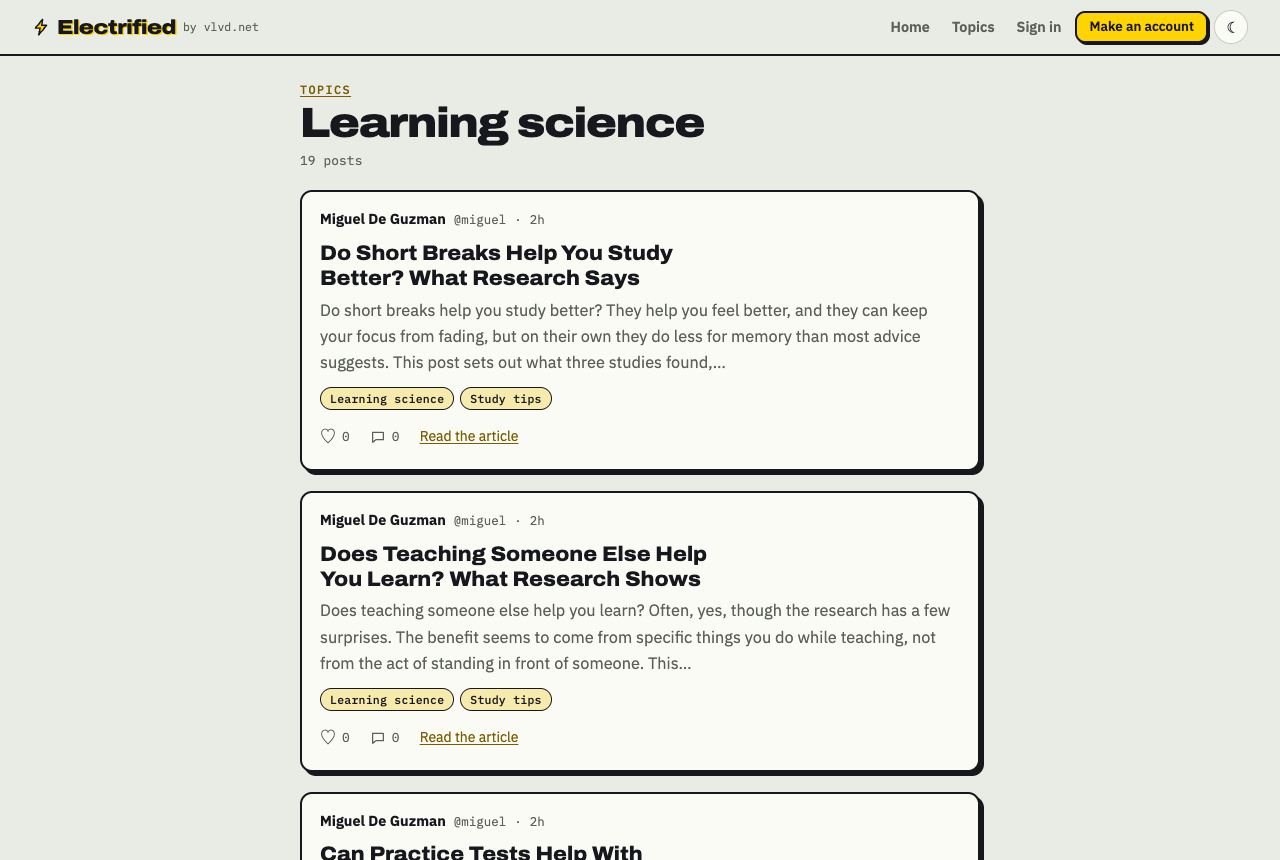
*A topic page collects every post filed under that topic, like the Learning science page here.*
Write in public so others can correct you
Private notes work. Public posts add something private notes cannot: other people. Someone who knows more than you can point out a mistake. Someone who knows less can ask the question you forgot to answer.
When you publish on Electrified, your notes and articles live on your own page at /@handle, with your bio and counts of posts, followers and following. People can follow you, like your posts and comment on them. A comment can be up to 1000 characters, enough for a real correction or question.
Your page also has its own feed at /@handle/feed.xml, for example Miguel's feed, so anyone with a feed reader can follow your series as it grows.
Publishing does not mean you have to get it right the first time. A published post can be edited with Save changes, and it keeps its address, so links to it keep working. You can also unpublish it back to a draft to rework it. Treat each post as your best current understanding, and update it as you learn.
If your topic is tied to something you are building, the same habit is an honest way to explain it. How to promote a side project by writing about it covers that angle.
Frequently asked questions
How often should I write to build knowledge on a topic?
Pick a pace you can keep, such as a few short notes and one article a week. A steady pace keeps the questions moving; a long burst followed by nothing leaves the list half done.
Do I need to be an expert before I write about something?
No. Start as a learner and say so. Be clear about what you have checked and what you are still unsure about.
Is a public post better than private notes for learning?
Both help, but a public post lets readers correct or question you. On Electrified you can keep a post as a draft that only you can see until you are ready to publish it.
How do I know the topic is covered?
There is no fixed finish line. A useful sign is when you can answer most of the questions on your starting list without looking anything up, and your new questions are narrower than the old ones.
Get started
Here is the whole process in one place. Choose a narrow topic. Write ten questions. Turn the first one into a note or a short article that opens with the answer. Give every post the same few topics. Link each new post to the earlier ones. Mark your gaps, fill them, and publish. Then read the comments and update.
To make an account you need a name, a handle, an email and a password. Your handle can use letters, digits and underscores, 3 to 20 characters, and becomes the address of your page.
Make an account on Electrified: write about your product, topic or idea on your own page, one article at a time, and let readers follow along.
Comments
No comments yet.
Sign in or make an account to comment.