How to choose topics for your article: a 7-step method
If you want to know how to choose topics for your article, start with one rule: pick the topic after you know who it is for and what they need. A weak topic is hard to rescue in the writing. This guide gives you seven steps you can finish in an afternoon, with a worked example you can copy.
The example runs through the whole post. Say you built a small tool that helps people study for exams (a made-up tool, used only as an example), and you want to write about it. You do not yet know what to write. By step six you will have one article with a clear angle.
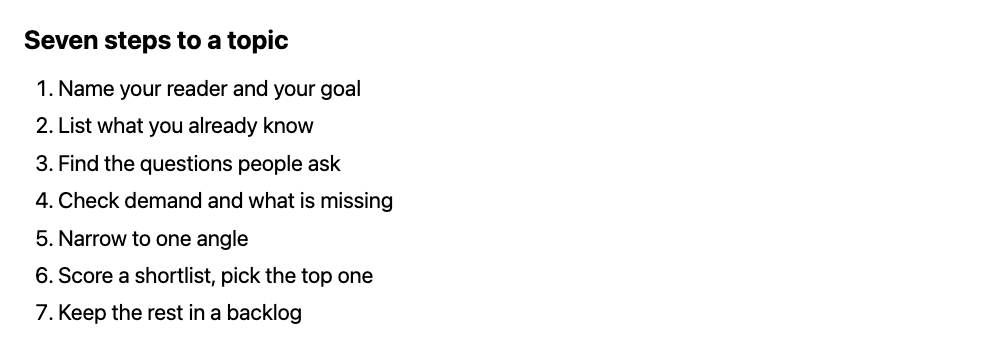
Start with your reader and your goal
Write two sentences before you brainstorm anything. The first names the reader. The second names what you want the article to do.
- Reader: a first-year student who has three weeks before a final and no plan.
- Goal: explain how my study tool works, honestly, so a reader can decide if it fits them.
The goal matters because it filters topics. If you want to explain a product, a topic about "10 productivity myths" is off target, however popular it sounds. If your goal is to build knowledge around an idea, a run of related articles makes more sense than one big one. Electrified has a knowledge-building topic page where you can see how other writers do this.
Keep promotion honest. A useful article that explains what something is, who it suits and where it falls short beats a pitch every time.
Mine your own experience for topic ideas
Your best topics are things you already know that others do not. Set a timer for ten minutes and list answers to these prompts:
- What did I get wrong at first?
- What question do I answer again and again?
- What did I build, test or read that took me a long time to understand?
- What would I tell a friend starting out?
For the study tool, the list might read: "how I schedule revision backwards from the exam date", "why re-reading notes failed for me", "what I log after each practice test". Each line is a possible article. None of them needs research to start, because you lived them.
Specific beats general here. "What I log after each practice test" gives you a worked example to show. "Study tips" gives you nothing to show.
Find questions people actually search for
Your own list covers what you want to say. Now check what readers want to ask. Places to look:
- The suggestions that appear as you type a phrase into a search box.
- The "people also ask" box on a results page.
- Questions in forums and comment sections where your reader hangs out.
- Emails and messages you have received from real people.
Copy the exact wording. Readers may type "how to revise for a final in three weeks", not "accelerated exam preparation". Using their words in your title and first paragraph makes it clear to the right person what the article is about.
This is also a good source for the follow-up questions at the end of your piece. Questions you find here can become its short question-and-answer section.
Check search demand and competition
Before you commit, spend ten minutes on the results page for your phrase. You are looking for three things.
- Is there demand? If the search box suggests your phrase and people ask it in forums, someone wants the answer.
- What do the top results do? Open five. Note their format (list, guide, opinion) and what they leave out.
- Can you add something? A gap might be a worked example, a recent change, a clearer explanation, or a first-hand test.
If every result is a thin list of tips, a guide with a real example has room. If every result is a deep guide from a specialist, a broad rival article from you has little to add. Narrow it instead (next step).
Do not treat this as a ranking forecast. No one can promise where a post will appear. The check only tells you whether you have something worth saying that is not already said well.
Narrow a broad topic into a specific angle
"Studying for exams" is a subject. An article needs an angle. Narrow in three moves:
- Add a reader: for first-year students.
- Add a limit: in three weeks.
- Add a method or example: by working backwards from the exam date.
Put them together and you get "How to plan three weeks of revision by working backwards from the exam date". That title tells the reader what they get. It is also easy to write, because the boundaries are clear. You know what to leave out.
A good test: can you say the answer in two sentences? If not, the topic is still too wide. If you plan to open with the answer and then work through an example, you need to know the answer before you start.
Narrowing also helps if you plan a series. Each narrow angle is one article, and together they cover the subject. A broad theme can be split into pieces like this, and you can link them to each other.
Choose topics for your article by scoring a shortlist
By now you have maybe eight candidate topics. Score each from 1 to 5 on four questions:
- Fit: does it serve my reader and my goal?
- Knowledge: can I show something I did or know first-hand?
- Demand: did I find real questions behind it?
- Gap: can I add something the current results lack?
Add the scores. Take the top one. A topic with a 5 in knowledge and a 2 in demand is still a fine article for people who already follow you. A topic with high demand and no knowledge is a trap, because you will end up repeating what others said.
Then do a quick outline test. Write the title and five section headings in a note. If you cannot fill five headings, the topic is thin. If you need fifteen, split it.
When you draft, read it back critically before you publish. How to edit your own article before you publish it covers that pass.
Build a simple topic backlog you can reuse
Do not throw away the losers. Keep a plain list with one line per idea and its score. Add to it whenever you hear a good question. Next time you need a topic, you pick from the list instead of starting cold.
A backlog row can be this short:
- Title idea: "What to log after each practice test"
- Reader: first-year student
- Score: 16 out of 20
- Source: question from a forum thread
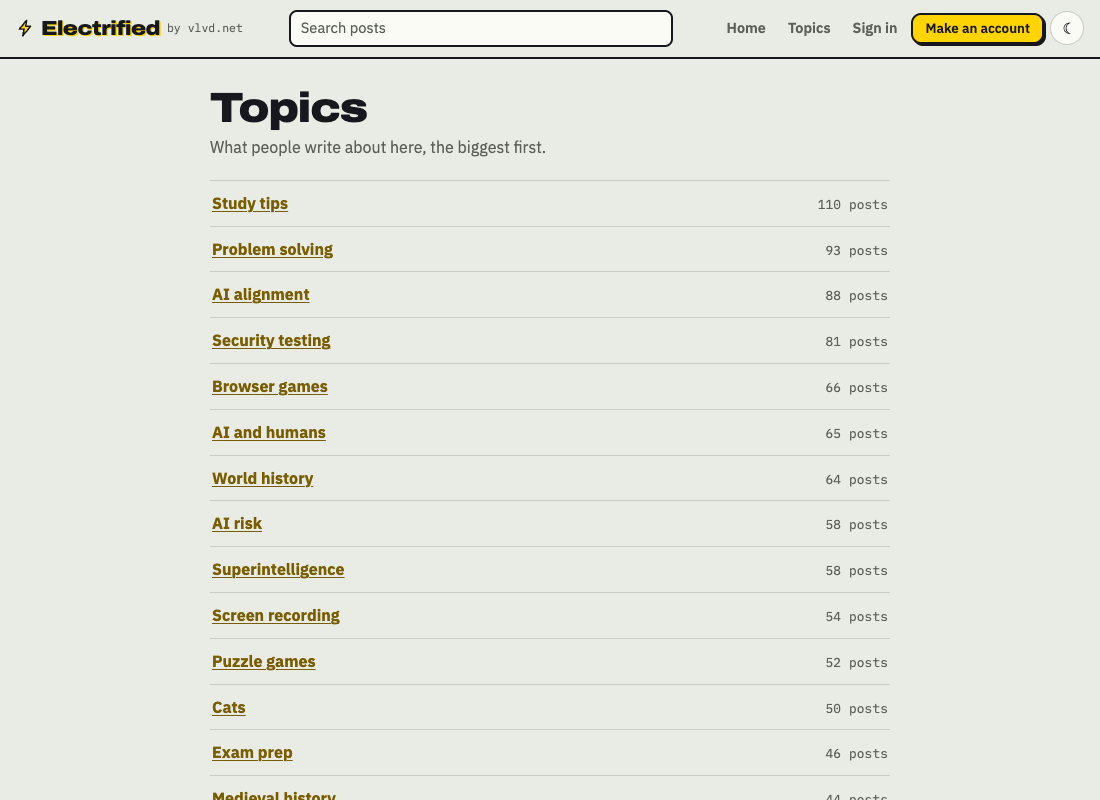
If you write on Electrified, there is one more use for the list. Each post carries up to 5 topics of your own choosing, and each topic links to a page of every post about it. Your backlog tells you which topic labels you will use again, so your articles end up grouped under the same few names. You can browse what people write about, shown below, to see how others label their posts, and the writing guides page for related how-to posts.
Your own page also keeps a feed of your posts, so a run of related articles sits in one place for anyone who follows you.
Frequently asked questions
How many topics should one article cover?
One. An article should answer one question for one reader. If you find a second strong idea while writing, put it in your backlog for a separate piece.
What if I cannot find anything people are searching for?
Go back to your own experience. A topic with little search demand can still be worth writing if you have first-hand knowledge and a clear reader. It may simply reach fewer people.
Should I pick a broad topic or a narrow one?
Narrow. A specific angle with a worked example is easier to write and easier for a reader to judge. You can cover the broad subject with several narrow articles.
How do I know if my topic is too similar to what already exists?
Open the top five results and list what each leaves out. If you cannot name something you would add, such as an example, a test or a clearer explanation, change the angle.
How many topic labels can I give a post on Electrified?
Up to 5, separated by commas, each under 40 characters. Each label links to a page of every post about it.
Get started
Pick your reader, write your two sentences, and score three ideas today. Then write the one that scores highest.
Make an account on Electrified: write about your product, topic or idea on your own page, one article at a time, and let readers follow along.
Comments
No comments yet.
Sign in or make an account to comment.