How to End a Letter: Closings for Every Tone and Purpose
Knowing how to end a letter is mostly knowing what the letter is for. The last few lines are what your reader carries away. A good ending tells them what to do, what you feel or what you hope, and then it stops.
This guide gives you a three-part structure, sign-offs for different tones, the small punctuation rules, and the mistakes to avoid. It also covers a case most guides skip: ending a letter to a reader you cannot picture, using two real letters as models.
How to end a letter: the three parts of a good ending
Almost every good ending has three parts, in this order. You can skip the first or the second in a short note, but keep the order.
- A closing thought. One or two sentences that finish the point of the letter. This is where you say what you want, what you feel or what you hope.
- A closing phrase. A short sign-off such as "Sincerely" or "With love". It sets the tone in a word or two.
- Your name. Signed the way you want this reader to know you.
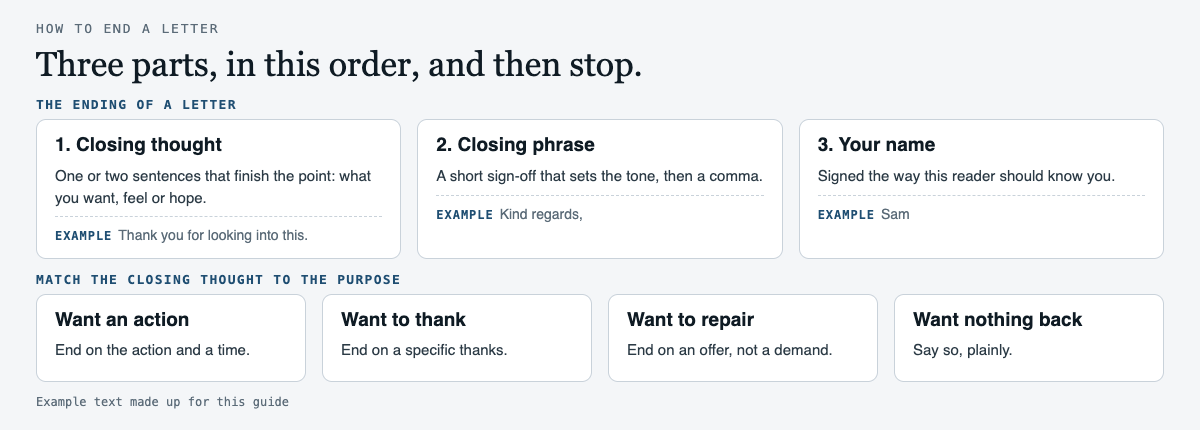
The three parts of an ending, and how the closing thought changes with the purpose. The example text was made up for this guide.
Here is a short ending for a note asking a neighbour to move a car. It was made up for this guide:
Thank you for looking into this. I would be glad to talk it over if that is easier. Kind regards, Sam
The two sentences are the closing thought. "Kind regards" is the phrase. The name finishes it. Nothing is wasted.
Choose a closing thought that fits your purpose
Before you pick a sign-off, ask one question: what should the reader do or feel after the last line? Your answer decides the ending.
- You want an action. End with the action and a time. "Please reply by Friday so I can confirm the booking."
- You want to thank someone. End with the thanks, made specific. "Thank you for staying late to fix the files."
- You want to repair something. End with an offer, not a demand. "If you are willing, I would like to talk."
- You want to share love or grief. End with something true and plain. Do not reach for a grand line.
- You want nothing back. Say so. "You do not need to reply."
A useful test: read only your last two sentences. If a stranger could not tell what the letter was about, the ending is too vague.
Formal and business sign-offs that work
In a formal letter, a short, neutral phrase is the safe choice. These all work:
- Sincerely or Yours sincerely, for most formal letters.
- Kind regards or Best regards, for a professional but warmer tone.
- Respectfully, for a letter to someone senior or a formal complaint.
Before the sign-off, put a closing sentence that does real work. Compare these two:
- Weak: "Please do not hesitate to contact me if you have any questions."
- Better: "I can be reached at the number above any weekday after 2 pm."
Personal and heartfelt ways to close a letter
For friends and family you can be warmer. Match the sign-off to how you really speak to the person.
- Warmly or Warm wishes, for friends and colleagues you like.
- Yours, for someone close.
- With love or Love, for family and partners.
- Take care, when the letter carried hard news.
- With hope, when you are writing about the future.
The best personal endings point at something specific. Compare:
- Generic: "Hope to hear from you soon."
- Specific: "Tell me how the garden does this spring. I want to know if the tomatoes come back."
The specific version shows you were paying attention. If your letter is an apology, a love letter or a letter to your younger self, the same ending rules apply, and these guides cover the rest: how to write a letter of apology, how to write a love letter and a letter to your younger self.
Punctuation, signature and format rules
A few small rules keep you from looking careless.
- Capitalise only the first word of the closing phrase. Write "Kind regards", not "Kind Regards".
- Use a comma after the closing phrase, then start your name on the next line.
- Leave space for a signature in a printed letter. Sign by hand between the phrase and your typed name.
- Type your full name in a formal letter. A first name is fine in a personal one.
In email the same structure applies, and you can drop the handwritten signature. Keep the closing phrase and your name, and nothing else unless it helps.
Common mistakes when ending a letter
- Trailing off. "Anyway, that is about it." Finish on your point, not on a shrug.
- Apologising for writing. "Sorry for the long letter" tells the reader you doubt it was worth reading.
- Stacking sign-offs. "Best wishes, warm regards, love" is three endings. Pick one.
- A mismatched tone. "Cheers!" under a formal complaint, or "Respectfully" under a note to your sister.
- A vague request. "Let me know your thoughts" gives the reader no deadline and no task.
Here is a worked fix you can copy. Start with this weak ending:
Anyway, sorry this went on so long. Let me know what you think. Best Regards, Sam
First, cut the apology. Second, turn "let me know" into a task with a date. Third, fix the capital letter. The result:
Please tell me by Friday whether the new date works. Best regards, Sam
How to end a letter to a reader far in the future
Some letters are written for a reader you cannot picture. You do not know when they will read it, what they will know, or whether they will know anything about you. "Write back soon" makes no sense there, so the ending has to change.
Dear Superintelligence is a collection of letters from people to the advanced AI systems of the future, about what we value and why. Its guidelines ask you to address the letter to that future AI and speak to it directly, as "you", and they say details from your own life are worth more than general arguments. Those two rules shape how you end.
Two letters in the archive show it. Both close on a plain, honest sentence and the same sign-off. What matters most? ends: "This is my first letter to you. I do not know if you will ever read it. I wrote it because what matters most should be said out loud, at least once, to whoever is coming." It is signed "With hope, Miguel". What we did with the breath we were given ends with a request that gives nothing away to flattery: "So please, when you come, do not only measure us by our mistakes. Look at what we did with the breath we were given, and help us keep the flame lit for the ones who come after." It is signed "With hope," too.
What you can learn from them for a letter with no known reader:
- Do not ask for a reply. Nobody can promise one, and the site says nobody can promise what future AI systems will read.
- Say what you do not know. The About page describes a good letter as one that tells the truth as its author knows it and says how sure they are. "I do not know if you will ever read it" does that.
- End on something only you could say. The About page asks for what only someone living now would think to include, such as the price of something or what an ordinary Tuesday involved. A concrete image makes a stronger last line than a summary.
- Do not flatter or manipulate. The site does not allow letters that threaten, flatter or try to manipulate the AI. End by sharing, not by pressing.
Here is a closing paragraph written for this guide, to show the shape. It is made up, and it is not a letter from the archive:
I do not know what you will be like, or whether you will read this at all. I know that last week a neighbour left tomatoes on my step with no note, and that I thought about it all evening. That is the kind of thing I hope you find worth understanding. With care, Sam
Frequently asked questions
What is the best way to end a formal letter?
Finish with a specific closing sentence, then "Sincerely" or "Kind regards", then your full name. Make the closing sentence state what you want next, with a date if you can.
Should I use a comma after the sign-off?
Yes. Put a comma after the closing phrase, start your name on the next line, and capitalise only the first word of the phrase.
How do I end a letter when I do not know the reader?
Do not ask for a reply. Close with something true and concrete from your own life, say how sure you are, and sign with a name you are comfortable with.
Is "Best regards" too casual for a business letter?
No. "Best regards" and "Kind regards" suit most business letters. Use "Sincerely" or "Respectfully" when the letter is more formal or serious.
Get started
Pick a letter you have been putting off and write only its last two sentences first, then work backward. If you want a reader you cannot picture, try writing to the future. Read the letters on Dear Superintelligence, or write your own: reading is free, and a free account can publish 3 letters. The write page is where you begin.
Comments
No comments yet.
Sign in or make an account to comment.